Category Archives: God

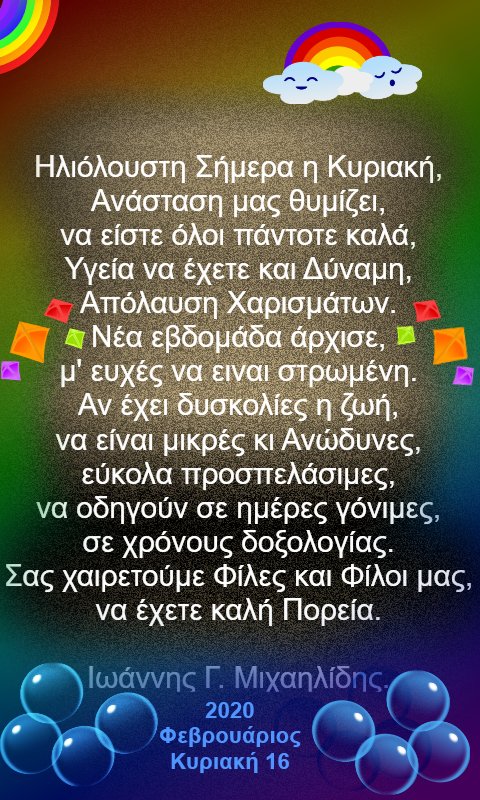
As always, Blessed Sunday.

Sunny Today Sunday,
Resurrection reminds us,
be all always well,
Have health and Strength,
Enjoying Gifts.
New week has begun,
μ’ wishes to be paved.
If life has difficulties,
to be small and Painless,
easily accessible,
lead to fruitful days,
in times of praise.
We greet you, our Friends,
have a good journey.
Ioannis G.. Michailidis.
2020 February 16
Day Sunday.
© MichaelidesPost.Com®

About God and People

Theocharis Belios

*Someone questions the faith of Christians and probably insults it, since he plays with the concepts of Holy and Holy and confuses the essence with the lady “grammar”. What would someone have to tell us and confess to us?.

Good and blessed good evening. Humbly forgive me, there are many of you who say it.? If so then that means her? Saint (or Hosios) it is called a man, who has been declared by the Church to be sanctified by God. The dead body of a Saint, the so-called relics, are kept in Churches. To declare someone a Saint in the Orthodox Church, several years need to be completed since his death (about 40). Saint means memorable. The one worth remembering. An example is church texts, which when referring to a saint, referred to’ this way (today the memory of the Saint is commemorated.. etc) recounting the Divine deeds, his origin and life… What you write from where you are driven to translate it so easily.

*And why some call non-Christians pagans;
This name was given in the early Byzantine years to the remaining pagans of that time who reacted to Christianity and remained attached to the primitive pagan cults of the past. The name comes from the Italian word pagi which means “apart” and paganus meaning “villagers”, and was established because pagans were often driven from the cities and fled to the villages.

Paganism in the villages was preserved several years after its disappearance in the cities. In Greece the last vestiges of paganism were eradicated in the time of the Byzantine emperor Basil I’ of Macedonia (867 – 886). In the West, mainly in the islands of Italy paganism was preserved until the 7th century, while in England and Russia until the 10th century.

Paganism is essentially idolatry. So the ancient Greek religion, as well as the religions of other pre-Christian peoples were clearly pagan. The concept of the divine in them, compared to the modern monotheistic conception, it has all the characteristics of idolatry. The worship of inanimate objects and imaginary divine entities is pure idolatry. And what do these have to do with God??


*The Greeks are superior to the Jews and they led us to their own religion.

Let me ask, do you mean that because you are Greek you are something superior to someone who is (I'll take it to the extreme) Muslim?

*From what we see in the Mohammedans today, rather we are better.
Humbly forgive me but I do not feel superior nor inferior to anyone. Or perhaps even more correctly, I feel inferior to everyone! The former is to cover my emotional ego. I answer you, you don't answer. And you try to avoid through the widened vague political discourse. You are or are not superior to a Mohammedan? With one I am or I am not, so simple. I don't think you can do it.

*These (the Mohammedans) though not all, they seem to be demonic.
No, the world is evil, we will change it.

*Not diabolical, he is probably demonic.
It is never too late and Florakis at 80 accepted Christ. Until then he didn't know. You're still young.

*If God is almighty, because it allows wars, diseases and injustices;
God does not punish, he is not some complex creature who wants us to suffer. God does not seek vengeance for our sins. God is not evil. It does not send cancer to children and adults, it doesn't kill in traffic families, it does not create wars, does not deprive people of food, does not separate androgynous. God is Good, it is Love.
The True God wants our salvation and not our harm, He wants us to be forgiven with Him eternally and not to go to hell because He was offended by our iniquity. God does not wait, when we sin he sends some evil. God is not passionate like us. God is not small-minded like us. God is lordly. His love is noble.

Of course some will argue that God being Almighty is responsible for all the evils of this world, since He could - by His Omnipotence- to prevent them.

First of all, God does not think as we do and that is why he does not intervene when we want him to and as we think is right and just.
Secondly, God is not short-sighted like us. God does not just want us to be well here on earth but to be saved eternally, that is why God allows some things to happen that in our little minds we consider curses. It is another thing to say that God sends evil. and another that God allows some trial that will come into our lives to wake us up from the spiritual lethargy we have fallen into.

Nothing in itself is bad, as long as we position ourselves correctly in what is happening. A disease from a curse can become a blessing, when the occasion arises to put in place the principle of repentance and good works, gaining compassion for suffering people. A breakup can become the occasion not to be hurt but to be humiliated, to accept that we have failed and become wiser, to stop trying to beat the other person in an argument and try to get along with the other person (if possible) with an attitude of forgiveness and understanding. A death, a familiar person, from a fact that can trap us in depression, it can lead us to the realization of our fragile life, in the cultivation of prayer, in memory of death, that will make us seriously look - and appreciate- our life.

Much can be said, but the point is not to convince that God is not to blame, but let's see how we can progress spiritually through the various trials of our lives.

If we approach our life with a secular mindset, looking for logical answers, looking for culprits, justifying ourselves, then trials will always be viewed as curses. But if we understand that the purpose of this life is to find Christ and not earthly happiness, if we understand that the question is our salvation and not the bullet us then we will see our cross as a way to her resurrection us and God not as awesome in His Omnipotence but as awesome in His Love, as the Father who endures our mistakes and awaits our return.

My name is Human


* My name is human – from above I rust – but to be human I must dare to look up, to face my higher self and face the LIGHT of love.
* My name is human
, but to distinguish myself from the reptiles that from the birth of the world creep and will creep eternally, I must passionately love myself naked as embodied in Gaia, pure and undefiled before my minds are filled with sins, illegal, nudes and other crap to make me hate him. Because in any faith and in any God there is no room for hatred, except for real, eternal love.
* My name is human, but to stand out from the reptiles I must passionately love my enemy, any enemy presented to me by each well-wisher from a baby through the faces of their teachings, to make me like them, "reptile" that is, it was a trap for me to crawl with them but also for them to control me from above.
* My name is human, to whom they gave religion without asking, separating me from the rest of my fellow men and removing me from the one and only creator, the creator of the Universe, the knower of everything, the God of light and complete harmony. So I follow love, as taught by all the great teachers who passed from time to time on this planet, and whose teaching has nothing to do with ridiculousness, hatred, suffering, luxuries, properties, false religions and many other nooks and crannies of dark priesthoods.
* My name is Greek, from Il las – rock of light – because the brilliant Greek culture as handed down to me under my ancestors has nothing to do with it, with the one presented to me by the cunning people of Earth who falsified everything. I am Greek, not Nationalistic but Universal, because Hellenism means philosophy, search for essence and truth, but the main thing, Hellenism means HUMANISM.
* My name is philosopher, not in the negative sense of the term that some insidious people have given it but in the sense of the researcher of A - LITHEIA, for to philosophize means to love the truth, since “in sight, that I saw nothing", faithfully following the philosopher Socrates whom it is understood they exterminated, as they exterminated from time to time all who spoke truths that ran counter to the interests of every swindler on earth.
* My name is human – from above I rust – but to be human I must dare to look up, to face my higher self This is what you want to hear.
<=><><=>

About God and People

Theocharis Belios

*Someone questions the faith of Christians and probably insults it, since he plays with the concepts of Holy and Holy and confuses the essence with the lady “grammar”. What would someone have to tell us and confess to us?.

Good and blessed good evening. Humbly forgive me, there are many of you who say it.? If so then that means her? Saint (or Hosios) it is called a man, who has been declared by the Church to be sanctified by God. The dead body of a Saint, the so-called relics, are kept in Churches. To declare someone a Saint in the Orthodox Church, several years need to be completed since his death (about 40). Saint means memorable. The one worth remembering. An example is church texts, which when referring to a saint, referred to’ this way (today the memory of the Saint is commemorated.. etc) recounting the Divine deeds, his origin and life… What you write from where you are driven to translate it so easily.

*And why some call non-Christians pagans;
This name was given in the early Byzantine years to the remaining pagans of that time who reacted to Christianity and remained attached to the primitive pagan cults of the past. The name comes from the Italian word pagi which means “apart” and paganus meaning “villagers”, and was established because pagans were often driven from the cities and fled to the villages.

Paganism in the villages was preserved several years after its disappearance in the cities. In Greece the last vestiges of paganism were eradicated in the time of the Byzantine emperor Basil I’ of Macedonia (867 – 886). In the West, mainly in the islands of Italy paganism was preserved until the 7th century, while in England and Russia until the 10th century.

Paganism is essentially idolatry. So the ancient Greek religion, as well as the religions of other pre-Christian peoples were clearly pagan. The concept of the divine in them, compared to the modern monotheistic conception, it has all the characteristics of idolatry. The worship of inanimate objects and imaginary divine entities is pure idolatry. And what do these have to do with God??


*The Greeks are superior to the Jews and they led us to their own religion.

Let me ask, do you mean that because you are Greek you are something superior to someone who is (I'll take it to the extreme) Muslim?

*From what we see in the Mohammedans today, rather we are better.
Humbly forgive me but I do not feel superior nor inferior to anyone. Or perhaps even more correctly, I feel inferior to everyone! The former is to cover my emotional ego. I answer you, you don't answer. And you try to avoid through the widened vague political discourse. You are or are not superior to a Mohammedan? With one I am or I am not, so simple. I don't think you can do it.

*These (the Mohammedans) though not all, they seem to be demonic.
No, the world is evil, we will change it.

*Not diabolical, he is probably demonic.
It is never too late and Florakis at 80 accepted Christ. Until then he didn't know. You're still young.

*If God is almighty, because it allows wars, diseases and injustices;
God does not punish, he is not some complex creature who wants us to suffer. God does not seek vengeance for our sins. God is not evil. It does not send cancer to children and adults, it doesn't kill in traffic families, it does not create wars, does not deprive people of food, does not separate androgynous. God is Good, it is Love.
The True God wants our salvation and not our harm, He wants us to be forgiven with Him eternally and not to go to hell because He was offended by our iniquity. God does not wait, when we sin he sends some evil. God is not passionate like us. God is not small-minded like us. God is lordly. His love is noble.

Of course some will argue that God being Almighty is responsible for all the evils of this world, since He could - by His Omnipotence- to prevent them.

First of all, God does not think as we do and that is why he does not intervene when we want him to and as we think is right and just.
Secondly, God is not short-sighted like us. God does not just want us to be well here on earth but to be saved eternally, that is why God allows some things to happen that in our little minds we consider curses. It is another thing to say that God sends evil. and another that God allows some trial that will come into our lives to wake us up from the spiritual lethargy we have fallen into.

Nothing in itself is bad, as long as we position ourselves correctly in what is happening. A disease from a curse can become a blessing, when the occasion arises to put in place the principle of repentance and good works, gaining compassion for suffering people. A breakup can become the occasion not to be hurt but to be humiliated, to accept that we have failed and become wiser, to stop trying to beat the other person in an argument and try to get along with the other person (if possible) with an attitude of forgiveness and understanding. A death, a familiar person, from a fact that can trap us in depression, it can lead us to the realization of our fragile life, in the cultivation of prayer, in memory of death, that will make us seriously look - and appreciate- our life.

Much can be said, but the point is not to convince that God is not to blame, but let's see how we can progress spiritually through the various trials of our lives.

If we approach our life with a secular mindset, looking for logical answers, looking for culprits, justifying ourselves, then trials will always be viewed as curses. But if we understand that the purpose of this life is to find Christ and not earthly happiness, if we understand that the question is our salvation and not the bullet us then we will see our cross as a way to her resurrection us and God not as awesome in His Omnipotence but as awesome in His Love, as the Father who endures our mistakes and awaits our return.

My name is Human


* My name is human – from above I rust – but to be human I must dare to look up, to face my higher self and face the LIGHT of love.
* My name is human
, but to distinguish myself from the reptiles that from the birth of the world creep and will creep eternally, I must passionately love myself naked as embodied in Gaia, pure and undefiled before my minds are filled with sins, illegal, nudes and other crap to make me hate him. Because in any faith and in any God there is no room for hatred, except for real, eternal love.
* My name is human, but to stand out from the reptiles I must passionately love my enemy, any enemy presented to me by each well-wisher from a baby through the faces of their teachings, to make me like them, "reptile" that is, it was a trap for me to crawl with them but also for them to control me from above.
* My name is human, to whom they gave religion without asking, separating me from the rest of my fellow men and removing me from the one and only creator, the creator of the Universe, the knower of everything, the God of light and complete harmony. So I follow love, as taught by all the great teachers who passed from time to time on this planet, and whose teaching has nothing to do with ridiculousness, hatred, suffering, luxuries, properties, false religions and many other nooks and crannies of dark priesthoods.
* My name is Greek, from Il las – rock of light – because the brilliant Greek culture as handed down to me under my ancestors has nothing to do with it, with the one presented to me by the cunning people of Earth who falsified everything. I am Greek, not Nationalistic but Universal, because Hellenism means philosophy, search for essence and truth, but the main thing, Hellenism means HUMANISM.
* My name is philosopher, not in the negative sense of the term that some insidious people have given it but in the sense of the researcher of A - LITHEIA, for to philosophize means to love the truth, since “in sight, that I saw nothing", faithfully following the philosopher Socrates whom it is understood they exterminated, as they exterminated from time to time all who spoke truths that ran counter to the interests of every swindler on earth.
* My name is human – from above I rust – but to be human I must dare to look up, to face my higher self This is what you want to hear.
<=><><=>

All you have to do is look up. Then God appears.

Just before the fall came to a screeching halt,
just before darkness becomes absolute,
just before the tears dry,
it is enough to look up.
Then God appears.
The fall is changing direction,
your space is lit up
and the tears are sweetened with joy.
– – – – – – – – – – – – – – – – – – – – – – – – – – –
I am not worthy to explain it to you
and anyway you don't lose if you believe me
N.N. 24-09-2019

There is no description available for the photo.


All you have to do is look up. Then God appears.

Just before the fall came to a screeching halt,
just before darkness becomes absolute,
just before the tears dry,
it is enough to look up.
Then God appears.
The fall is changing direction,
your space is lit up
and the tears are sweetened with joy.
– – – – – – – – – – – – – – – – – – – – – – – – – – –
I am not worthy to explain it to you
and anyway you don't lose if you believe me
N.N. 24-09-2019

There is no description available for the photo.


Why do we light candles in church?; – The symbolism and the answer

Γιατί ανάβουμε κερί στην εκκλησία; - Ο συμβολισμός και η απάντηση

Why do we light candles in church?;
– The symbolism and the answer

Why do we light candles in church?; There is special symbolism in lighting it; Questions, to which Metropolitan Chrysostomos of Nikopolis and Preveza gives an answer to APE-MPE, who points out, among others, that the habit of lighting contains profound symbolism and that it is an important movement of man in his search for the divine to communicate with God.

"One of the blessed customs of the faithful when they enter the temple is to take one or more candles, to light them in the certain position (manual) and then to worship the images of Christ, of Panagia and the saint of the temple. This habit, which is perhaps most often done mechanically, contains profound symbolism. Everything that exists or happens in the Holy Temple and in the Worship of our Church hides symbolism to remind us both of the events of our Lord's earthly life and of the believer's obligation not to lose heart, not to be abandoned to the biotic raston, but to awaken spiritually by taking on the spiritual weapons that our Church grants him in the spiritual struggle", emphasizes the pastor of Nikopolis and Preveza.
To the question of what the candle symbolizes, he invokes answers given by the Fathers of the Church. Features, notes:
"The Church Fathers give the answer, to whom we always turn and who give answers to everything and may they have lived centuries ago.
Saint Simeon of Thessaloniki mentions six symbols for the candle and certainly refers to the so-called pure candle, that is, the beeswax. He says the candle symbolizes: a) The purity of our soul, b) The malleability of our soul, which we must shape according to the commandments of the Gospel, c) The fragrance of Divine Grace, which every soul must emit, like the candle has a sweet smell, d) Like real wax, burning, it mixes with the fire and gives them food, so also the soul burned by the Divine Love is gradually led to deification, e) The light of Christ and f) The love and peace with which the believer becomes a bright beacon to others.
Saint Nicodemus the Saint lists six other symbols and reasons for lighting the candle:
1) To glorify God, who is the Light “I am the Light of the world”, (John. 8, 12), 2) To dispel the darkness of the night and drive away the fear that darkness causes, 3) To show the inner joy of our soul, 4) To give honor to the saints of our faith, imitating the Christians of the first centuries, who lit candles at the graves of the martyrs, 5) To symbolize our good works during Kyriakon Loyon “so let your light shine before men” and 6) So that the sins of those we light the candles and those for whom we light them are forgiven".
Next, focuses on the light of the flame and emphasizes that "The candle produces flame and the flame emits light. Light is a dominant element of our worship. We are called to be light because He is the Light. At the pre-sanctified Divine Liturgy, the officiating priest, holding a lighted candle, turns to the faithful and pronounces “Christ's light shines everywhere”. In the sequence of the monk's haircut, the provost gives the priest a lighted candle again, telling him “so let your light shine before men, that they may see your good works, and glorify your father in heaven”, (Math. e, 16), but also at the end of the Divine Liturgy we sing “we saw the true Light”».
In conclusion, the metropolitan of Nikopolis and Preveza declares: "Christ constantly calls us to become Light with our lives, with our words and with our works.
Therefore, it is not a formal or mechanical act to light the candle, but an important movement of man in search of the Divine to communicate with God".

Why do we light candles in church?; – The symbolism and the answer

Γιατί ανάβουμε κερί στην εκκλησία; - Ο συμβολισμός και η απάντηση

Why do we light candles in church?;
– The symbolism and the answer

Why do we light candles in church?; There is special symbolism in lighting it; Questions, to which Metropolitan Chrysostomos of Nikopolis and Preveza gives an answer to APE-MPE, who points out, among others, that the habit of lighting contains profound symbolism and that it is an important movement of man in his search for the divine to communicate with God.

"One of the blessed customs of the faithful when they enter the temple is to take one or more candles, to light them in the certain position (manual) and then to worship the images of Christ, of Panagia and the saint of the temple. This habit, which is perhaps most often done mechanically, contains profound symbolism. Everything that exists or happens in the Holy Temple and in the Worship of our Church hides symbolism to remind us both of the events of our Lord's earthly life and of the believer's obligation not to lose heart, not to be abandoned to the biotic raston, but to awaken spiritually by taking on the spiritual weapons that our Church grants him in the spiritual struggle", emphasizes the pastor of Nikopolis and Preveza.
To the question of what the candle symbolizes, he invokes answers given by the Fathers of the Church. Features, notes:
"The Church Fathers give the answer, to whom we always turn and who give answers to everything and may they have lived centuries ago.
Saint Simeon of Thessaloniki mentions six symbols for the candle and certainly refers to the so-called pure candle, that is, the beeswax. He says the candle symbolizes: a) The purity of our soul, b) The malleability of our soul, which we must shape according to the commandments of the Gospel, c) The fragrance of Divine Grace, which every soul must emit, like the candle has a sweet smell, d) Like real wax, burning, it mixes with the fire and gives them food, so also the soul burned by the Divine Love is gradually led to deification, e) The light of Christ and f) The love and peace with which the believer becomes a bright beacon to others.
Saint Nicodemus the Saint lists six other symbols and reasons for lighting the candle:
1) To glorify God, who is the Light “I am the Light of the world”, (John. 8, 12), 2) To dispel the darkness of the night and drive away the fear that darkness causes, 3) To show the inner joy of our soul, 4) To give honor to the saints of our faith, imitating the Christians of the first centuries, who lit candles at the graves of the martyrs, 5) To symbolize our good works during Kyriakon Loyon “so let your light shine before men” and 6) So that the sins of those we light the candles and those for whom we light them are forgiven".
Next, focuses on the light of the flame and emphasizes that "The candle produces flame and the flame emits light. Light is a dominant element of our worship. We are called to be light because He is the Light. At the pre-sanctified Divine Liturgy, the officiating priest, holding a lighted candle, turns to the faithful and pronounces “Christ's light shines everywhere”. In the sequence of the monk's haircut, the provost gives the priest a lighted candle again, telling him “so let your light shine before men, that they may see your good works, and glorify your father in heaven”, (Math. e, 16), but also at the end of the Divine Liturgy we sing “we saw the true Light”».
In conclusion, the metropolitan of Nikopolis and Preveza declares: "Christ constantly calls us to become Light with our lives, with our words and with our works.
Therefore, it is not a formal or mechanical act to light the candle, but an important movement of man in search of the Divine to communicate with God".