
Researcher's Night 2015 in Thessaloniki
Tag Archives: Thessalonica
Books: This way you will encourage your child to read books!

|
This way you will encourage your child to read books!
The books and reading nurture a child's spirit, they open up new horizons and it can become one of their favorite habits!
|
||||||||
The book he doesn't go to the museum
Since then I've been having an affair, I would say, relationship with books, although I haven't found the time to read most of my library (so too…
|
||||||||
|
Writing is torture according to Roth
In the last one book of Roth published in our country, "Reading myself and others", we meet the author in a completely…
|
||||||||
|
Man must learn to live with his shortcomings
The 2008 issued in France its first book entitled "Donald W. Winnicott, a new approach” (Donald G. Winnicott, a new approach), …
|
||||||||
Book: Tales of school violence and racism
In… pirate book of Papatheodoulou "The good and the bad … the state award for Children's Illustrated Book for the 2012, but also the…
|
||||||||
|
Three-day exhibition of laconic products and book in the Metro at Syntagma
The 8th Exhibition of Laconian and local products book will take place over the three days 9-11 March at Syntagma Metro station.
|
||||||||
|
500 words with Alexander Nikas
From MINOAS publications are released books of "Each 29 of February", "Gates of Exit", while in April "One century and one" is published…
|
||||||||
Crime fiction reading marathon by Metaichmio Publications
Those who complete it successfully, they will have the opportunity to fill their library with the police books of a whole year and yes…
|
||||||||
Thessalonica: A wort tank became the first public exchange library
For the next six months, the think tank – after all books are placed in an inverted wort tank, in a barrel…
|
||||||||


The city below Thessaloniki

The "City under the City" has a myriad of small and big secrets and amazing stories. If they come to light, attract and delight people.
1.000 from the 10.000 subway findings make their way to the Archaeological Museum of Thessaloniki and the Museum of Byzantine Culture
This will be done next year in Thessaloniki as well, where the ancient neighborhoods excavated during the metro works will "speak".
The best witnesses when people are gone are, most, the works of their hands, movable and immovable. Some, the second ones, they will go to the Pavlos Melas camp, regardless of what eventually happens with the byzantine crossroads at Venizelos station. The mobiles, which exceed one hundred thousand, they will have their place in some building of the camp, where visitable archaeological warehouses will operate.
This plan takes time to materialize. The competent prehistoric bureaus – classical and Byzantine antiquities, which have been digging for so many years along the entire length of the metro axis, prepare in the 2014 a long periodical exhibition with two strands. One will be hosted at the Archaeological Museum of Thessaloniki and the other at the Museum of Byzantine Culture.

From the cemeteries
The Archaeological Museum of Thessaloniki will present the rich findings from the excavations of the IST’ Ephorate of Prehistoric and Classical Antiquities. Emphasis will be placed on the findings found in two cemeteries ? the western one at the New Railway Station and the Democracy Square Station, the east at the Fountain.
Currency, vessels, lamps, jewelry, figurines, tools, clay vessels, spice jars will be on display. Among them the golden wreaths that had been placed as gifts. Findings from residential and building remains found at the Agia Sofia stations will be placed with them, University, Euclid.
More than 1.000 archaeological findings of the Byzantine period, which reconstruct parts of the history of Thessaloniki from the 4th century to the present, will be presented in the section of the exhibition organized by the 9th Ephorate of Byzantine Antiquities at the Museum of Byzantine Culture.
The protagonist here will be the main road axis of the city, large parts of which were exposed under today's Egnatia. The decumanus of the Romans, the Middle Street or Avenue of the Byzantines, with the laboratories, the residences, community service projects, it remained almost the same for centuries and testifies to the "secular" face of the city.

Of the approx 100.000 findings of the period, will be exposed 1.000. Among them: coins of different denominations, vessels, lamps, glass vials, women's and men's jewelry of all kinds and materials (pectoral crosses, glass and copper bracelets, gold, copper and silver rings), utility items from shops – laboratories – houses, as well as all kinds of grave goods.
"REASON FOR STUDY"
"It's a very good occasion to show the public what the city was hiding in its bowels", says the general secretary of Culture Lina Mendoni. “How important her past is. But also to give him something in return for the suffering he suffered because of the works."
The general secretary reminds that something similar was done with great success in Athens, where the exhibition "The city under the city" presented at the Museum of Cycladic Art was a great success.
He even emphasizes that this large periodical exhibition, which will last one year, it will provide motivation and occasion for the scientific study of the findings.
THE TWO TEMPLES
Off the main road, the exhibition on Byzantine Thessaloniki will highlight both early Christian churches found within the two cemeteries, east and west from the city center: a 7th century temple and a three-aisled early Christian basilica.
Source : ethnos.gr

Costas Tzavaras announced a merger of museums in Thessaloniki

The International Book Fair will take place in May in the city
The decision to merge the State Museum of Contemporary Art with the Macedonian Museum of Contemporary Art in Thessaloniki was announced by the PAITHPA Deputy Minister responsible for Culture Kostas Tzavaras at a press conference in Thessaloniki at noon on Thursday 7 February. In the same interview, he also announced the dates of this year's 10th International Book Fair in the city, in the presence of the Governor of Central Macedonia Apostolos Tzitzikostas and the mayor of Thessaloniki Yiannis Boutaris.
Describing the fact that there are two museums with the same object in the same city as unthinkable, he commented on the merger of the State Museum of Contemporary Art with the Macedonian Museum of Contemporary Art as a "demand that has matured". By combining them it will be created, argued the minister, "one of the largest museums in Greece and one of the largest Museums of Contemporary Art in Europe with the aim of promoting contemporary art". The new museum will be a Legal Entity under Private Law and will be managed as provided by law. The Museum of Photography is not included in the merger, which will become autonomous and operate as an independent legal entity.
10the Thessaloniki International Book Fair
From the 16 until 19 The 10th Thessaloniki International Book Fair will finally take place in May. It will be, said the minister, "a great celebration of culture centered on the book, dozens of events, at least 30 international participations and the encouragement for all Greek publishers to participate". The aim of the ministry, he stated, is to strengthen the participation of Greek and foreign publishers, the better promotion of the Greek book to the Greek and international public and the synergies with the cultural institutions of the city in order for Thessaloniki to become a pole of culture.
The Ministry in collaboration with 18 supervised cultural institutions prepares a program 200 events, which will start before the start of the exhibition, acting as a "pre-shock of the great celebration" that will send messages to the international environment, in collaboration with the Region of Central Macedonia, the Municipality of Thessaloniki but also the world of publishers, such as the Panhellenic Federation of Book Publishers and the Union of Publishers of Northern Greece. The organization, which the minister characterized as the "beginning of a historic period in the history of the institution, which Thessaloniki deserves and deserves".
Following the recent decision to abolish the National Book Centre (THERE), the exhibition will be the first event under the new data that has been established. Honored country for 2013 -as had already been set in motion a long time ago- it will be Great Britain. The thematic exhibition will be dedicated to K. P. Cavafy, on the occasion of their anniversary 150 years since his birth, while the Municipality of Thessaloniki is preparing a tribute on the subject of "Cyril and Methodius" in a separate stand inside the exhibition where a photographic exhibition of heirlooms will be presented, which will then travel to the countries where the Thessalonian missionaries worked.
The Governor of Central Macedonia, Apostolos Tzitzikostas, emphasized the decision of the Central Macedonia Region to invest in culture and support all sectors and announced the decision to reactivate the Lazarist Monastery.
The mayor of Thessaloniki, Yiannis Boutaris, expressed his belief that the 10th Thessaloniki International Book Fair will be crowned with success and added that the municipality will continue to work closely with the ministry. Referring to the merger of the two museums, he pointed out the importance of highlighting both the collections of the Macedonian Museum and the Kostakis collection of the State Museum of Contemporary Art.
Also present at the press conference were the Presidents of the State Museum of Contemporary Art and the Macedonian Museum of Contemporary Art, Mrs. Katerina Koskina and Xanthippi Heupel, which for their part welcomed the ministry's initiative to proceed with the merger of the two Museums and described today's announcements as "historically important" as, as they mentioned signal the need for a change and focused on the need for the new museum to be an extroverted organization.
Archaeological Museum of Amphipolis, Serres
As part of his visit to Thessaloniki, the deputy minister visited the archaeological site and the Archaeological Museum of Amphipolis Serres, he congratulated the Ministry of Macedonia-Thrace and the Region of Central Macedonia for contributing financially to the progress of the excavations and declared that "the State will do its duty and this project will reach its end". They will be given initially 50.000 euros for the completion of the excavation and "at the beginning of March the project will be included in the public investment program and will be financed in its entirety by the Ministry of Culture".
Source : tovima.gr
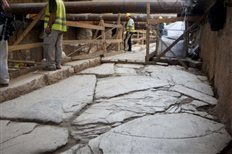
The Roman triliza below Thessaloniki
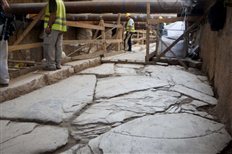
You imagine a wide road (latitudinal 10 and more meters), layered with thick, heavy marble slabs, bordered by marble curbs and colonnades, and on this road move chariots and pedestrians and animals and soldiers and emperors and…
And on a street corner – of the not so crowded despite the "maximus" of his character – to be engraved, almost artificial, a huge frenzy; Yes, the famous game that is still played today. And... I was thrilled to see Roman soldiers and centurions playing in the middle of the street;
The oversized trill of decumanus maximus (ancestor of today's Egnatia street) was located at the height of today's Agia Sophia street, just a few meters below the pavement of the polypath – and from the subway opening works – Egnatia street and has a diameter of about two meters.
Archaeologists working as part of the excavations to open the subway tunnel have not arrived at the exact dating of the impressive find, as the street on which it was located was allegedly "carved" after the 3rd AD. century and was preserved for at least three centuries later (until the 6th AD).
It is a monumental road of Roman character (decumanus is the Latin term that referred to large streets of Roman cities that were oriented from east to west and were usually decorated at the beginning and end with piazzas). The revelation of the excavations concerns a section of the length of the road 82,5 and width 10 meters.
The "birth" of the street dates back to the 3rd BC. century – when the city was founded by King Kassander. The traces of the ancient Macedonian road are about two meters below the cobbled and obviously wider and more luxurious Roman road that was "built" on top of it around the 3rd AD. century.
For more than four centuries the road, which is re-engraved with the Hippodamian system of town planning, turns into a main thoroughfare of the city.
THE the greatest decumanus of Thessaloniki is paved with thick marble slabs 15 centimeters and is bordered by wide marble curbs 4,7 meters. In its southern part (the northern one was not excavated as it 'approaches the limits of the station pit) the ruins of buildings are preserved, while between the road and the buildings it intervened, as is the case today in cities, dense network of built clay and lead pipes, which served the needs of water supply and drainage. It is even characteristic that the perfectly insulated water supply pipes passed through the sewer pipes without ever leaking. The road changes shape (width, length, use) throughout the centuries. The Roman road, after its earthquakes 620 A.D. and the destruction of many monuments of the city, "narrowing", during the Turkish occupation it became a path again, in the 19th century it is paved with Italian cobblestones and on it are laid the lines of the tram which also passes under the arch of Galerius, as seen in photographs of Thessaloniki from the beginning of the previous year (20uh) century.
The excavation was carried out as part of the archaeological work carried out by the 9th Ephorate of Byzantine Antiquities alongside the work for the opening of the Thessaloniki metro. During the same excavation (jurisdiction of the 9th Ephorate of Byzantine Antiquities) who started it 2007 and continues, a number of mobile finds were uncovered (jewelry, Christian symbols and church utensils, tools etc. of Byzantine Thessaloniki) and hundreds of gold and copper coins.
Source : tanea.gr

Play and art at the Thessaloniki Museum of Photography
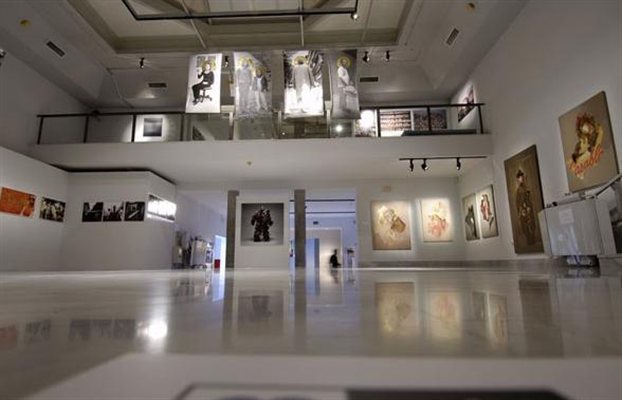
Educational workshops for children 6-12 years from 17 Of March 2012
A series of interesting educational workshops for children of all ages 6-12 organized by the Museum of Photography of Thessaloniki. It is an original initiative that combines photography with play and visual creation.
The program includes five workshops, which, starting on Saturday 17 March will be completed on 26 May.
More detailed, these laboratories are:
1the laboratory: Saturday 17 Of March, 12.00-14.00
The world through a frame
2the laboratory: Saturday 31 Of March, 12.00-14.00
The photo of myself
3the laboratory: Saturday 21 April, 12.00-14.00
Fantastic stories I
4the laboratory: Saturday 12 May, 12.00-14.00
Fantastic stories II
5the laboratory: Saturday 26 May, 12.00-14.00
Tales and pictures
The workshops will take place at the Thessaloniki Museum of Photography, Warehouse A, 1the floor, Port. Registration is required (on the phone 2310566716 , Mrs. Maria Kokorotsou) until Thursday 15 Of March (for the 1st workshop)
Source : tovima.gr

Opeth live in Athens and Thessaloniki
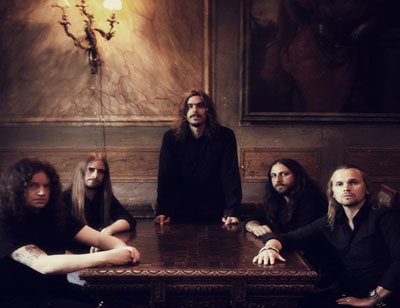
Οι Opeth, modern exponents of progressive, death metal coming in March 2012 in Greece for two concerts on Saturday, March 3 2012, in Block 33, Thessaloniki and on Sunday 4 Of March 2012, at the Fuzz Club, in Athens.
Opeth with me in plain sight, deep and unmistakable roots in the dark romanticism of Scandinavian death metal, with influences from the founders of the hard rock scene Sabbath, Purple & Zeppelin, they relentlessly pursue, for two decades, aesthetic development and perfection and constitute a distinct musical phenomenon.
With crazy doses of technique in their luggage, from 1995 that released their first album (Orchid), they didn't stop experimenting , to evolve, to explore new avenues, establishing with their works the sound of the modern era. Long-winded compositions, metal riffs, rhythmic changes, unparalleled melodies, acoustic passages alternating in perfect balance with brutal death vocals. The band seems to adopt disparate elements between them but, finally, in every work he finds the golden ratio and the albums are impressively homogeneous. Pure musical enjoyment!
In September, that passed us by, Heritage was released, their tenth album.
Until then, we had been "lit with nine stars" – as they themselves depict on the cover of their new album -. Their debut was with Orchid which managed to incorporate unique death metal, black metal, prog rock and folk elements in long, sad compositions that take your breath away. Then came Morningrise which the fanzine Lamentations of the Flame Princess declared "perfect". Followed by My Arms, Your Hearse, which Metal Storm called "a trip to heaven". The concept album Still Life marked their further evolution, while for Blackwater Park, the Village Voice compared them to King Crimson and CMJ called them "a metal union of Pink Floyd and the Beatles". In the next two, Deliverance and Damnation – Dr. Jekyll and Mr. Hyde work together harmoniously and fans perceive them as a double album. With Roadrunner, their new record label, they brought out Ghost Reveries and Watershed and completely captivated us.
At Heritage. ο Mikael Akerfeld, singer, guitarist, lyricist, songwriter and bandleader re-teams with his mentor Steven Wilson, mastermind of Porcupine Tree, presents us with a masterpiece and Opeth establish themselves as a leading force in the prog metal scene with deep roots in death metal. In their latest creation they are more careful, focused and passionate as ever. As Akerfeldt himself comments "Opeth make music that they themselves want to listen to.... with Heritage we feel rejuvenated. We found a new sound that we want to explore further. Let's see where it takes us, which will get us out...".
Opeth is one of the most perfect and dense live bands. Each of their live performances is an auditory delight! We will be rocking with them as loud and brutal as possible on Saturday 3 Of March 2012, in Block 33, in Thessaloniki and on Sunday 4 Of March 2012, at the Fuzz Club, in Athens
Source : culturenow.gr