Tag Archives: Museums

The city below Thessaloniki

The "City under the City" has a myriad of small and big secrets and amazing stories. If they come to light, attract and delight people.

1.000 from the 10.000 subway findings make their way to the Archaeological Museum of Thessaloniki and the Museum of Byzantine Culture
This will be done next year in Thessaloniki as well, where the ancient neighborhoods excavated during the metro works will "speak".
The best witnesses when people are gone are, most, the works of their hands, movable and immovable. Some, the second ones, they will go to the Pavlos Melas camp, regardless of what eventually happens with the byzantine crossroads at Venizelos station. The mobiles, which exceed one hundred thousand, they will have their place in some building of the camp, where visitable archaeological warehouses will operate.
This plan takes time to materialize. The competent prehistoric bureaus – classical and Byzantine antiquities, which have been digging for so many years along the entire length of the metro axis, prepare in the 2014 a long periodical exhibition with two strands. One will be hosted at the Archaeological Museum of Thessaloniki and the other at the Museum of Byzantine Culture.

From the cemeteries
The Archaeological Museum of Thessaloniki will present the rich findings from the excavations of the IST’ Ephorate of Prehistoric and Classical Antiquities. Emphasis will be placed on the findings found in two cemeteries ? the western one at the New Railway Station and the Democracy Square Station, the east at the Fountain.
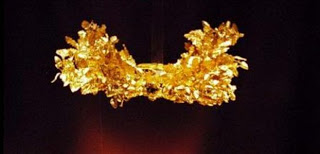
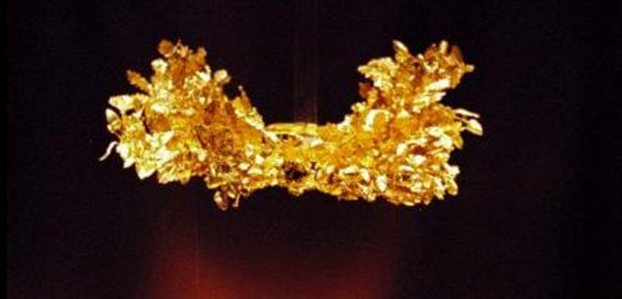
Currency, vessels, lamps, jewelry, figurines, tools, clay vessels, spice jars will be on display. Among them the golden wreaths that had been placed as gifts. Findings from residential and building remains found at the Agia Sofia stations will be placed with them, University, Euclid.

More than 1.000 archaeological findings of the Byzantine period, which reconstruct parts of the history of Thessaloniki from the 4th century to the present, will be presented in the section of the exhibition organized by the 9th Ephorate of Byzantine Antiquities at the Museum of Byzantine Culture.
The protagonist here will be the main road axis of the city, large parts of which were exposed under today's Egnatia. The decumanus of the Romans, the Middle Street or Avenue of the Byzantines, with the laboratories, the residences, community service projects, it remained almost the same for centuries and testifies to the "secular" face of the city.

Of the approx 100.000 findings of the period, will be exposed 1.000. Among them: coins of different denominations, vessels, lamps, glass vials, women's and men's jewelry of all kinds and materials (pectoral crosses, glass and copper bracelets, gold, copper and silver rings), utility items from shops – laboratories – houses, as well as all kinds of grave goods.

"REASON FOR STUDY"
"It's a very good occasion to show the public what the city was hiding in its bowels", says the general secretary of Culture Lina Mendoni. “How important her past is. But also to give him something in return for the suffering he suffered because of the works."
The general secretary reminds that something similar was done with great success in Athens, where the exhibition "The city under the city" presented at the Museum of Cycladic Art was a great success.
He even emphasizes that this large periodical exhibition, which will last one year, it will provide motivation and occasion for the scientific study of the findings.

THE TWO TEMPLES
Off the main road, the exhibition on Byzantine Thessaloniki will highlight both early Christian churches found within the two cemeteries, east and west from the city center: a 7th century temple and a three-aisled early Christian basilica.

Source : ethnos.gr

Costas Tzavaras announced a merger of museums in Thessaloniki

The International Book Fair will take place in May in the city

The decision to merge the State Museum of Contemporary Art with the Macedonian Museum of Contemporary Art in Thessaloniki was announced by the PAITHPA Deputy Minister responsible for Culture Kostas Tzavaras at a press conference in Thessaloniki at noon on Thursday 7 February. In the same interview, he also announced the dates of this year's 10th International Book Fair in the city, in the presence of the Governor of Central Macedonia Apostolos Tzitzikostas and the mayor of Thessaloniki Yiannis Boutaris.
Describing the fact that there are two museums with the same object in the same city as unthinkable, he commented on the merger of the State Museum of Contemporary Art with the Macedonian Museum of Contemporary Art as a "demand that has matured". By combining them it will be created, argued the minister, "one of the largest museums in Greece and one of the largest Museums of Contemporary Art in Europe with the aim of promoting contemporary art". The new museum will be a Legal Entity under Private Law and will be managed as provided by law. The Museum of Photography is not included in the merger, which will become autonomous and operate as an independent legal entity.
10the Thessaloniki International Book Fair
From the 16 until 19 The 10th Thessaloniki International Book Fair will finally take place in May. It will be, said the minister, "a great celebration of culture centered on the book, dozens of events, at least 30 international participations and the encouragement for all Greek publishers to participate". The aim of the ministry, he stated, is to strengthen the participation of Greek and foreign publishers, the better promotion of the Greek book to the Greek and international public and the synergies with the cultural institutions of the city in order for Thessaloniki to become a pole of culture.
The Ministry in collaboration with 18 supervised cultural institutions prepares a program 200 events, which will start before the start of the exhibition, acting as a "pre-shock of the great celebration" that will send messages to the international environment, in collaboration with the Region of Central Macedonia, the Municipality of Thessaloniki but also the world of publishers, such as the Panhellenic Federation of Book Publishers and the Union of Publishers of Northern Greece. The organization, which the minister characterized as the "beginning of a historic period in the history of the institution, which Thessaloniki deserves and deserves".
Following the recent decision to abolish the National Book Centre (THERE), the exhibition will be the first event under the new data that has been established. Honored country for 2013 -as had already been set in motion a long time ago- it will be Great Britain. The thematic exhibition will be dedicated to K. P. Cavafy, on the occasion of their anniversary 150 years since his birth, while the Municipality of Thessaloniki is preparing a tribute on the subject of "Cyril and Methodius" in a separate stand inside the exhibition where a photographic exhibition of heirlooms will be presented, which will then travel to the countries where the Thessalonian missionaries worked.
The Governor of Central Macedonia, Apostolos Tzitzikostas, emphasized the decision of the Central Macedonia Region to invest in culture and support all sectors and announced the decision to reactivate the Lazarist Monastery.
The mayor of Thessaloniki, Yiannis Boutaris, expressed his belief that the 10th Thessaloniki International Book Fair will be crowned with success and added that the municipality will continue to work closely with the ministry. Referring to the merger of the two museums, he pointed out the importance of highlighting both the collections of the Macedonian Museum and the Kostakis collection of the State Museum of Contemporary Art.
Also present at the press conference were the Presidents of the State Museum of Contemporary Art and the Macedonian Museum of Contemporary Art, Mrs. Katerina Koskina and Xanthippi Heupel, which for their part welcomed the ministry's initiative to proceed with the merger of the two Museums and described today's announcements as "historically important" as, as they mentioned signal the need for a change and focused on the need for the new museum to be an extroverted organization.
Archaeological Museum of Amphipolis, Serres
As part of his visit to Thessaloniki, the deputy minister visited the archaeological site and the Archaeological Museum of Amphipolis Serres, he congratulated the Ministry of Macedonia-Thrace and the Region of Central Macedonia for contributing financially to the progress of the excavations and declared that "the State will do its duty and this project will reach its end". They will be given initially 50.000 euros for the completion of the excavation and "at the beginning of March the project will be included in the public investment program and will be financed in its entirety by the Ministry of Culture".
Source : tovima.gr

Fewer in Museums, more in the archaeological sites

Decrease in Museum visitors in the month of February 2012 and even in percentage 23,7%, as well as a reduction in collections by 42,2% in relation to its corresponding month 2011 shows the recent survey of movement of Museums and Archaeological Sites presented on Tuesday.

However, a different picture emerges in the archaeological sites with an increase in visitors by 39,9% and reduction of the corresponding collections in percentage 45,8% in relation to its corresponding month 2011.

During his first two months 2012 a decrease is observed 19,3% to Museum visitors as well as a reduction 34,3% in receipts in relation to its corresponding period 2011.

The same is not the case, however, in the picture presented by the visits to the archaeological sites during its first two months 2012. On the contrary, an increase is observed 35,6% to visitors and reduction 30,1% in receipts in relation to its corresponding period 2011.

The survey of the movement of Museums and Archaeological Sites produces results from the year 1970, with collection from the Archaeological Resources and Expropriations Fund (CAP ) of the Ministry of Culture and Tourism of the data referring to the number of visitors and the receipts from the allocated tickets to Museums and archaeological sites.

Source : tovima.gr

Our heritage is not for sale

Reactions to the practice of the Thyssen-Bornemisza museum to auction a project to finance its needs

You would sell a museum's work to deal with its financial problems; The question for a country like Greece, whose multitude of museums are devoted to the preservation and promotion of antiquities, it could only be hypothetical. How would it be possible to hammer her cultural heritage… Some things anyway, even in times of complete collapse of values, remain high.
The director of the great Spanish museum Thyssen-Bornemisza did, however. His excuse is serious, since the museum is facing a problem of survival, which intensified with the financial crisis. But his act is also daring, after handing over one of the paintings in his collection to be auctioned by Christie's. Similar action in Greece would be hard to imagine. Not only with regard to the sale of antiquities and more generally of works and objects that have been classified as monuments, because this is expressly prohibited by the Constitution and the Archaeological Law, but also contemporary works, which can be freely traded.
On the other, American museums have been selling their works for years for various reasons. The essential difference with Spain is that for the first time, at least admittedly, this move is due to financial difficulties. Regardless of whether the work of the romantic landscape painter John Constable reaches the asking sum of 21 million. sterling, the director of Thyssen-Bornemisza opens a window sealed well to this day, regarding the management of museums internationally.

Intangible heritage
“Even if it was allowed by law, even if I had permission to do so, I would never sell a work of the museum" answers the question professor Mr. Nikos Stampolidis, director of the Museum of Cycladic Art, one of the few private archaeological museums in the country. “Only over my dead body!» is the reaction of Dr. Angeliki Kottaridis, which as head of IZ’ The Ephorate of Antiquities is responsible for the Museum of the Royal Tombs of Vergina, the archaeological museums of Pella and Veria, as well as the Byzantine Veria.
After all, the difference between an ancient object and a modern work of art is telling, since a work of painting or sculpture was produced to be sold, unlike antiquities, which are excavation findings and were once people's properties. "They are material works, but their status is immaterial," emphasizes Mrs. Kottaridis. "I mean, what could I sell?; A golden ivory piece from Philip's bed;».
According to the existing institutional framework however, the sale of works for the National Gallery (and for modern art museums) it is not prohibitive. However, its director Mrs. Marina Lambraki-Plaka is negative about any possibility of a sale. "Personally, I wouldn't dare. I could never make such a decision, even in a last resort" he declares.

The suggestions
Therefore, the question of financial support for museums remains. Thus, the search for new ways of financing them is imperative. “As a last resort I would ask prospective buyers to “adopt” a project, but leaving it in place, to the museum" suggests Mr. Stampolidis, while flexibility and ingenuity are required for Mrs. Kottaridis: "When the Americans sell the right to participate in an excavation instead 3.000 dollars and when the people of Skopje and the Bulgarians do the same to 1.500 dollars for two weeks, it is clear that what we also need is a new cultural strategy" he says.
She would also "sell" participation in workshops that would manufacture products with the ancient know-how – woven, ceramics, metal works, pictures -, which will then be marketed. Also DVD, games and online applications. But also the networking of archaeological sites to provide more services to visitors. Why don't all these things happen?;
"We are ready for the change of the institutional framework regarding the management of museums" says the general secretary of the Ministry of Culture Mrs. Lina Mendoni. "Because with the current laws, a donation may never reach the body for which it is intended, and this because of its registration in the regular budget, and the Archaeological Resources Fund, which has the responsibility of producing copies and other products for the sales, it is outdated a long time ago" she admits.
"A necessary condition is to break the taboos and institutions of the TAP and to take into account’ considering the logic of the market" concludes Mrs. Mendoni. And it seems that today this is not only necessary. It is mandatory.

Stacked in warehouses
Small clay lamps, evenly between them, by the hundreds. Fragments of vessels by the thousands. Forcedly piled up in the warehouses of museums or the Ephoria of Antiquities, many finds of the excavations that do not present a special archaeological interest remain in disuse. Their concession is prohibited, despite the proposals that have been made to sell or donate them to museums, educational institutions and in general to foreign bodies that promote ancient Greek culture.
«Δεν υπάρχει λόγος να πωληθούν γιατί η οικονομική τους αξία δεν είναι τέτοια που να λύνει κάποιο πρόβλημα. On the contrary, και το μικρότερο από αυτά έχει την ιδιαίτερη σημασία του για τους επιστήμονες» λέει η αρχαιολόγος κυρία Αγγελική Κοτταρίδη. Για τον καθηγητή κ. Νίκο Σταμπολίδη ωστόσο αποτελούν μια ευκαιρία προβολής της χώρας: «Μπορεί να πωληθούν ή να δωρηθούν, με την προϋπόθεση όμως πάντα ότι θα φέρουν τα στοιχεία τηςταυτότητάςτους και ότι θα εκτίθενται σε κοινόχρηστους χώρους. Γιατί έτσι θα μπορούσε να αποτελούν ένα κομμάτι της πολιτιστικής μας κληρονομιάς σε άλλον τόπο».

Source : tovima.gr

Summer opening hours for archaeological sites and museums is proposed by the Ministry of Culture

Instructions to the general secretary of Culture of the Ministry of Culture and Tourism, regarding the issue of the summer schedule of the country's archaeological sites and museums, sent yesterday by the Deputy Minister of Culture and Tourism Petros Alivizatos.

The undersecretary, recognizing the delay in the recruitment procedures of seasonal staff through ASEP due to elections, which does not allow the issuance of a relevant administrative act for summer hours, as well as the intense protests of the tourist world, requested the immediate implementation of temporary operating hours from 9.30 a.m. until 5.30 pm.

The temporary operation during the specified period negates the need for staffing in two shifts, in order for the spaces to function even after 3 pm.

The public will be able to visit the areas of responsibility of the Ministry of Health and Welfare from 10 a.m. until 5 pm, ξεπερνώντας με τον τρόπο αυτόν τη δυσχέρεια στελέχωσης που αντιμετωπίζουν οι περιφερειακές υπηρεσίες σε φυλακτικό προσωπικό.

Το ωράριο αυτό δεν ισχύει για αρχαιολογικούς χώρους που λειτουργούν ήδη με δύο βάρδιες και πέραν τις 3 pm, όπως η Ακρόπολη των Αθηνών, οι οποίοι συνεχίζουν με το υφιστάμενο ωράριό τους.

Alongside, ο υφυπουργός απέστειλε οδηγίες για την καλύτερη αξιοποίηση του υπάρχοντος φυλακτικού προσωπικού, ζητώντας την άμεση απεμπλοκή του από τυχόν καθήκοντα και εγκαταστάσεις που δεν αποτελούν αρμοδιότητά του και ζήτησε να αναπροσαρμοστούν οι εκτελούμενες υπηρεσίες, προκειμένου να επιτευχθεί καλύτερη φύλαξη τομέων.

Source : kathimerini.gr

Μουσεία και αρχαιολογικοί χώροι με χειμερινό ωράριο ως τον Ιούνιο

Δεν προκηρύχθηκε διαγωνισμός για επιλογή εποχικών υπαλλήλων λόγω εκλογών

Χειμερινό ωράριο για μουσεία και αρχαιολογικούς χώρους, τουλάχιστον ως τον Ιούνιο. Αυτά είναι τα άσχημα νέα για τον πολιτισμό και τον τουρισμό καθώς η προκήρυξη των εκλογών δεν άφησε το περιθώριο της πρόσληψης εποχικών υπαλλήλων μέσω της διαδικασίας του ΑΣΕΠ, όπως είναι επιβεβλημένο.

Οσον αφορά την καθυστέρηση πάντως, το ΥΠΠΟ δηλώνει ότι την σχετική άδεια έλαβε μόλις στις 29 Of March, γεγονός που δεν του επέτρεψε την έγκαιρη προκήρυξη του διαγωνισμού. Και πάλι όμως προσλήψεις θα γίνουν μόνον για 680 υπαλλήλους αντί των 1000, που είχαν προσληφθεί πέρυσι αλλά και πάλι δεν έφταναν

Ετσι λοιπόν τα μουσεία θα συνεχίσουν να λειτουργούν ως τις 3 το μεσημέρι ενώ οι αρχαιολογικοί χώροι ως τις 3 or 5 μ. μ. με εξαίρεση την Ακρόπολη που είναι ανοικτή ως τις 7.

Υπάρχει ωστόσο και ένα καλό νέο, το οποίο ανακοίνωσε η γενική γραμματέας του υπουργείου Πολιτισμού κυρία Λίνα Μενδώνη, ότι από του χρόνου και ως το 2015, θα γίνονται και άλλες προσλήψεις με επτάμηνες συμβάσεις (πάντα μέσω ΑΣΕΠ), στο πλαίσιο ευρωπαϊκών προγραμμάτων για κοινωφελή έργα.

Source : tovima.gr