Tag Archives: tanea.gr

Bob Dylan's harsh response

With a long interview in the magazine "Rolling Stone" which is released on Friday, the legendary Bob Dylan talks about everyone and everything, but mainly for the accusations that he "steals" from other artists for his songs. "They can all melt in hell," he says in an aversion to his speech!

In 71 his years, the great Robert Allen Zimmerman – by world bob dylan – returns to the discography with his 35th album, the 'Tempest' which was released a few days ago, and with an interview that already, before it hits US newsstands, has sparked debate, mainly for the harsh words he uses against his critics.

In the interview with "Rolling Stone", dylan is asked by journalist sam jones about accusations that he has been "borrowed" without mentioning it lyrics by henry timrod, a 19th century poet, for songs on his six-year-old album Modern Times. He has also been accused that on the album "Love and Theft" the 2001 had used excerpts from "Confessions of a Yakuza", the dark novel by the Japanese author Yunishi Saga, without mentioning it again.

"Indeed in folk and jazz borrowing is a tradition that is rich and even enriching. It's true for anyone. Except me. There are other rules for me" Dylan emphasizes and continues in a harsher tone. “You're talking about Henry Timrod, have you ever heard of him; Who has read him lately?; And who brought him to the fore?; Who makes you read him; Go ask his descendants what they think of all this. And if you think it is so easy to use his verses and help you in your work, do it and let's see how far you get. Women complain about something like that too!».

Dylan, who started his career in music the 1959, he claims in his interview that he has been in the spotlight for a long time. "This is all part of a tradition, that goes back a long time. They are the same ones who once stuck the name of Judas on me. Judah, the most hated name in history! If you think your name is bad, try to find your way with such a name. And all this why; Because I had played the electric guitar; As if this is the same as betraying the Lord and handing Him over for crucifixion. All these diabolical gams…see, they can melt in hell!».

Source : tanea.gr

The Roman triliza below Thessaloniki

You imagine a wide road (latitudinal 10 and more meters), layered with thick, heavy marble slabs, bordered by marble curbs and colonnades, and on this road move chariots and pedestrians and animals and soldiers and emperors and…

And on a street corner – of the not so crowded despite the "maximus" of his character – to be engraved, almost artificial, a huge frenzy; Yes, the famous game that is still played today. And... I was thrilled to see Roman soldiers and centurions playing in the middle of the street;

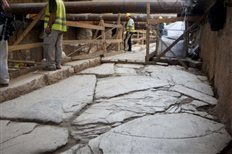
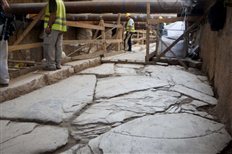
The oversized trill of decumanus maximus (ancestor of today's Egnatia street) was located at the height of today's Agia Sophia street, just a few meters below the pavement of the polypath – and from the subway opening works – Egnatia street and has a diameter of about two meters.
Archaeologists working as part of the excavations to open the subway tunnel have not arrived at the exact dating of the impressive find, as the street on which it was located was allegedly "carved" after the 3rd AD. century and was preserved for at least three centuries later (until the 6th AD).
It is a monumental road of Roman character (decumanus is the Latin term that referred to large streets of Roman cities that were oriented from east to west and were usually decorated at the beginning and end with piazzas). The revelation of the excavations concerns a section of the length of the road 82,5 and width 10 meters.

The "birth" of the street dates back to the 3rd BC. century – when the city was founded by King Kassander. The traces of the ancient Macedonian road are about two meters below the cobbled and obviously wider and more luxurious Roman road that was "built" on top of it around the 3rd AD. century.
For more than four centuries the road, which is re-engraved with the Hippodamian system of town planning, turns into a main thoroughfare of the city.

THE the greatest decumanus of Thessaloniki is paved with thick marble slabs 15 centimeters and is bordered by wide marble curbs 4,7 meters. In its southern part (the northern one was not excavated as it 'approaches the limits of the station pit) the ruins of buildings are preserved, while between the road and the buildings it intervened, as is the case today in cities, dense network of built clay and lead pipes, which served the needs of water supply and drainage. It is even characteristic that the perfectly insulated water supply pipes passed through the sewer pipes without ever leaking. The road changes shape (width, length, use) throughout the centuries. The Roman road, after its earthquakes 620 A.D. and the destruction of many monuments of the city, "narrowing", during the Turkish occupation it became a path again, in the 19th century it is paved with Italian cobblestones and on it are laid the lines of the tram which also passes under the arch of Galerius, as seen in photographs of Thessaloniki from the beginning of the previous year (20uh) century.
The excavation was carried out as part of the archaeological work carried out by the 9th Ephorate of Byzantine Antiquities alongside the work for the opening of the Thessaloniki metro. During the same excavation (jurisdiction of the 9th Ephorate of Byzantine Antiquities) who started it 2007 and continues, a number of mobile finds were uncovered (jewelry, Christian symbols and church utensils, tools etc. of Byzantine Thessaloniki) and hundreds of gold and copper coins.

Source : tanea.gr

The exploration of Mars from the Curiosity vehicle began

It successfully landed today on 8.32 (Greece time) on the planet Mars the robotic vehicle Curiosity, NASA announced. The seven-minute process was the hardest landing of an unmanned spacecraft ever on the Red Planet. The vehicle immediately began sending pictures back to earth and searching for extraterrestrial life forms.

The Curiosity rover sent its first signal when it entered the Martian atmosphere. "We received signals, things look good" said a member of the mission. NASA's space shuttle launched from Cape Canaveral on 26 November 2011.

Its mission is to explore Mars in order to determine whether the Red Planet ever had the conditions to support any life.

Immediately after the successful landing the mission members erupted in cheers and one of the officials handed out Mars chocolates…

The same atmosphere of joy prevailed when the robot sent the first photo, of exceptional purity, of his shadow on the ground of Mars, immediately after his landing.

US President Barack Obama in his announcement speaks of an unprecedented technological achievement.

The program cost money 2,5 di. dollars.

The craft entered the Martian atmosphere at a speed of approx 20 thousands of km/h. A combination of systems (parachutes, specially designed thrusters etc.) built into the craft helped Curiosity to land as "softly" as possible so as not to damage any of its advanced and ultra-sensitive instruments.

New ambitious exploration phase

A new ambitious phase of exploration of the neighboring "red planet" is thus inaugurated, with the main stake being finding traces of microbial life, either in the distant past, or more recently, either- as the most visionary hope- even in the present.

In essence, the new mission is expected to lay a firmer foundation for a future human-first mission to the planet, something that is not expected to happen at least two decades ago.

The weight 900 kg nuclear powered (with plutonium fuel) six-wheeled robotic rover, with the official name "Mars Science Laboratory" (Mars Scientific Laboratory"), it's the size of a car, it is more than twice as long and five times heavier than the twin rovers “Spirit” and “Opportunity” who reached Mars the 2004.

"Curiosity" was launched on 26 November 2011 and traveled approx 248 million. kilometers to reach Mars, being the
largest and most expensive vehicle ever sent to another planet.

The entire shipment cost approx 2,5 billion dollars and it is hoped that the vehicle will last many more years than the two years NASA originally planned.

It is the most complete and technologically advanced space mobile scientific laboratory, as it has a range of cameras and scientific instruments, as well as a robotic sample collection arm, which will allow him to carry out, in the coming years, a wide range of on-site scientific analyses. Every day, the results of his surveys of the Martian soil will be sent electronically to Earth for further analysis by
the scientists.

The autonomous rover, which will remain stationary in its place for several days, until it is ensured that all is well with its electronic systems, will focus his investigations on its alluvial rocks, height approx 5 km, Mount Sharp (or, as is its official name, Aeolis mountains), which is located inside the ancient and huge Gale Crater, latitudinal 154 km. and aged over 3,5 di. years.

The rocks in question are considered a kind of "time capsule" for the successive geological stages of the planet from the wettest
and his warm past to his arid and cold present.

The vehicle- laboratory, which will move slowly with a speed of just 30 meters per hour (going through the lot 200 meters per day), will continue to analyze Martian rocks looking for complex organic molecules, which will probably constitute the
chemical "signature" of some past or present microorganisms.

But the difficulty for scientists will be to make sure that such carbon-based molecules are indeed of biological origin (the metabolism of microbes), since they could also have been produced through abiotic geochem
procedures.

Research so far has shown that once upon a time, billions of years ago, Mars had an atmosphere and liquid water, therefore a basic condition for the emergence of some form of life was met.

Now, it is hoped that the “Curiosity” will take another step, also finding evolved organic molecules that could be remnants or byproducts of such microorganisms.

Continuation of the article attanea.gr

When tourism persists culturally

The romantic coloring of the English traveler artist Edward Lear reveals – in an exhibition at the Asian Art Museum of Corfu – the virgin landscapes of the Ionian Islands of the 19th century, freed from the archeology of his time

"Around 3 in the morning we anchored in the beautiful paradise of Corfu and looked out over the calmest of seas, with the ridges of the hills covered with cypress trees and dotted with country houses all the way to the sea…», he wrote in his diary on 19 April 1848 the English traveler Edward Lear.
It is one of the notes of admiration of the English illustrator and poet of the Victorian era. Who in the spirit of 19th century travelers traveled to Greece, he was fascinated by the Ionian Sea and settled in Corfu painting watercolors, oil paintings, creating drawings and engravings.
As meticulous by nature and impressed by the beauty of the place, Lear detailed the corners of his works and the pages of his diary, and it is no exaggeration to think that if he were alive today he would be a successful social media user..
Two hundred years since his birth, the relationship of the philanthropic English artist with the Ionian Islands and especially with Corfu is reflected in the large exhibition that opened at the Museum of Asian Art under the roof of the Palaces of Archangelos Michael and Agios Georgios in Corfu.
Culture and tourism: the new product that Corfu has added to the choices of its visitors. Lear, with endless horizons, rocks bathed in evening light, seas framed by the dawn breeze, offers his share.
In the middle of the 19th century he traveled on foot or on horseback in unexplored Greece. The virgin landscapes that met his gaze he rendered in paintings. “More and more I'm getting the impression that eventually I'll mostly be known as “The Painter of Greece”», he declared himself as soon as he settled in Corfu, the 1856.
The exhibition "Edward Lear and the Ionian Islands" captures moments from his travels in the Ionian. Its significance lies in the fact that "in the vaguely melancholic landscapes from the Ionian Islands that Lear renders with romantic descriptiveness, his compatriots remotely collect the first information about the area", points out the curator of the exhibition and director of the Asian Art Museum Despina Zerniotis.
Twentieth of twenty-one children in the family of stockbroker Jeremiah Lear and his wife Ann, he was known in his homeland for poems and writings with paradoxologies (nonsense) and works with zoological illustrations. However, with the landscapes from his excursions in the Mediterranean he secured his living.
"The entirety of his Greek production constitutes a unique treasury of visual evidence for the natural environment of Greece in the 19th century. For the image of the landscape before the neo-Greek deformation and development interventions", Fani-Maria Chigaku points out, painting curator at the Benaki Museum.
Lear's humor prompted him to capture even snapshots of the daily lives of the inhabitants: villagers in local costumes of the Ionian Islands chat in front of huts or churches, they pose next to goats, while in his sketches he captured details from weddings and local festivals.
Source : tanea.gr