

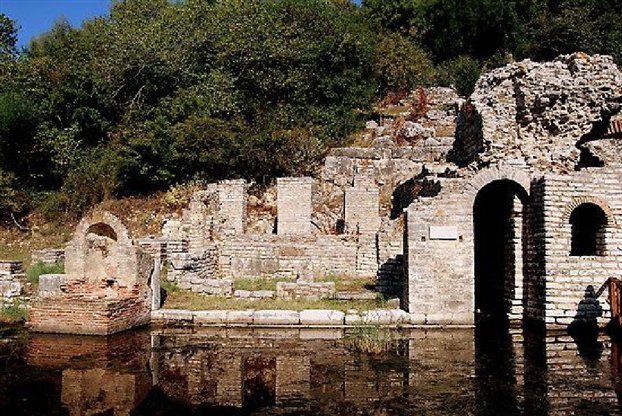
The research has been conducted since last May by an American University
A wooden plow of the 7th BC. century they traced to 6,5 meters deep the members of the American archaeological mission of the University of Notre Dame in the ancient city of Buthroto in Albania. The object came to light during last week's excavations and is of great importance, as it is the first wooden find not only in the area but in the entire Balkans.
Besides, it should be considered, that it is Greek, as in the 7th BC. century the Greek colony of Bouthrotos was founded, which later in the Roman era also experienced a great flourishing and subsequently acquired a Christian diocese.
This plow that is, which was kept submerged in water, like all the ruins of the ancient coastal city it comes from the first Greek years of Vothrotos' life. Something very important, because the surviving remains of the city date back to the Roman and Byzantine eras.
The research has been carried out since last May by the American archaeological mission of the University Our Lady of Indiana under the archaeologist David Hernandez, which he first collected for this purpose 55 experts including archaeologists, anthropologists, bioarchaeologists, geneticists, historians as well as students from Albania, USA, Italy, Hungary, Hellas, Czech Republic etc. An important find this year was also the propylon of a building that had high columns and a floor paved with stone slabs.
also: More than 250 were the coins of various eras that came to light testifying to the developed relations of Bouthrotus with the countries of the Mediterranean throughout antiquity. The vessels, especially those of the 4th and 3rd BC. century is of exceptional quality and art, a proof of the high standard of living of the inhabitants but also of the range of trade. Copper objects, buckles, jewelry and glassware, spatulas but also parts of sculptures (mainly extremities: hands and feet) complement this year's harvest, while a pleasant surprise from the Middle Ages was a whistle that was probably used to call hawks.
Moreover, the surface archaeological research in the area proved to be particularly important, during which Paleolithic and Neolithic bones and objects were collected, such as ceramics, which prove the oldest habitation in the area.
Bouthroto is in the distance 20 about kilometers from Agioi Saranda and was a city that was preserved over the centuries by changing rulers.
After the Romans in the early Christian years it was one of the twelve cities that made up the province of Epirus, in the Middle Ages it is even mentioned as an important fortress. After the conquest of Constantinople by the Franks, it passed to the Despot of Epirus while the conquerors alternated (Sicilians, Navarros, Venetians Mr. a.) with interest mainly for its rich fish farms. As a city it was abandoned in the 15th century due to its wet soil.