
In Greece of recession and unemployment, the area of art and creation employs more than 100.000 people
How many people are currently employed in the field of culture?; According to the research of "Vima", based on official agency records, more than 100.000. That's how many people do theater, music, cinema, visual arts, book, those who work in cultural institutions, private and public enterprises, festival, art schools, the technical staff and in general those employed in… behind.
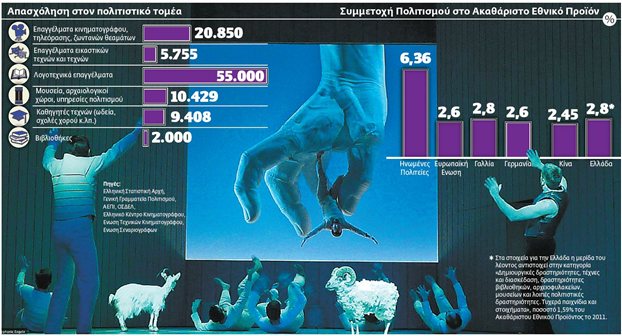
Obviously this number doubles on a practical basis. A very large crowd that is active around culture, the "poor relative" or otherwise one of the biggest victims of the crisis, which, however, participates with a percentage 2,8% in the Gross National Product. The fund is minus and the cuts in the field of culture compose a rather gloomy landscape. Only in the field of music, the Hellenic Society for the Protection of Intellectual Property AEPI is registered 12.746 members. From them 9.051 they are artists. For its part, the Organization for Collective Management of Works and Speech (OSDEL) counts 3.000 authors, translators and others working in the book field, number multiplied by ten. Specifically, according to the words of those in charge, the number of those who have written cat’ exclusivity or have participated in the creation of a work during the last ten years amounts to 55.000 people. According to the Hellenic Statistical Authority, the total number of employees (businessmen, artists, technicians, administrative staff, other workers, taxi companies etc.) in state and municipal theaters over time 2010-2011 it was 4.284, while the number of artists who participated in group exhibitions the 2011 5.755.
In the field of cinema approx 1.700 people work at festivals, 980 employed in distribution companies and 360 in movie theaters, according to the Hellenic Film Center. Six hundred are the members of the Union of Greek Cinema and Television Technicians and 180 the members of the Union of Screenwriters of Greece. Always according to the Hellenic Film Center 100 short and feature films were shot on 2011. Despite our efforts, the Society of Greek Directors could not provide us with data on the number of Greek directors.
The General Secretariat of Culture reports that as of 31.12.2012 they were working 6.748 permanent and indefinite and 3.681 contractors in the field of Culture – figures valid per quarter but showing slight variations.
A large group of people make up the teaching staff of professional drama schools, dance, Logistical upgrade of cultural spaces, music schools, conservatories – overall 9.408 during space 2010-2011 according to the Greek Statistical Authority. According to the same Authority, also the 2010, 1.932 workers were employed in libraries. If the above numbers are added, we have approx 100.000 people. Do they all manage to make a living?;
"Impossible to make a living writing books"
"In Greece it is impossible to make a living just by writing books" tells us the 46-year-old writer Amanda Michalopoulou. "His golden decades 1980 and his 1990, where the literature was a bestseller and the author was socially acclaimed, they have passed. Book sales have dropped dramatically, and naturally so. You used to see some people in banks with a book in hand. Today everyone has a plain look: they look ahead as if they are looking at nothing".
She herself tries to find other ways, more lucrative, to do what he knows how to do – "because I couldn't do any other job". It has, for example, two plays ready (one for children and one for adults) who intends to soon present them and request cooperation from groups that may be interested. Amanda Michalopoulou also teaches creative writing at the Heraklion Museum and at the cultural society of Kifissia Pyrna, while also doing private lessons working together with groups. "I think this choice of mine is mentally related to the need for communication that I feel," he explains. “In prose you always have one “holding”, you have to wait to talk. The only thing that could make me worry is that with all this the creative energy goes elsewhere – and not in writing. But I have the basic hope and feeling that these activities work in favor of writing. It's a slight shift in my activities. And when some people ask me “oh well, how is it possible to write with such desperation around;”, I answer them: That's when I grab the pencil".
"Just securing my food"
Our 59-year-old national tragedian Lydia Koniordou believes that the theater and the large number of those who serve it from many and different sides were not so shaken by the financial crisis. "Permanent positions never existed in the theater, We mostly worked on a project basis and were always looking for work. Certainly the jobs have decreased, multifaceted projects as well, opportunities are less, however, there is a clearing in the landscape: good shows do well and survive".
Lydia Koniordou agrees that in Greece there is a disproportionately large number of theaters in relation to the population. "That they work, however, it means that some people are getting money from this work," he adds. In her opinion, the big losers in theater at this time are the young people: "There is a lot to offer from young people, children are hard to absorb and pay more to show their work than get paid".
She feels lucky to be part of a show like Bob Wilson's Odyssey at the National Theater. "The salary I receive from the National with the reductions I have suffered is approximately the same as I received when Nikos Kourkoulos was artistic director. It is rather low compared to the years I have been in the theater, but since the time I was apprenticed to Karolos Kuhn I have learned to live with what I make. With the money I get from the National and acting lessons (SS.: teaches at the Ancient Drama Center "Desmi" and at drama schools) I can secure my food. I have given up central heating, I warm myself with an oil stove like when I was a student at Exarchia, I have minimized the use of the car and commute with one “duckling” of the 80's and… i can't pay the tolls, taxes and so on. I just pretend they don't exist".
"Crisis does not make high art"
For the 55-year-old visual artist Tasso Manjavino, the crisis is not going to highlight the good works and the notable artists. "The crisis hits those who have taken art seriously. Gross commercial works remain commercial. “He is being punished” the good painting, with collectors appearing as… mavaragorites and asking to step on the artist's need to buy cheap works" he says. "In my opinion, crisis does not make high art. Unless we're talking about heroes". He himself does not know any of his colleagues who face extreme situations of poverty, but he is sure that only those who have made sure to have a knot on the end survive.
"I don't think young directors are any different from other young workers from other fields, in light of the fact that all of them are subject to long periods of unemployment, working conditions with low wages, debts that are time-barred and an industry in collapse" tells us the 31-year-old filmmaker Giorgos Zois.
“In my case, because of the run of my films, I can and do live from my profession because of job offers made to me after festivals and awards and copyrights from abroad. But this was not done by any entrepreneurial economic development nor is it a ray of light for the youth of our times. I don't want to give my random individual path as an alibi to a fallen system that is anxious to blackmail reality out of isolated exceptions. Greek everyday life does not fit any of us".
Literary evenings… without a coffee
The surrounding despair did not stop 41-year-old translator Dimitris Alexakis, son of the writer Vassilis Alexakis, to create together with a new group of partners – his wife, actress and director Fotini Banou, the sociologist Ari Asproulis and the theater researcher Teta Apostolakis – the cultural activities area Television Control Center in Kypseli (Cyprus 91A), where his decades 1960 and his 1970 black and white televisions were being repaired and assembled. The Center opened its doors to the public in November 2012.
"We created something new in an era where everything is against" says Dimitris Alexakis. "And we realize that month by month the crisis deepens more and more. The place is suffocatingly full, for example, in the literary evenings that we organize for those who stay for three and a half hours in the mood for discussion and participation, but without even taking a coffee. And that for us is devastating, prof’ that we have bet to make our expenses from the small bar of the place. Bad lies. It takes passion and risking any family fortune to survive in this space creating something new in this day and age. Our parents supported us, who were not rich, but they felt that there was a question of dignity. And what,what we earn we dispose of in space. Yes, “we go inside” every month and we also have a small child, but we are proud of’ what we do and we don't plan to stop. We're just constantly cutting our expenses.".
Source : tovima.gr