

One of the world's first buildings was discovered in Jordan. In Scotland came to light boat 1000 years with the burial of a Viking. While scientists reconstituteddigitally a school of Roman gladiators. The "Top 10" of the archaeological discoveries of the past year, as recorded by the authoritative American magazine "Archaeology" includes investigations, events, even highlighting the effects of the war in Libya on the monuments, the political and social upheaval in Egypt, Tunisia and Syria by 2011.
Absent from this list, however, is Greece, not necessarily due to a lack of archaeological activity but perhaps also due to insufficient information. Moreover, as the magazine itself points out, the reason par excellence why it will go down in history 2011 is the political and economic crisis in the world. Without meaning that, of course, that archaeologists and other scientists stopped working and presenting work. Applications of modern technology, for example, in archeology new possibilities open up both in field research and in the study of findings to draw more accurate conclusions.
So in the "Top 10" of "Archaeology"., are included, in no particular order anyway, the following events:
– Viking burial on a ship, which came to light in exceptionally good condition in Ardamurchan, Scotland (the first on British soil). The dead man was a high-ranking warrior who had been buried with his weapons, a sword with a silver hilt, shield, spear, ax but also a drinking horn.
– Neolithic building uncovered in Wadi Fainan, Jordan. It is dated 11.700 years before today, it is oval in shape and was made of mud. An interesting fact is that it is surrounded by two terraces reminiscent of the construction of an amphitheater, while according to the evidence it had a roof, which covered a part of it. The building may have been used periodically by small groups of people to process products such as barley and peanuts or for gatherings.
– Research developments on the search for skin remains in fossil remains of Australopithecus sediba discovered in Malapa, South Africa. The remains are 2,2 million years old and a thin layer of minerals found on them, it is thought that it could be the remains of skin. However, the investigation has not yet reached definitive conclusions.
– Discovery of the earliest domesticated dogs in Predmosti, Czech Republic. This is about publishing a study, which refers to three dog skulls, dating from ca 31.500 years ago and present characteristics, which separate them from their ancestor the wolf. This is a smaller and wider muzzle and a wider space for the brain. Researchers as recently, they considered that the domestication of the dog took place before 14.000 years.
– Unveiling of a rare burial of a woman, who was a Mayan ruler in Nakum, Guatemala. The burial chamber was found under another and was _surprisingly_ untouched by antiquarians. The woman carried two vases on top of her head and was buried with valuables. Both the quality of the grave and the position in which it was found, show that it was used for people of royal descent for half a millennium.
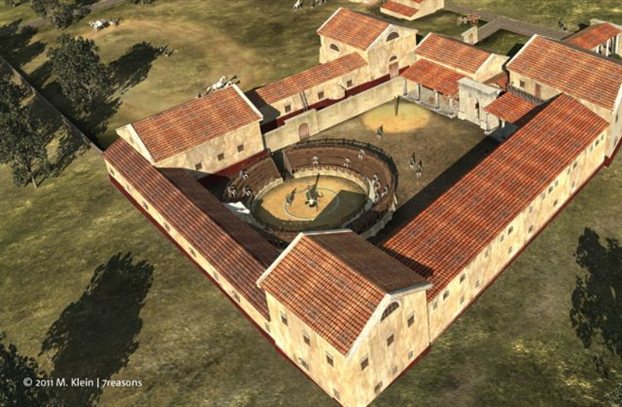
– Digital reconstruction of the "Gladiator Gymnasium" found in the ancient Roman city of Carnundum in Austria by an international team of researchers from the Ludwig Boltzmann Institute for Archaeological Research and Virtual Archeology.
In this city, which she once had 50.000 inhabitants and today it is a huge archaeological park, the fourth largest in the world has been discovered, school for gladiators of the 4th c. X. century. It is a closed complex with an inner courtyard, circular training area, living quarters and a cemetery while high-resolution images collected by the GPR survey show underfloor heating, swimming pools and paths.
Additional, with the improved technology developed, visitors can watch the life of the gladiators inside it.
– Uncovering meal remains in Chinese burials in Shaanxi and Xinjiang provinces. The world's oldest soup is 2000 years, the particular one found in pots was dog soup. the second _ 2400 years old _ it was millet noodles.
– War and ethnogenesis through the excavation of pre-Columbian settlements at Taraco, on the edge of Peru's Lake Titicaca. The research showed, that cooperation between different ethnicities can certainly be a path to success, but sometimes an organized conflict can be more effective in obtaining resources!
– Revelation of the whaler "Two Brothers" that sank the 1823 in Hawaii. The ship holds a special place in literary history, for his captain was hard-headedGeorge Pollard Jr.Pollard's first ship, the "Essex" was rammed and sunk by a blow whale, providing inspiration toHerman Melville for the creation of the famous work of "Moby Dick".
– The "Arab Spring" and its effects on the monuments of Egypt as well, of Tunisia, of Syria and Libya. Recording of the disasters and looting in these countries, to the degree, that this is possible due to turbulence and minimal information. As is well known, Egyptian archaeological sites and museums were looted, last September, the Seleucid city of Apamea in Syria was looted, while many monuments in these countries have been damaged by the military operations.
Source : tovima.gr