All posts by Culture

Start of a new publication period. Thanks for the Support.


Αξιότιμοι Φίλες και Φίλοι Αναγνώστες.

Οργανώνουμε τις σελίδες μας σε νέα βάση, αυτήν την στιγμή δεν είμαστε ακόμη έτοιμοι.
Σας προσκαλούμε να είστε σε συχνή επαφή μαζί μας ώστε να λάβετε γνώση των νέων αναρτήσεων.

Η Ενημέρωση των Σελίδων μας θα γίνει σταδιακά.

Με εκτίμηση ο Εκδότης

Ioannis G.. Michailidis

Arslanoglou Achilleas: GOOD MONTH

MULTICOLORED, EUODIASTO, COMPETITIVE AND HOPEFUL MONTH FOR ALL

May or May is the fifth month of the year in the Julian and Gregorian calendars and has 31 days. In the Attic calendar it was the eleventh month of Thargilia, corresponding with the time interval 23 April-May 23, while it was the third month of the ten-month Roman calendar (Greater).

According to Plutarch, this month was dedicated to the God Mercury. Its name is due to the mother of God Mercury the nymph Maia, which was the most beautiful of the Pleiades, the seven daughters of Atlas and Pleione.
In art in the month of May, the Romans represented him as a middle-aged man wearing a broad tunic with large cuffs (like today's dressing) and having on his head the canister full of flowers while at his feet was a peacock (peacock) with open wings.


May is "a month of joy and worship of vegetation", with beliefs and customs of a timeless nature, like the traditional custom with the May Day wreath which decorates the door of the house until 24 June, when it is burned in the fires of Ai-Yiannis.

The great religious feast of May is that of Saints Constantine and Helen (21 May) and the 29th of May is a day off, where "Turkey the City".
THE 1 May has been characterized as an almost universal day of strike (and not a holiday) and is dedicated to workers' claims and struggles. On this day you honor the labor movement and the first major demonstrations that took place 1886 in Chicago with a request for the three eights : eight hours of work, eight entertainment and eight sleep.

In GREECE, his tobacco workers' strike 1936 in Thessaloniki it was painted with blood which was recorded, in the next day's newspapers, with a characteristic photo which showed a mother wailing over her slain child. That photo inspired Yiannis Ritsos to write the "Epitaph": "May Day you hated me / May day I miss you...".

Axileas Arslanoglou's photo.

Why do we light candles in church?; – The symbolism and the answer

Γιατί ανάβουμε κερί στην εκκλησία; - Ο συμβολισμός και η απάντηση

Why do we light candles in church?;
– The symbolism and the answer

Why do we light candles in church?; There is special symbolism in lighting it; Questions, to which Metropolitan Chrysostomos of Nikopolis and Preveza gives an answer to APE-MPE, who points out, among others, that the habit of lighting contains profound symbolism and that it is an important movement of man in his search for the divine to communicate with God.

"One of the blessed customs of the faithful when they enter the temple is to take one or more candles, to light them in the certain position (manual) and then to worship the images of Christ, of Panagia and the saint of the temple. This habit, which is perhaps most often done mechanically, contains profound symbolism. Everything that exists or happens in the Holy Temple and in the Worship of our Church hides symbolism to remind us both of the events of our Lord's earthly life and of the believer's obligation not to lose heart, not to be abandoned to the biotic raston, but to awaken spiritually by taking on the spiritual weapons that our Church grants him in the spiritual struggle", emphasizes the pastor of Nikopolis and Preveza.
To the question of what the candle symbolizes, he invokes answers given by the Fathers of the Church. Features, notes:
"The Church Fathers give the answer, to whom we always turn and who give answers to everything and may they have lived centuries ago.
Saint Simeon of Thessaloniki mentions six symbols for the candle and certainly refers to the so-called pure candle, that is, the beeswax. He says the candle symbolizes: a) The purity of our soul, b) The malleability of our soul, which we must shape according to the commandments of the Gospel, c) The fragrance of Divine Grace, which every soul must emit, like the candle has a sweet smell, d) Like real wax, burning, it mixes with the fire and gives them food, so also the soul burned by the Divine Love is gradually led to deification, e) The light of Christ and f) The love and peace with which the believer becomes a bright beacon to others.
Saint Nicodemus the Saint lists six other symbols and reasons for lighting the candle:
1) To glorify God, who is the Light “I am the Light of the world”, (John. 8, 12), 2) To dispel the darkness of the night and drive away the fear that darkness causes, 3) To show the inner joy of our soul, 4) To give honor to the saints of our faith, imitating the Christians of the first centuries, who lit candles at the graves of the martyrs, 5) To symbolize our good works during Kyriakon Loyon “so let your light shine before men” and 6) So that the sins of those we light the candles and those for whom we light them are forgiven".
Next, focuses on the light of the flame and emphasizes that "The candle produces flame and the flame emits light. Light is a dominant element of our worship. We are called to be light because He is the Light. At the pre-sanctified Divine Liturgy, the officiating priest, holding a lighted candle, turns to the faithful and pronounces “Christ's light shines everywhere”. In the sequence of the monk's haircut, the provost gives the priest a lighted candle again, telling him “so let your light shine before men, that they may see your good works, and glorify your father in heaven”, (Math. e, 16), but also at the end of the Divine Liturgy we sing “we saw the true Light”».
In conclusion, the metropolitan of Nikopolis and Preveza declares: "Christ constantly calls us to become Light with our lives, with our words and with our works.
Therefore, it is not a formal or mechanical act to light the candle, but an important movement of man in search of the Divine to communicate with God".


Arslanoglou Achilleas: GOOD MONTH

HAPPY, HAPPY, CREATIVE, BLESSED, HOPEFUL MONTH
February the second month of the year, with duration 28 days for common years and 29 leap days.
It was originally the twelfth and last month of the Roman calendar but when January became the first month of the calendar, around the 153 e.g., February was established as the second.
With the calendar reform of Julius Caesar, the 45 e.g., February had 29 days the common years and 30 partyou're in the middle of nowhere. Nevertheless, the 4 B.C. the emperor Octavian Augustus removed a day from February and added it to August, which was dedicated to him.
Its name comes from the Latin verb februare (sublimate, lustrate), due to the rites of purification and cleansing performed in Rome (February and Feralia), from which the later Apocreos celebrations and Carnival events originate.
According to others, the name February comes from "veins", that is, the underground water that springs up during its duration from the many rains.
In the ancient Attic calendar, February corresponded to the second fortnight of the month of Gamilion and the first fortnight of the month of Anthestirion. During this time in Athens, Theogamia was celebrated (in honor of the marriage of Zeus and Hera) and the Dispensaries (in honor of Dionysus), on the first day of which the jars with the new wine were opened.


Πνευματικό μνημόσυνο από το Δικηγορικό Σύλλογο Βέροιας‘Έπαινος σε αριστεύσαντα μαθητή.

From: http://www.verianet.gr

Σε μια σεμνή και λιτή τελετή, πραγματοποιήθηκε το καθιερωμένο πνευματικό μνημόσυνο που τελεί κάθε χρόνο ο Δικηγορικός Σύλλογος Βέροιας.
Η τελετή πραγματοποιήθηκε στην αίθουσα εκδηλώσεων του συλλόγου και παραβρέθηκαν, πλην των μελών του Δικηγορικού Συλλόγου, εκπρόσωπος του Σεβασμιωτάτου Μητροπολίτη Βεροίας και Ναούσης, του στρατηγού διοικητή της 1ης Μεραρχίας, της βουλευτού Ημαθίας, Φρόσως Καρασαρλίδου, ο δήμαρχος Βέροιας και μέλη του ΔΣ της Φιλοπτώχου Αδελφότητας.
Ο πρόεδρος του δικηγορικού συλλόγου, Φώτης Καραβασίλης ήταν ο ομιλητής, who, σύμφωνα με το τελετουργικό, διάβασε τα ονόματα αποβιωσάντων δικηγόρων, συμβολαιογράφων και υποθηκοφυλάκων.
Ακολούθησε απονομή επαίνου στον μαθητή Γεώργιο Τσιλιόπουλο, σύμφωνα με τα προβλεπόμενα του κληροδοτήματος Αικατερίνης και Αναστασίου Κάππου

Ο ΤΟΥΡΚΟΣ ΖΩΓΡΑΦΟΣ ΠΟΥ ΕΓΙΝΕ…. ΑΓΙΟΓΡΑΦΟΣ ΚΑΙ ΜΟΙΡΑΖΕ ΤΙΣ ΑΓΙΟΓΡΑΦΙΕΣ ΤΟΥ ΣΕ ΟΛΗ ΤΗΝ ΤΟΥΡΚΙΑ!

Γράφει ο Νίκος Χειλαδάκης

At 18 of February 2012, απεβίωσε ο Alaattin Sürmeli, ένας Τούρκος… αγιογράφος, (ναι μάλιστα), που είχε προκαλέσει αίσθηση σε όλη την Τουρκία για τις θαυμαστές ελληνορθόδοξες αγιογραφίες του.
Ο Αλαντίν Σουρμελί έγινε γνωστός για πρώτη φορά στις 26 Σεπτεμβρίου του 2000 όταν είχε δηλώσει τότε σε τηλεοπτική εκπομπή του τουρκικού καναλιού, NTV πως είναι αγιογράφος και πως λατρεύει το επάγγελμα του το οποίο έχει δώσει μια άλλη διάσταση στην ζωή του.

Αναφερόμενος στο πώς έγινε αγιογράφος είχε τότε ομολογήσει : «Κάποτε είχε πάει να επισκεφτεί την παλιά χριστιανική εκκλησία της Αντάκιας, (Αντιόχειας), ένας ελληνορθόδοξος χριστιανός παπάς. Ο παπάς αυτός γοητεύτηκε από μια καταστραμμένη εικόνα και μου ζήτησε να την αναπαλαιώσω και να την ξανακάνω όπως ήταν, όταν την είχαν ζωγραφίσει οι χριστιανοί αγιογράφοι της παλιάς εκκλησίας. Αποφάσισα να την αναπαλαιώσω και όταν τελείωσα την δουλειά μου και την έδειξα στον παπά αυτός γοητεύτηκε από την εργασία μου. Έδειξε την εικόνα και σε άλλους και μετά από λίγο καιρό ήρθαν και άλλοι χριστιανοί, (από πού ;), και μου ζήτησαν να ζωγραφίσω χριστιανικές εικόνες. Το έργο μου τους άφησε πολύ ικανοποιημένους και στη συνέχεια άρχισα να ασχολούμαι συστηματικά με την αγιογραφία και έγινα κανονικός αγιογράφος».

Ο Αλαντίν Σουρμελί, όπως ανέφεραν τα τουρκικά δημοσιεύματα, είχε από μικρός κλίση στις καλές τέχνες ενώ διάβαζε ιστορία και τον γοήτευε η φυσική ομορφιά την οποία είχε αναπαραστήσει στα πρώτα έργα του. Ήταν το «τσιράκι», όπως αναφέρει χαρακτηριστικά, του ονομαστού Τούρκου ηθοποιού, Νετζάτ Ουϊγούρ. Συνεχίζοντας τις ομολογίες του είχε πει : «Πιστεύω πως ήταν θεϊκή επιταγή να ασχοληθώ με τα χριστιανικά μωσαϊκά. Επί χρόνια είχα δουλέψει στην Σμύρνη σαν καλλιτέχνης ζωγράφος και το 1967 είχα επιστρέψει απογοητευμένος στην πατρίδα μου, την Αντάκια και άρχισα να ασχολούμαι με το να κάνω επιγραφές, όταν τότε με επισκέφτηκε ο Χριστιανός παπάς για να μου αναθέσει να ζωγραφίσω αγιογραφίες. Από τότε έχει αλλάξει ριζικά όλη η ζωή μου και έχω επιδοθεί στην αγιογραφία με την οποία ασχολούμαι αποκλειστικά. Έχω ζωγραφίσει τον Ιησού Χριστό, την Πανάγια, Ανά Μεριέμ, (έτσι ονομάζουν οι μουσουλμάνοι την Παναγία), καθώς και σκηνές από τα θαύματα του Ιησού Χριστού. Όλα τα έργα μου έχουν εκπλήξει τους χριστιανούς με την επιτυχή αναπαράσταση τους και την πιστότητα των εικόνων που έχω αγιογραφήσει και συνεχώς μου αναθέτουν και νέες παραγγελίες για αγιογράφηση χριστιανικών εικόνων».

Όπως τόνισε ο Αλαντίν Σουρμελί, «η αγιογραφία για μένα δεν είναι μια απλή τέχνη, αλλά κάτι παραπάνω. Η αγιογραφία έχει γίνει ολόκληρη η ζωή μου και δεν μπορώ να φανταστώ τον εαυτό μου να κάνει πια κάτι άλλο. Με κάθε εικόνα που ασχολούμαι, πρώτα συγκεντρώνομαι πάνω σε κάθε γραμμή που θα τραβήξω πάνω της. Η αγιογραφία είναι μια τέχνη που απαιτεί ειδική προσοχή και για τον λόγο αυτό θέλει ιδιαίτερη προσπάθεια για να αποδώσει».

Η φήμη του Τούρκου αυτού αγιογράφου όπως είχε γράψει και η τουρκική εφημερίδα Τζουμχουριέτ, at 26/9 2000, έχει απλωθεί σε όλη την Τουρκία και όχι μόνο.

ΝΙΚΟΣ ΧΕΙΛΑΔΑΚΗΣ
Δημοσιογράφος-Συγγραφέας-Τουρκολόγος
www.nikosxeiladakis.gr

Δημοσιογράφος- Συγγραφέας- Τουρκολόγος, Εθνικά Θέματα Ελλάδα, Τουρκία, Ελληνοτουρκικά

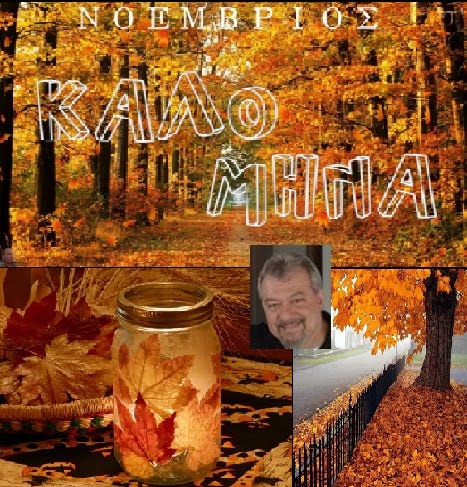
Καλό Νοέμβριο μήνα.

ΚΑΛΟ ΜΗΝΑ ΦΙΛΟΙ ΜΟΥ

Ας απολαύσουμε τις μυρωδιές και τα χρώματα του Νοέμβρη

κι ας ελπίσουμε ότι θα μας γεμίσουν με όμορφα συναισθήματα και στιγμές χαράς
Ο Νοέμβριος είναι ο ενδέκατος μήνας του Γρηγοριανού ημερολογίου, he's got 30 ημέρες και ξεκινά κάθε χρόνο την ίδια ημέρα που αρχίζουν ο Φεβρουάριος και ο Μάρτιος (με εξαίρεση τα δίσεκτα έτη). Στο ρωμαϊκό ημερολόγιο ήταν ένατος στη σειρά όπως δηλώνει και τ΄ όνομά του (novem=εννέα) Οι Ρωμαίοι τον είχαν αφιερώσει στον Ποσειδώνα και γιόρταζαν τα Ποσειδώνια.
Για τους αρχαίους Έλληνες, ο Νοέμβριος ήταν ο 5ος μήνας του αττικού έτους και είχε το όνομα «Μαιμακτηρίων». Το όνομα αυτό προέρχεται από ένα από τα ονόματα του Θεού Δία που ονομαζόταν και «Μαιμάκτης», δηλαδή θυελλώδης. Ήταν ο θεός των καιρικών συνθηκών και οι θνητοί έκαναν γιορτή προς τιμήν του για να εξασφαλίσουν με προσευχές την ευμένειά του, ώστε να μην είναι ο καιρός απειλητικός και επικίνδυνος για τον άνθρωπο και οι άνεμοι να μην είναι ιδιαίτερα σφοδροί.
Το χαρακτηριστικό λουλούδι αυτού του μήνα είναι το χρυσάνθεμο και η τυχερή πέτρα το τοπάζι.
Η πιο σημαντική αγροτική εργασία του μήνα, όχι μόνο για τους Έλληνες αλλά για όλους τους λαούς της Μεσογείου, είναι το λιομάζωμα, το μάζεμα δηλαδή της ελιάς για την παραγωγή λαδιού. Αρχίζει τον Νοέμβριο και διαρκεί σε ορισμένα μέρη μέχρι και τρεις μήνες.
Στις γιορτές του μήνα περιλαμβάνονται η εορτή των Ταξιαρχών Αρχαγγέλων Μιχαήλ και Γαβριήλ, του Αγίου Φιλίππου, της Αγίας Αικατερίνης και του Αγίου Ανδρέα. Η μεγαλύτερη, Nevertheless, γιορτή του μήνα είναι τα Εισόδια της Θεοτόκου στις 21 November.
Ο Αρχάγγελος Μιχαήλ θεωρείται ως «ο κατεξοχήν ψυχοπομπός άγγελος» και για το λόγο αυτό σε ορισμένες περιοχές, την παραμονή της εορτής του, έφερναν τα παπούτσια τους μέσα στο σπίτι για να μην τα δει ο Αρχάγγελος κι έλθει να τους πάρει πριν την ώρα τους.
Από την αρχαιότητα διάφορα ιδιαίτερα εμφανή ουράνια αντικείμενα προειδοποιούσαν τους ανθρώπους σαν σημάδια των αλλαγών του καιρού. Το πιο γνωστό παράδειγμα είναι το ανοιχτό αστρικό σμήνος των Πλειάδων, γνωστότερο ως Πούλια. Από την εποχή του Ησίοδου η δύση των Πλειάδων αμέσως μετά την δύση του Ήλιου, που συμβαίνει στα μέσα Νοεμβρίου, σημάδευε και σημαδεύει την περίοδο της έλευσης του κρύου και προειδοποιούσε τους γεωργούς να ολοκληρώσουν τη σπορά.
Η βροχή των Λεοντιδών, θεαματικό ουράνιο φαινόμενο, συμβαίνει κάθε χρόνο γύρω στις 17 November. Η γη μας, στη διάρκεια της περιφοράς της γύρω από τον ήλιο, συναντά το σύννεφο των σωματιδίων του κομήτη Τεμπλ-Τατλ. Τα μικροσκοπικά σωματίδια βάρους γραμμαρίων χτυπάνε την ατμόσφαιρα της γης, αναφλέγονται και σχηματίζουν μία φωτεινή σφαίρα 2 to 3 μέτρων που κινείται με ταχύτητα 30 to 60 χιλιομέτρων (γνωστή κι ως πεφταστέρι).


—