Category Archives: Book

To save the good book, its price must be reduced

Eleven bibliophile blogs in joint letter to publishers asking them to reduce book prices. They recognize , of course, that lately most publishers have reduced the prices of older books by making very tempting offers.

But the problem of modern books remains, whose price ranges between 15-20 euro, which in the days of crisis they consider to be prohibitive.
In addition, these bibliophile bloggers point out that publishers are in danger of falling into the "publish what sells" logic, which in the long run will destroy literature.

The signatories of the letter point out that they understand "the various difficulties, from obligations to employees, the cost of paper, rights burdens, of translations and so on within the particularities of the Greek market with its linguistic limitations and the small population" , but they emphasize that "again the book, precisely in the present crisis, we must spread it as a good and not as a luxury of the few".

They therefore suggest to the publishers to take "a courageous step: reduction in the price of new securities, so as not to stop the creative expression of all of them, among whom, always, there are talents that should not be wasted, because he will have qualified out of sheer necessity, the ephemeral and the salable".

The letter of the eleven blogs

“Ladies and gentlemen editors,

requested, both for you and for us bibliophile bloggers, is to increase readability in a Greece, who reads less and less.

The main problem in recent years is the crisis. An acute and multi-layered crisis. Your business has been invaded, but in a stratified manner it is now reflected in the largest part of Greek society and affects it, respectively proportionately and nevertheless dramatically, the lives of all of us. When unemployment and plummeting incomes have soared to their highest rates in decades, the main priority of course can only be the defense of Dignity in everyday life with all that it must include in conditions of Democracy: Health, Roof, Food, Education, Freedom.

For the bibliophiles of this country, which in the majority of them is not a privileged part, that lives outside of common economic reality, the book is a very important asset included in the above, which cannot and should not be included in their list, which will be reduced or cut completely, because precision often makes it unapproachable.

If with the offers, the bazaars, turning to the old titles and going back to the libraries seems like a good solution, what will happen with the new titles?;

They will concern fewer and fewer; And if this is consolidated as a forced condition in the crisis, we will go from publishing flood to publishing ebb, whose required characteristics will be described with the phrase we issue the,what can be depreciated;

Objections to the price of the book had been heard in the past, both by readers and by experts in the field, journalists and critics. When an average book costs €15-20, most people will prefer to watch a movie at the cinema, which costs much less than €10 or the same money to spend on another kind (entertaining) outlet.

The same is unfortunately true for the e-book. Where the price should be much lower, since the issuance costs are lower, slight differences are observed compared to the printed book. The reader would be logical, which has the corresponding device, to be motivated to buy intangibles, while he who has not, to find motivation to follow the development.
 Before we get to the sad and fundamentally anti-civilization point, that is, to completely annihilate the number of readers, let you try, the publishing houses, as this obligation primarily falls to you, a brave step: reduction in the price of new securities, so as not to stop the creative expression of all of them, among whom, always, there are talents that should not be wasted, because he will have qualified out of sheer necessity, the ephemeral and the salable.

 The book, today, it is expensive and prevents its purchase. This is the reality, which however, you, you can change.

 As readers, bloggers and citizens, we ask you for the biggest possible reduction and, if you do, us first, we will support her.

We understand the various difficulties, from your obligations to employees, the cost of paper, rights burdens, of translations and so on within the particularities of the Greek market with its linguistic limitations and the small population, but then again the book, precisely in the present crisis, we must spread it as a good and not as a luxury of the few.

Our blogs, always welcoming and without any kind of exchange, we worked and we are working, of course, as… book advertisers! Especially those that transcend the ephemeral…

 We can continue serving Literature together with you (and any other kind of reason) και συμβάλλοντας στην επιβίωσή της, αν κι εσείς θελήσετε να προχωρήσετε σ’ αυτό, που επιτακτικά πλέον σας ζητάμε: χαμηλές τιμές σε όλα και ειδικότερα στα καινούργια βιβλία, without changing their aesthetics and quality.

Sincerely

bookworm,  Book cafe, Reading, Vaults, Anagnostria, Thalis' blog, Read-for-a-Life, Desperado, Kangaroo, Degas Reading Club, Spring Agreement".

Source : tovima.gr

BOOK : “The dangers of borrowing”,Plutarch

It is indeed wise to read "The Perils of Lending" today, work of Plutarch's mature period. This is a speech written earlier on 92 A.D. and was probably pronounced in Athens and other Greek cities in order to warn about the consequences of overindebtedness to foreigners mainly, Italians in the majority of lenders, at that time.
It is worth highlighting some quotes that are more relevant than ever in our day, to realize that mindless borrowing is a curse and brings peoples to despair and to the brink of destruction. Something our ancient ancestors knew years ago.
"Plato in the Laws forbids taking water from one's neighbor's land unless one has first failed to find water on one's own land, having dug until he encountered the so-called ceramitis, i.e. layer of clay, however, it mandates that those who cannot have their own share their neighbors' water, as the law requires, in distress, to provide assistance. So there shouldn't be a law for money either, which forbids men to borrow from others and resort to foreign sources, if they do not first examine their own fortune and their own capabilities, and do not single out and gather, drop, drop, that is useful and necessary for them;»
"For the lenders we can say: There is interest before interest, and there is another interest….Mostly, however, they lie, and even fraudulently, lenders in their accounts, when they write that they give so and so the debt amount, while they give him less, and the cause of their lies is greed, not the need nor the hardship, but greed, which at the end, while destroying their victims, to them it brings neither pleasure nor benefit".
“So are you, in poverty, which brings many evils with it, don't add the hassles of borrowing and debt, but also do not deprive her of the only thing in which she excels in wealth, carelessness. Because then the ridiculous situation of the proverb arises:
I can't carry the goat, load the ox on my shoulders".
"The perils of borrowing" (About the don't see borrowing), Plutarch. Nefeli Publications. October 2011.
Source : protagon.gr

BOOK : "The perils of borrowing",Plutarch

It is indeed wise to read "The Perils of Lending" today, work of Plutarch's mature period. This is a speech written earlier on 92 A.D. and was probably pronounced in Athens and other Greek cities in order to warn about the consequences of overindebtedness to foreigners mainly, Italians in the majority of lenders, at that time.
It is worth highlighting some quotes that are more relevant than ever in our day, to realize that mindless borrowing is a curse and brings peoples to despair and to the brink of destruction. Something our ancient ancestors knew years ago.
"Plato in the Laws forbids taking water from one's neighbor's land unless one has first failed to find water on one's own land, having dug until he encountered the so-called ceramitis, i.e. layer of clay, however, it mandates that those who cannot have their own share their neighbors' water, as the law requires, in distress, to provide assistance. So there shouldn't be a law for money either, which forbids men to borrow from others and resort to foreign sources, if they do not first examine their own fortune and their own capabilities, and do not single out and gather, drop, drop, that is useful and necessary for them;»
"For the lenders we can say: There is interest before interest, and there is another interest….Mostly, however, they lie, and even fraudulently, lenders in their accounts, when they write that they give so and so the debt amount, while they give him less, and the cause of their lies is greed, not the need nor the hardship, but greed, which at the end, while destroying their victims, to them it brings neither pleasure nor benefit".
“So are you, in poverty, which brings many evils with it, don't add the hassles of borrowing and debt, but also do not deprive her of the only thing in which she excels in wealth, carelessness. Because then the ridiculous situation of the proverb arises:
I can't carry the goat, load the ox on my shoulders".
"The perils of borrowing" (About the don't see borrowing), Plutarch. Nefeli Publications. October 2011.
Source : protagon.gr

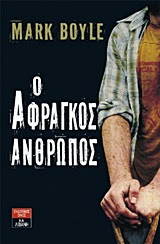
BOOK: The African Man

How relatives and friends react; What are you eating; Where do you live ; How is your social and personal life affected? ; How do you wash? ; Mark Boyle discovers the answers the hard way and in the process explores the serious effects that our obsession with money has. Describing cuttlefish toothpastes, seasonal foods, skill exchange initiatives and composting toilets, travels to Ireland without a penny in his pocket and is faced with the most unthinkable situation : Christmas without cash. Following his own strict rules, Mark goes back to the basics and discovers original ways to clear accounts and prosper for free.

Smart, touching, diffuse from money and energy saving tips and maybe up to date, The book The African Man will make you wonder what really has value in life.

BOOK: The African Man

How relatives and friends react; What are you eating; Where do you live ; How is your social and personal life affected? ; How do you wash? ; Mark Boyle discovers the answers the hard way and in the process explores the serious effects that our obsession with money has. Describing cuttlefish toothpastes, seasonal foods, skill exchange initiatives and composting toilets, travels to Ireland without a penny in his pocket and is faced with the most unthinkable situation : Christmas without cash. Following his own strict rules, Mark goes back to the basics and discovers original ways to clear accounts and prosper for free. Smart, touching, diffuse from money and energy saving tips and maybe up to date, The book The African Man will make you wonder what really has value in life.