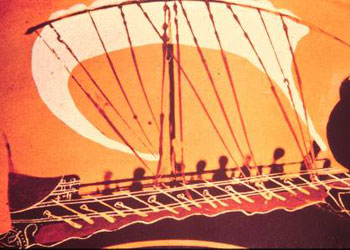
Scientific research indicates the presence of Greeks in B. America in antiquity

An article with a "guide" to the texts of Plutarch, dedicated to the global movement "We are all Greeks". of Δρ.Μηνά Τσικριτσή Ερευνητή Αιγαιακών Γραφών υποδεικνύει παρουσία Ελλήνων στη Β. America.

Αφιερωμένη στην παγκόσμια κίνηση στήριξης της Ελλάδας «Είμαστε όλοι Έλληνες», is the new research of the Aegean scriptures researcher dr. Mina Tsikritsi, which proves with the use of new technologies that the prehistoric Greeks had visited North America long before Christopher Columbus discovered it.

The research of Mr. Tsikritsis based on Plutarch's text "On the apparent face of the Moon's circle", where in paragraphs 941A-942, describes the journey of the Greeks to a continent which was "west of the three islands and north-west of Britain".

The researcher identified and demonstrated through computer programs the restoration of a forgotten historical reality, which has so far eluded many researchers, thus continuing the research done two years ago by Professor H. Mariolakos, who had argued that the prehistoric Greeks knew of the existence of America, which they were visiting.

In his announcement Dr. M. Chipping is supported, that before Columbus there was a communication starting from the Minoan era until the Hellenistic years. The purpose of these Bronze Age voyages was to trade and traffic the pure copper found in Canada's Lake Superior. It seems that after the first Minoan traders, the Mycenaeans also continued, who, as Plutarch mentions, they sent Hercules to rekindle the presence of the Greek element, which had been lost with the intermingling of the natives. Subsequently, in the Iron Age, interest in the area declined and remained until the Hellenistic times a ceremonial cult tradition. So every thirty years some ships are sent to regions that had the worship of Saturn to renew the human staff with priests.

As Mr. Tsikritsis "all this is proven by astronomical evidence, which were processed with the help of computer programs confirming the chronological determination of the journey described by Plutarch.

That's how it's explained, according to Mr. Tsikritsi, and that in the region around Lake Superior and on the Isle of Royale in Canada great copper mining has been done at one period, between 2400 and 1200 B.C, even though the area was in the stone age.

According to the ancient text of Plutarch the moderator of the dialogue, Lambrias invites Sulla the Carthaginian to retell a story he heard from the servants of the temple of Saturn in Carthage, The story told by a foreign visitor to the temple who came from the great continent. Finally, the data mentioned in the text confirm, as shown by the study of Mr. Tsikritsi, using a PC, the description of a journey the 86 AD held by Canada in Carthage. The conclusions are summarized below:

1. The apocalyptic text correctly specifies the distance from Britain to the island of Ogygia- Iceland, with oar boat sailing 5 days (880 km).

2. It mentions a large continental land in whose area there were three islands (Greenland, Baffin Island, Newfoundland) which were equal, northwest of Britain.

3. Determines that at the same latitude (in the same straight line) is the entrance to the Gulf of Saint Lawrence(Gulf of St. Laurence) with the Caspian Sea, a fact that we observe in its straight line.

4. He correctly identifies that the gulf of Ag. Lavrentiou is a little bigger than Maiotida lake, today's Azov. On the shores of the gulf he mentions that Greeks have lived since ancient times and after the expedition of the Mycenaean Heracles, probably in the 15th century BC, the Greek element that was dying out due to the intermingling with the locals was re-warmed (it is understood that Heracles did not go alone with Iolaus, but it was a campaign of hundreds of Greeks who demographically changed the area inside the bay of Ag. Lavrentiou where they lived).

5. It defines a period of thirty years, after which the return journey would begin: when the Planet Saturn rises in the constellation Taurus. Astronomical data confirms that at latitude 47° north, in the 1st century AD, this period was at the end of May 86 A.D.

6. When he started the return journey they stayed for three months on the island of Greenland to the north (60the N), which the sun only sets for an hour during the summer solstice between 9/6 and 9/7. This designation confirms that the island of Greenland must be identified with the underworld, where Saturn was buried in a cave and was guarded by Zeus.

7. The reason for the great journeys in the Bronze Age is documented by pure copper, which was found in large quantities in the area around Lake Superior and on Isle Royale in Canada. They were mined from this area 50.000 tons of copper between 2400 and 1200 B.C.

8. In the time of Plutarch he himself mentions, that they did not carry copper but golden cups and vessels containing the provisions of the journey.

9. Finally, it is known that in ancient times oracles were centers for recording geographical knowledge, thereby advising on future colonizations. Thus it is accepted that Plutarch after the 86 AD who was a priest at the Oracle of Delphi, has this knowledge.

10. The return journey seems to have been from the north, starting in Canada, they were going to Greenland (Saturn island) they came to Iceland and from there to Britain. Confirmation element of this route is the station island, which even today bears the name of Mycenae (Mykines) the westernmost island of the Faeroe

In conclusion, the research of Minas Tsikritsis is that a trip took place from Canada to Carthage in May 86 A.D. In combination with the other elements confirmed by Y/N, the other descriptions of Plutarch are also accepted, that is, in the ancient years before the campaign of Herakles, ancient Greeks had also gone to the area, probably the Minoans. These elements come and confirm archaeological scattered finds of writing – and not only – from areas in the Americas. Finally before Columbus, the Chinese and Vikings had gone to America and Greeks at least in the 1st century BC and possibly as early as the 2nd millennium BC.

Source : kathimerini.gr

Scientific research indicates the presence of Greeks in B. America in antiquity

An article with a "guide" to the texts of Plutarch, dedicated to the global movement "We are all Greeks". of Dr. Minas Tsikritsi Researcher of Aegean Scriptures indicates the presence of Greeks in B. America.

Dedicated to the global support movement for Greece "We are all Greeks", is the new research of the Aegean scriptures researcher dr. Mina Tsikritsi, which proves with the use of new technologies that the prehistoric Greeks had visited North America long before Christopher Columbus discovered it.

The research of Mr. Tsikritsis based on Plutarch's text "On the apparent face of the Moon's circle", where in paragraphs 941A-942, describes the journey of the Greeks to a continent which was "west of the three islands and north-west of Britain".

The researcher identified and demonstrated through computer programs the restoration of a forgotten historical reality, which has so far eluded many researchers, thus continuing the research done two years ago by Professor H. Mariolakos, who had argued that the prehistoric Greeks knew of the existence of America, which they were visiting.

In his announcement Dr. M. Chipping is supported, that before Columbus there was a communication starting from the Minoan era until the Hellenistic years. The purpose of these Bronze Age voyages was to trade and traffic the pure copper found in Canada's Lake Superior. It seems that after the first Minoan traders, the Mycenaeans also continued, who, as Plutarch mentions, they sent Hercules to rekindle the presence of the Greek element, which had been lost with the intermingling of the natives. Subsequently, in the Iron Age, interest in the area declined and remained until the Hellenistic times a ceremonial cult tradition. So every thirty years some ships are sent to regions that had the worship of Saturn to renew the human staff with priests.

As Mr. Tsikritsis "all this is proven by astronomical evidence, which were processed with the help of computer programs confirming the chronological determination of the journey described by Plutarch.

That's how it's explained, according to Mr. Tsikritsi, and that in the region around Lake Superior and on the Isle of Royale in Canada great copper mining has been done at one period, between 2400 and 1200 B.C, even though the area was in the stone age.

According to the ancient text of Plutarch the moderator of the dialogue, Lambrias invites Sulla the Carthaginian to retell a story he heard from the servants of the temple of Saturn in Carthage, The story told by a foreign visitor to the temple who came from the great continent. Finally, the data mentioned in the text confirm, as shown by the study of Mr. Tsikritsi, using a PC, the description of a journey the 86 AD held by Canada in Carthage. The conclusions are summarized below:

1. The apocalyptic text correctly specifies the distance from Britain to the island of Ogygia- Iceland, with oar boat sailing 5 days (880 km).

2. It mentions a large continental land in whose area there were three islands (Greenland, Baffin Island, Newfoundland) which were equal, northwest of Britain.

3. Determines that at the same latitude (in the same straight line) is the entrance to the Gulf of Saint Lawrence(Gulf of St. Laurence) with the Caspian Sea, a fact that we observe in its straight line.

4. He correctly identifies that the gulf of Ag. Lavrentiou is a little bigger than Maiotida lake, today's Azov. On the shores of the gulf he mentions that Greeks have lived since ancient times and after the expedition of the Mycenaean Heracles, probably in the 15th century BC, the Greek element that was dying out due to the intermingling with the locals was re-warmed (it is understood that Heracles did not go alone with Iolaus, but it was a campaign of hundreds of Greeks who demographically changed the area inside the bay of Ag. Lavrentiou where they lived).

5. It defines a period of thirty years, after which the return journey would begin: when the Planet Saturn rises in the constellation Taurus. Astronomical data confirms that at latitude 47° north, in the 1st century AD, this period was at the end of May 86 A.D.

6. When he started the return journey they stayed for three months on the island of Greenland to the north (60the N), which the sun only sets for an hour during the summer solstice between 9/6 and 9/7. This designation confirms that the island of Greenland must be identified with the underworld, where Saturn was buried in a cave and was guarded by Zeus.

7. The reason for the great journeys in the Bronze Age is documented by pure copper, which was found in large quantities in the area around Lake Superior and on Isle Royale in Canada. They were mined from this area 50.000 tons of copper between 2400 and 1200 B.C.

8. In the time of Plutarch he himself mentions, that they did not carry copper but golden cups and vessels containing the provisions of the journey.

9. Finally, it is known that in ancient times oracles were centers for recording geographical knowledge, thereby advising on future colonizations. Thus it is accepted that Plutarch after the 86 AD who was a priest at the Oracle of Delphi, has this knowledge.

10. The return journey seems to have been from the north, starting in Canada, they were going to Greenland (Saturn island) they came to Iceland and from there to Britain. Confirmation element of this route is the station island, which even today bears the name of Mycenae (Mykines) the westernmost island of the Faeroe

In conclusion, the research of Minas Tsikritsis is that a trip took place from Canada to Carthage in May 86 A.D. In combination with the other elements confirmed by Y/N, the other descriptions of Plutarch are also accepted, that is, in the ancient years before the campaign of Herakles, ancient Greeks had also gone to the area, probably the Minoans. These elements come and confirm archaeological scattered finds of writing – and not only – from areas in the Americas. Finally before Columbus, the Chinese and Vikings had gone to America and Greeks at least in the 1st century BC and possibly as early as the 2nd millennium BC.

Source : kathimerini.gr

Nikos Hatzinikolaou : The shocking confession to Petros Kostopoulos

THE Nikos Hatzinikolaou spoke to Petros Kostopoulos, guest on "Friday Night" about his relationship with television, for his wife and the child they are expecting, but also for the great health adventure he went through.

"I don't miss television at all. People don't believe it, you don't believe it either. You are making a very big mistake. In the first interview I gave - it's been many years, 21-22 since- I said that I consider television a parenthesis in my journalistic journey. I have to tell you that I never fell in love with television. I served her with professional conscientiousness but the madness I have for the newspaper and the love I have for the radio, I never had them for TV. This is the truth!» declared the famous anchorman, while he emphasized: “I have to tell you, on the contrary, how there are many moments when I feel like maybe God took pity on me and left me out of the news these days. I tell you this with complete honesty because I believe that in this period of deep crisis, television has so far not lived up to the expectations of our fellow citizens, of viewers and, in this sense, I don't mind being absent".

At the same time, he revealed that on the night of the elections, he will have television coverage: "On election night I will be at a television station. I have an invitation from Elli Stai to co-present with her the night of the elections on state television, if ALTER has not been opened or ALTER has not been closed – because if ALTER is closed I will find another TV station, that's what I've said. I am waiting for the processes to complete and attempts to open ALTER. If it doesn't open, I will not sit on my eggs", while for the reasons he is waiting for the developments of the channel he added: "I have my reasons. The main reason is that on this channel I felt the greatest journalistic freedom of late 28 – 29 years that I have been in the profession and I think this is a very important reason. I never had any interference or meddling.".


Source : yupi.gr

Sakis Rouvas: The big premiere in Thessaloniki

Friday night, The Sakis Rouvas and the Onirama welcomed the public of Thessaloniki at «Politia live clubbing», in a truly glamorous premiere.

The stage of the nightclub was transformed to host a dynamic live show and so did Onirama, as well as the leading Greek star gave their best, exciting the audience. Also present at the premiere was Yiannis Latsios, but also the wife of Thodoris Marantini, Sissy Christidou.

Source : yupi.gr

In 1 time the crossover Fiat 500X

Rumors of creating a special crossover version of Fiat 500 are confirmed. The car will be named 500X and will start production next year.

The big plans of the Fiat group for the 500 it seems that they are gradually being implemented. After the 5-door 500L that was officially presented a few days ago at the Geneva Motor Show, the mini model of the Italian brand is preparing to acquire a crossover "brother".

This will be done in the coming months with a model called the 500X based on the platform of the 5-door 500L. According to information, its production will begin within 2013 and it is estimated that it might replace the Sedici in the Fiat range. Its total length is estimated to be close to 4,2 meters, while with the "background" of Fiat's collaboration with the Chrysler group, it is not excluded that this new model will also use technology from Jeep's off-road cars.

Source : autotriti.gr

WRC Portugal – Hirvonen wins with Citroen

The Portugal Rally developed very positively for Citroen and the Mikko Hirvonen, since after an excellent performance the Finn took the 1st place on the podium.
The Portugal Rally left a particularly pleasant taste for the friends and people of Citroen, after the driver Mikko Hirvonen with co-driver Jarmo Lehtinen won the 1st place of this difficult and quite tough race. This is his 15th victory in the World Rally Championship (WRC) for the Finn who is now 9 points ahead of team-mate Sebastien Loeb in the driver's championship race. Hirvonen took the lead as early as Friday's 2nd special stage and held it until the end of the race.
"He is particularly satisfied and relieved because this was a very difficult rally" said the experienced driver referring also to the heavy rain on Sunday and the last day of the race which made life very difficult for the participants.

In second place overall and by a margin 1:51,8 from Hirvonen we meet M. Ostberg in the Adapta World Rally Team's Fiesta RS WRC who overcame a technical problem with a cylinder in his engine to then drive exemplary. 3rd place goes to the very ambitious 21-year-old E.Novikov who took full advantage of the Ford Fiesta RS WRC he drives to see his name in the honors of a WRC race for the first time.

Continuation in the World Rally Championship (WRC) will be given to 27 April in Argentina.

Source : autotriti.gr

our breath, Your review