Riding a foreign or new motorcycle

In several cases you may have the opportunity (or be forced) ride a foreign or new motorcycle. In this case, you need to exercise increased vigilance and caution.

The most basic thing to try from the very first steps, it's the brakes. Play with the levers a bit and compare: are stronger than yours, they are softer to the touch; The conclusions will be life saving when you need to brake.

There are plenty of times when you have the opportunity or are forced to drive something else: when you go for a ride with a friend and switch bikes halfway through, when driving a rental car, when you test ride but also when you buy a new model or leave yours for service and get a replacement from the workshop.

The care you have to show in these cases is great. The new or foreign model has its own quirks and should not be treated with the logic that “nothing is wrong, I have been riding motorcycles for many years". Each model is unique and should be treated as such.

So read the main points that you should pay attention to when riding an unfamiliar motorcycle.

1. The first thing you must do when you get in the saddle, is to adjust the mirrors to your measurements.

2. Press both feet firmly on the ground and rock the motorcycle left and right, to calculate its weight. Especially if it is a heavier model than yours, repeat the process until you get used to it.

3. Getting started, pay attention to the clutch. It's definitely not set to the same standards as yours. Start slowly keeping in mind the disengagement point, so you can change relationship faster.

4. In the event that the model you own has ABS and the one you are driving for the first time does not, brake hard sometimes, so you get used to the fact that at the end of the lever travel, the brakes may lock.

5. If you are making the transition from a small displacement bike to a large one, don't force it until you get used to it. Even if you've been driving an R1 for the last few years, forced to duck ride for a few days and back to R1 again, a short adjustment period is necessary before you "drink" his blood again.

6. If the motorcycle you are going to ride has electronic systems that can be adjusted on the fly (B.C. ignition maps, electronically adjustable suspensions, etc.), spend a few minutes on them before you start, so they don't distract you while driving.

7. In case you change from a scooter to a motorcycle or vice versa, we never forget the following: scooters rely more on the rear brake, while the motorcycles in the front.

8. Always bear in mind that in many cases the new or foreign model you will be called upon to drive, it won't react the same way yours does. Don't forget that you're not driving the model you're used to, and you probably know it inside out, but a foreign and unpredictable one.

Source : mototriti.gr

Greece is on everyone's mind

The Greek crisis monopolized the interest at the 62nd Berlinale

"Congratulations, Gentleman" ("Congratulations, Sir"). Monday noon on the fourth floor of the "heart" of the Festival, in the Berlinale Palast hall. Vittorio Taviani takes out his briefcase and says the above words to me as he shakes my hand tightly as he bids me farewell. Our interview with his brother Paolo has preceded.
The inseparable duo of veteran Italian creators ("Father Master", "Chaos", "Alonzanfan") was in Berlin for the presentation and promotion of the movie "Caesar Must Die". But when they heard that someone from the small group of journalists in front of them was Greek, showed undivided interest. «The Greece, the Greece…Vittorio murmured plaintively.

It had only been a few hours before the night Athens turned into hell. The nightmarish images had been beamed across the planet and the Taviani were aware, like everyone else. "A lot of bad things in Greece at this time" Paolo Taviani told me. “I still mourn the good man, my very good friend, this great director and man, Theodoros Angelopoulos. And now this disaster… In Italy we are afraid. We are afraid of what we see happening in Greece and what we cannot predict will happen. Maybe I'm naive, but I still believe in Europe, in the European Union and in the capacity of this institution, through capital and banks, to solve the problem of debt and the financial crisis".

"Spain's position is worse"
This year in Berlin, every time you said you were from Greece, the looks were changing. Others joked (black), others assumed a mournful tone, others were surprised to see me there, while some were of the opinion that Greece was the easy target, the weak link, the scapegoat of the European Union.
Talking to Spanish actor Juan Diego Boto, who played the inquisitor in "El Greco" by Yiannis Smaragdis (and whom we will see in the latter's next film "And God Loves Caviar"), I was surprised by the severe criticism he leveled at his own country: “Our position is worse than yours, because today in Spain the opinion of the people does not count at all" said Boto, giving as an example the demand of the European Union that his country include in its Constitution the control of its deficit.
"The Constitution of Spain prohibits changes unless voted by the people. So what they did was to change the Constitution so that the people didn't have to be asked. They changed the Constitution so they could… to change the Constitution. After that I stopped believing in a cheating system".

"The only solution, let the streets burn"
"My opinion is that the collapse of the communist system can only lead to the collapse of the capitalist one," German director Christian Petschold told me., who was also competing with the film 'Barbara', the story of an East German doctor (Nina Hoss) who is determined to escape to the West. "The only real chance for things to change and for the rotten system to die that is not only suffering Greece but the whole world is in the lower layers, to the people themselves. But this will be a very bloody business and people are afraid of it, as I fear her too".

Petschold, however, is in favor of extreme demonstrations in Greece. "The roads must be burned, this is your only chance" he said referring to last Sunday's events. "You saw how the Socialist Party of Germany reacted; It is against the oppression that Greece receives. We Germans must show solidarity towards the Greeks. The workers must stand with the workers. This is not a war of states but a sign of solidarity among the workers of all peoples".

"Despair is not an option"
The positive in all this ominous situation is that a Greek-speaking film represented our country in the official competition program of the 62nd Berlin Film Festival. "Meteora" by Spyros Stathoulopoulos, co-production of Greece / Germany, they refer to the love of a monk and a nun of Meteora (Theo Alexander – Tamila Kulieva). "Everyone has their own opinion on the crisis," the young director told reporters. "I can only be objective when I see and hear everything,what is going on inside my own house. The strict austerity measures have affected everyone in Greece, a fact I experienced seeing my grandmother's pension halved. For’ that's why I decided to give her a role in my film" he concluded, causing a lot of laughter in the room. Referring to the unpleasant phase that Greece is going through, Theo Alexander in the same interview said the most hopeful thing. The actor, who is currently making a good career in America (plays one of the vampires in the hit TV series 'True blood'), found a way to combine film with reality: "I think that in their hearts the “Meteora” they say that in the dark times we live in these times, despair is not an option. We are lucky to be among the living. And as the living we have a duty not to give up and to fight".

Source : tovima.gr

Last bow to Whitney Houston

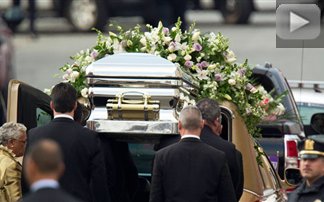
Presence of relatives, her friends and colleagues, and to the sounds of gospel music, Whitney Houston's funeral was held in Newark on Saturday, at the church he attended as a child.

"We love you Whitney Houston" declared the mayor of the area, Cory Booker, in front of the flower-covered coffin. The famous singer breathed her last last Saturday, in age 48 years.

Her ex-husband, Bobby Brown, her daughter and her mother Kissi Houston invited approx 1.500 people at New Hope Church in Newark, New Jersey.

Stevie Wonder and Alicia Keys among them, who sang in memory of Houston. Aretha Franklin was also invited, but she stated that she was very ill, to attend.

Also present was the Reverend Jesse Jackson, Dionne Gorwick, cousin of Houston and actor Kevin Costner, with whom they co-starred in "The Bodyguard", an important moment for the careers of both.

Elton John was also invited, Beyoncé and her husband, famous rapper Jay-Z, as well as Oprah Winfrey. A large gospel choir was also found in the temple, dressed in white.

The funeral was widely covered by the American media, but also the BBC, who broadcast it directly.

Source : protothema.gr

The Bronzes of Goumenissa at the Mylos Club in Thessaloniki

The BRONZES OF GOUMENISSA by Alexandros Zora for a unique appearance at the Mylos club on
Monday 20 February 2012.

Brass sounds, intensity, explosive rhythm is some of the elements of a brass band. Sounds, tension and rhythms that accompany and co-exist daily with life, the feasts, the tradition of central-western Macedonia.

Clarina, trumpets, trombones and tambourines are some of the instruments that make up this unique timbre, as it was shaped and developed from the beginning of the century in Macedonia, but especially in the city of Goumenissa, birthplace of hundreds of folk organists today.

The “Bronze of Goumenissa by Alexandros Zora” is the most famous band in the region with the passion and talent of the musicians that make it up, is a genuine and important exponent of the musical tradition of central-western Macedonia.

Alexander (Aleck) Zoras, born in 1966 in Goumenissa of Kilkis. He is a descendant of a large musical family of the region.

He started from a very young age with music accompanying his father Vozikis (Manoli) at various events such as weddings and festivals, where he took his first clarinet lessons.

His father is one of the old Goumenissa organists who switched from the zourna to the clarinet. Today he mainly plays the tambourine.

Alexandros Zoras teaches traditional clarinet in various schools and clubs. In addition to the clarinet, he also plays the accordion and various percussion instruments.

The emergence of brass instruments and their inclusion in traditional folk orchestras, both in the region of Central Western Macedonia and the wider Balkan area, set in the early 20th century. It is likely that it arose from the dissolution of the Turkish musical sections during the liberation of Macedonia in 1912. With their special color and explosive sound, they slowly displaced older instruments such as the zournas, the bagpipe, the flugeres and the horses and were established in the region.

In the area of ​​Goumenissa, although they were used later than in Western Macedonia, a larger tradition was created. A tradition passed down from generation to generation.

The city is the birthplace of hundreds of musicians and folk instrumentalists, various instruments such as clarinet, trumpets, trombones, euphony, saxophones drums, drums and gran casa. All of them form the core of various musical groups in various cultural events such as weddings, festivals etc.

The name Halkina of Goumenissa was first given to the band of Alexandros Zoras in a collaboration with Dimitra Galani in the middle of the decade 1990. Since then the band has established itself taking part in concerts with many well-known artists such as Manolis Mitsias, at musical events, in international and domestic festivals with dance groups.

The Bronzes of Alexandros Zoras with the Zoras family as the main core and in collaboration with various other musicians, they have appeared in important venues such as the Herodeion and the Concert Hall.

To 2004 the band of Alexandros Zora was nominated for the Arion music awards in the category of traditional music. They have recorded many productions and appeared on many television and radio shows.

 Source : culturenow.gr

Greece is on everyone's mind

The Greek crisis monopolized the interest at the 62nd Berlinale

"Congratulations, Gentleman" ("Congratulations, Sir"). Monday noon on the fourth floor of the "heart" of the Festival, in the Berlinale Palast hall. Vittorio Taviani takes out his briefcase and says the above words to me as he shakes my hand tightly as he bids me farewell. Our interview with his brother Paolo has preceded.
The inseparable duo of veteran Italian creators ("Father Master", "Chaos", "Alonzanfan") was in Berlin for the presentation and promotion of the movie "Caesar Must Die". But when they heard that someone from the small group of journalists in front of them was Greek, showed undivided interest. «The Greece, the Greece…Vittorio murmured plaintively.

It had only been a few hours before the night Athens turned into hell. The nightmarish images had been beamed across the planet and the Taviani were aware, like everyone else. "A lot of bad things in Greece at this time" Paolo Taviani told me. “I still mourn the good man, my very good friend, this great director and man, Theodoros Angelopoulos. And now this disaster… In Italy we are afraid. We are afraid of what we see happening in Greece and what we cannot predict will happen. Maybe I'm naive, but I still believe in Europe, in the European Union and in the capacity of this institution, through capital and banks, to solve the problem of debt and the financial crisis".

"Spain's position is worse"
This year in Berlin, every time you said you were from Greece, the looks were changing. Others joked (black), others assumed a mournful tone, others were surprised to see me there, while some were of the opinion that Greece was the easy target, the weak link, the scapegoat of the European Union.
Talking to Spanish actor Juan Diego Boto, who played the inquisitor in "El Greco" by Yiannis Smaragdis (and whom we will see in the latter's next film "And God Loves Caviar"), I was surprised by the severe criticism he leveled at his own country: “Our position is worse than yours, because today in Spain the opinion of the people does not count at all" said Boto, giving as an example the demand of the European Union that his country include in its Constitution the control of its deficit.
"The Constitution of Spain prohibits changes unless voted by the people. So what they did was to change the Constitution so that the people didn't have to be asked. They changed the Constitution so they could… to change the Constitution. After that I stopped believing in a cheating system".

"The only solution, let the streets burn"
"My opinion is that the collapse of the communist system can only lead to the collapse of the capitalist one," German director Christian Petschold told me., who was also competing with the film 'Barbara', the story of an East German doctor (Nina Hoss) who is determined to escape to the West. "The only real chance for things to change and for the rotten system to die that is not only suffering Greece but the whole world is in the lower layers, to the people themselves. But this will be a very bloody business and people are afraid of it, as I fear her too".

Petschold, however, is in favor of extreme demonstrations in Greece. "The roads must be burned, this is your only chance" he said referring to last Sunday's events. "You saw how the Socialist Party of Germany reacted; It is against the oppression that Greece receives. We Germans must show solidarity towards the Greeks. The workers must stand with the workers. This is not a war of states but a sign of solidarity among the workers of all peoples".

"Despair is not an option"
The positive in all this ominous situation is that a Greek-speaking film represented our country in the official competition program of the 62nd Berlin Film Festival. "Meteora" by Spyros Stathoulopoulos, co-production of Greece / Germany, they refer to the love of a monk and a nun of Meteora (Theo Alexander – Tamila Kulieva). "Everyone has their own opinion on the crisis," the young director told reporters. "I can only be objective when I see and hear everything,what is going on inside my own house. The strict austerity measures have affected everyone in Greece, a fact I experienced seeing my grandmother's pension halved. For’ that's why I decided to give her a role in my film" he concluded, causing a lot of laughter in the room. Referring to the unpleasant phase that Greece is going through, Theo Alexander in the same interview said the most hopeful thing. The actor, who is currently making a good career in America (plays one of the vampires in the hit TV series 'True blood'), found a way to combine film with reality: "I think that in their hearts the “Meteora” they say that in the dark times we live in these times, despair is not an option. We are lucky to be among the living. And as the living we have a duty not to give up and to fight".

Source : tovima.gr

Last bow to Whitney Houston

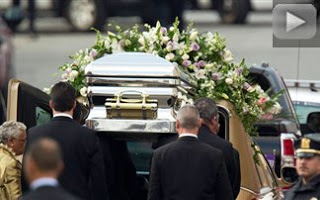
Presence of relatives, her friends and colleagues, and to the sounds of gospel music, Whitney Houston's funeral was held in Newark on Saturday, at the church he attended as a child.

"We love you Whitney Houston" declared the mayor of the area, Cory Booker, in front of the flower-covered coffin. The famous singer breathed her last last Saturday, in age 48 years.

Her ex-husband, Bobby Brown, her daughter and her mother Kissi Houston invited approx 1.500 people at New Hope Church in Newark, New Jersey.

Stevie Wonder and Alicia Keys among them, who sang in memory of Houston. Aretha Franklin was also invited, but she stated that she was very ill, to attend.

Also present was the Reverend Jesse Jackson, Dionne Gorwick, cousin of Houston and actor Kevin Costner, with whom they co-starred in "The Bodyguard", an important moment for the careers of both.

Elton John was also invited, Beyoncé and her husband, famous rapper Jay-Z, as well as Oprah Winfrey. A large gospel choir was also found in the temple, dressed in white.

The funeral was widely covered by the American media, but also the BBC, who broadcast it directly.

Source : protothema.gr

The Bronzes of Goumenissa at the Mylos Club in Thessaloniki

The BRONZES OF GOUMENISSA by Alexandros Zora for a unique appearance at the Mylos club on
Monday 20 February 2012.

Brass sounds, intensity, explosive rhythm is some of the elements of a brass band. Sounds, tension and rhythms that accompany and co-exist daily with life, the feasts, the tradition of central-western Macedonia.

Clarina, trumpets, trombones and tambourines are some of the instruments that make up this unique timbre, as it was shaped and developed from the beginning of the century in Macedonia, but especially in the city of Goumenissa, birthplace of hundreds of folk organists today.

The “Bronze of Goumenissa by Alexandros Zora” is the most famous band in the region with the passion and talent of the musicians that make it up, is a genuine and important exponent of the musical tradition of central-western Macedonia.

Alexander (Aleck) Zoras, born in 1966 in Goumenissa of Kilkis. He is a descendant of a large musical family of the region.

He started from a very young age with music accompanying his father Vozikis (Manoli) at various events such as weddings and festivals, where he took his first clarinet lessons.

His father is one of the old Goumenissa organists who switched from the zourna to the clarinet. Today he mainly plays the tambourine.

Alexandros Zoras teaches traditional clarinet in various schools and clubs. In addition to the clarinet, he also plays the accordion and various percussion instruments.

The emergence of brass instruments and their inclusion in traditional folk orchestras, both in the region of Central Western Macedonia and the wider Balkan area, set in the early 20th century. It is likely that it arose from the dissolution of the Turkish musical sections during the liberation of Macedonia in 1912. With their special color and explosive sound, they slowly displaced older instruments such as the zournas, the bagpipe, the flugeres and the horses and were established in the region.

In the area of ​​Goumenissa, although they were used later than in Western Macedonia, a larger tradition was created. A tradition passed down from generation to generation.

The city is the birthplace of hundreds of musicians and folk instrumentalists, various instruments such as clarinet, trumpets, trombones, euphony, saxophones drums, drums and gran casa. All of them form the core of various musical groups in various cultural events such as weddings, festivals etc.

The name Halkina of Goumenissa was first given to the band of Alexandros Zoras in a collaboration with Dimitra Galani in the middle of the decade 1990. Since then the band has established itself taking part in concerts with many well-known artists such as Manolis Mitsias, at musical events, in international and domestic festivals with dance groups.

The Bronzes of Alexandros Zoras with the Zoras family as the main core and in collaboration with various other musicians, they have appeared in important venues such as the Herodeion and the Concert Hall.

To 2004 the band of Alexandros Zora was nominated for the Arion music awards in the category of traditional music. They have recorded many productions and appeared on many television and radio shows.

 Source : culturenow.gr

our breath, Your review