

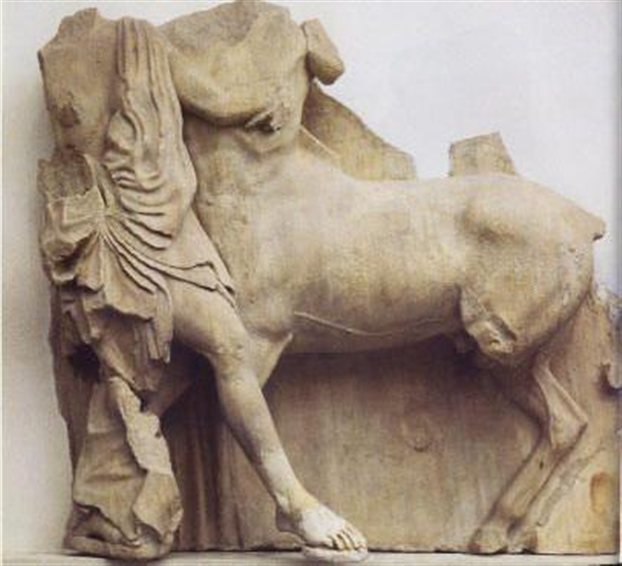
Discussion begins between the Acropolis Museum and the British Museum
"Stray" fragments of the Parthenon, from its sculptural decoration mainly, which are in the British Museum may return to Greece _if not in their entirety, but at least some of them _ as long as cooperation is achieved, which he proposed at the last UNESCO session last June, the Acropolis Museum.
The issue was raised for the first time and is of course independent of Greece's constant and ongoing request for the reunification of the Parthenon Sculptures. In this particular case, the president of the Acropolis Museum, professor Mr. Dimitris Pandermalis proposed the special request for a first reunification of "stray" fragments, which are in the British Museum with the sculptures exhibited in Athens.
In the intentions of the Acropolis Museum like this, is the invitation in the autumn of representatives of the British Museum, in order to see the exhibition of the Parthenon Sculptures together in order to form their own opinion about the possibility of re-positioning fragments found in the British Museum in the places from which they are missing. The main argument of the Greek side is, that the recovery of the overall image of a sculpture, even with the addition of a small broken marble is a matter, first of all, scientific ethics.
But what kind of fragments are these?; For example the back part of the upper torso of Poseidon from the west pediment of the Parthenon (the front part is exhibited in the Acropolis Museum).
Part of the leg of a Lapithidos being seized by a Centaur from the 12th south pediment of the temple (the composition is preserved almost entirely in the Acropolis Museum).
Part of the chest of a warrior depicted on the frieze, as well as other stray fragments of sculptured heads, hands or feet. Of course, there are also some very small fragments.
Of course, many discussions will need to be held in order to have a positive outcome, but the beginning was made and indeed with a positive sign.
In any case, the willingness of the British side to cooperate on such a delicate issue is highly welcomed. It is also noted that according to the standard practice applicable to the Intergovernmental Commission of UNESCO, the two sides negotiated on the sidelines of the Meeting a relevant "Recommendation" draft (Recommendation), which was unanimously adopted by the Commission.
In addition to this, the representative of the British Ministry of Culture Mrs. Bower positively assessed the Greek proposal for a 3D digital scan of the Parthenon frieze in terms of its parts that are in the British Museum. The digital scanning of the stones found in the Acropolis Museum is already being completed in the autumn - it started about a year ago - and at the end the digital composition of the entire frieze will be done in order to obtain "more accurate scientific knowledge", as Mrs. Bauer mentioned.
The same, however, in Greece's constant request for the return of the Sculptors, which was presented at the meeting by the general director of Antiquities and Cultural Heritage of the Ministry of Education and Culture Mrs. Maria Andreadaki – Vlazakis and professor Mr. Pandermali repeated the familiar arguments of the British side, that this matter falls under the exclusive supervision and management of the Board of Governors of the British Museum.
As for the fragments of the Acropolis, however, it should be noted that they have already started to be returned to Greece. We recall the marble part of the corner capital, which was in the possession of a Dutch privateer, who had taken it as a souvenir on a visit in his decade’ 50. Another large fragment from the north frieze of the Parthenon depicting a man's head and part of a boat supported by him, which was returned by the Vatican (it was in the Etruscan Museum of the Vatican).
One foot man, fragment of the north frieze returned by the University of Heidelberg. And even on loan from the Salina Museum of Palermo, Italy, found for a few months in the Acropolis Museum a fragment of the relief decoration of the Parthenon in which the extreme right leg and the fringes of the garment of the goddess Artemis are depicted. Fragments of the Parthenon frieze can be found in many European cities: Paris, Vienna, Copenhagen, Munich and Würzburg.
Very often, however, the political leadership of the Ministry of Culture had expressed the country's willingness to provide "in return" in the event of a donation or long-term loan, even of fragments of the Parthenon sculptures, and to cooperate in the organization of exhibitions in foreign museums by lending antiquities..
A problem that has not been solved yet is the embargo of the Greek Ministry of Culture (current Secretariat) to the British Museum. A tactic, which was adopted in the 80s by Melina Merkouri, perfectly understandable and useful for that time, when the request for the return of the Sculptures was first raised, but not necessarily today.
Times have changed, people too, even the means of claim, so that now the embargo creates problems instead of acting as a bargaining chip. The impossibility of official cooperation with the British Museum "forbids" even direct discussion between the two parties, makes communication difficult, exchange of views and communication, let alone the organization of joint exhibitions or other cultural activities. Something that does not apply to private Greek museums, which do not follow this line.
However, the development of relations is now imperative and this is of course not related to the request for the return of the Sculptors, which will always remain in the forefront until satisfied.