

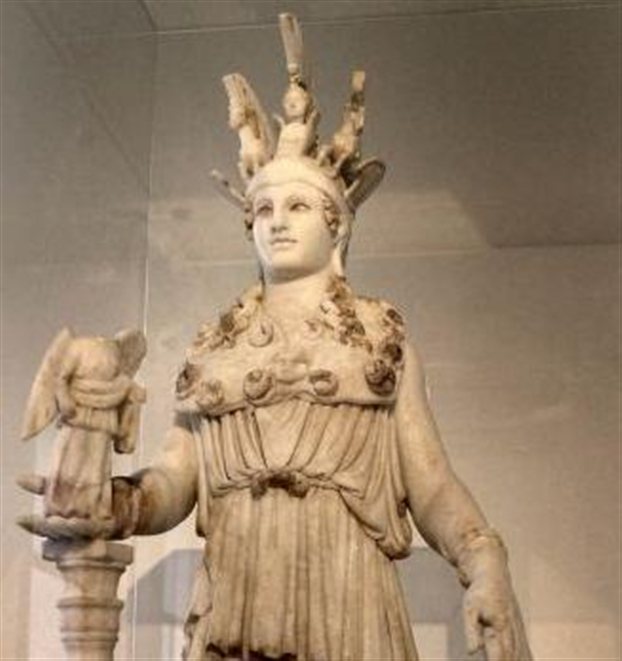
How with the transition to the Christian world the goddess Athena was "replaced" in the religious consciousness by the Virgin Mary
General, patron saint and virgin. She is the goddess Athena or the Virgin Mary; Protector of women, of children and childbirth. It is Artemis the Child-giver and Midwife or perhaps the Virgin Mary; Prudent, worlds, benevolent, gentle and merciful, who experienced unbearable pain and experienced much suffering. Is it the goddess Isis or is it the Virgin Mary, mother of Christ;
There, in the turning of the Greek world from polytheism to Christianity, when the latter slowly began to prevail in religious consciousness and devotional practice, mixing elements of the pagan past with the new religion would not only not cut it, but it would greatly contribute to its consolidation. Standards of centuries, besides, were difficult to remove. On the contrary, their assimilation by Christianity was the connecting link that people needed to accept it more easily. Result, many of the ancient deities and rituals to remain in the Christian calendar and to adapt to the formality and traditions of the new religion.
It is a coincidence that the great feast of Panagia on the fifteenth of August coincides with the birthday of the goddess Athena on 28 of the ancient month of Hecatombaion (mid July – mid August), when the Panathenaia was celebrated, the biggest celebration of ancient Athens; Or is it a coincidence that the temple of the virgin Athena on the Acropolis was transformed into a temple of the Virgin Mary; Besides, it was not only the Parthenon that became a Christian church, since according to Justinian's decree all ancient sanctuaries had to be converted into temples in order to purify. In many of them, where women were worshipped, pagan deities, temples were built dedicated to the Virgin Mary, which very often also took on the attributes of the ancient deities.
The properties
The recurring seasonal cycles of death and rebirth and the cults associated with the land, vegetation and a good harvest were also associated with the Virgin Mary, as the great folklorist Georgios Megas has written. The Entrances of the Virgin are associated with sowing and the Virgin takes on the characteristics of the goddess Demeter, sometimes acquiring the nickname Aposporitissa and sometimes Mesosporitissa. In fact, the ancient custom of panspermia remains, the polyspores, as we say today.
Aeiparthenos, such as the ancient goddesses Athena and Artemis, it was called Panagia from the 6th century. But at the same time, she is the protector of pregnant women who, in order to have a good delivery, keep a plant amulet, "the grass of the Virgin Mary", as it is called. There were other ancient mother deities: Astarte, Leto, Gaia, the Isis, with roots lost in the depths of the Neolithic era. The archetype of all, however, is considered to be the Great Mother or Mother Earth or Great Mother Goddess, which according to Jung is a matriarchal model that exists in humans before and from conception.
After all, the Great Mother was the main deity in Minoan Crete, from a certain time even alongside the "young god" (either as her "uncle infant" or as her husband). According to nature's cycle of death and rebirth the Great Mother continually marries the young god who is born and dies each year.
Protectors
General of generals, the Virgin Mary protects her faithful – as did the goddess Athena the Athenians – in every difficult moment. The 626, in the siege of Constantinople by Avars and Persians, the faithful who have gathered in the Great Church will suddenly see in front of them the Virgin Mary has spread her protective veil over the city (remember Athena's veil at Panathenaia). And the biggest proof: "I fight the battle, I strategize the victorious ones" sing the besieged Christians at the last mass of Hagia Sophia, the 1453.
The Akathistos Hymn, however, is somewhat similar to the "equal aretalogies", that is, the hymns to the goddess Isis, as the Archeology professor says. Michael Tiberios. Many of the characteristics of the Egyptian goddess, which had been Hellenized, they also went to Panagia. "Like the Virgin Mary, so this goddess acquired a myriad of nicknames, in other words, she was myrionymi, such as “almighty” and “queen of the sky, of the earth and the underworld”" notes Mr. Tiberius.
The Parthenon Basilica
It is unknown exactly when the Parthenon was converted into a Christian temple, but what is certain is that under Justinian (482-565) consecrated and designated as the "Catholic Church of Athens". The cult of the pagan virgin thus gave way to the Christian Virgin and the church took the name Panagia Athiniotissa. Indeed, for this purpose and in order to serve the needs of the new cult, the Parthenon underwent many operations and was transformed into a three-aisled basilica.
The prestige of the temple was great, since even Vasilios B’ Bulgaroktonos celebrated his victory against the Bulgars at Panagia Athiniotissa. After all, it was a magnificent temple, with the golden icon of the Virgin Mary and wonderful mosaics. Only 188 mosaics were saved from them and transferred the 1848 in the British Museum, while today little traces of the original performances can be seen. But what is preserved are the hundreds of engravings with the names of generals, bishops etc., but also simple inscriptions of names, deaths, titles and occupations, prayers and symbolic representations inscribed over the centuries on the columns of the temple. During the Fall of Athens by the Latins, however, the church was captured and converted into a Catholic church under the name "Santa Maria di Atene", while later it became a mosque.
The alleged similarity of the representation of a marble metope of the Parthenon with the scene of the Annunciation is also due to its rescue during the Middle Ages by fanatics of the new religion who destroyed the ancient decoration of the temple. The metope is today in the Acropolis Museum.
Source : tovima.gr