
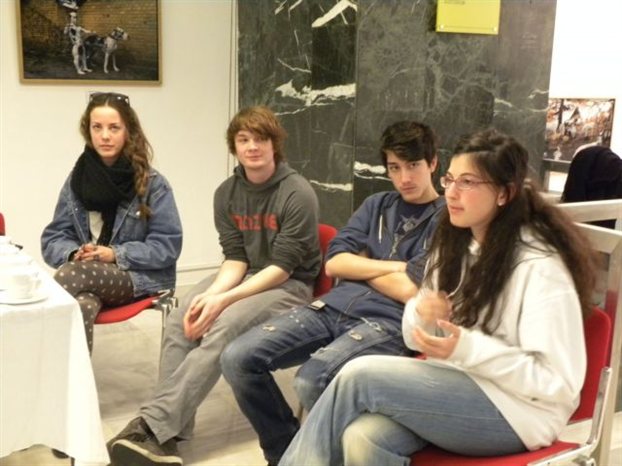
Documentary film production workshop with Greek and German students during the crisis
What could be the result of a collaboration between Greek and German students?, the common characteristic of which is that they prefer to see the world through the lens of the camera; What would the Greek children like to show the Germans from their country; But also what would the Germans like to show the Greeks from their own country;
Questions like the above have been put on the table for a few months now through an ambitious plan of "cultural cooperation and exchange of hospitality" between Greece and Germany. Greeks in Germany and Germans in Greece under the veil of support of the Creative School in Bergis Gladbach, Germany (in collaboration with the Screenagers creative network), of the Goethe Institute of Athens and Story Doc, of the Greek educational institute for the promotion of the documentary.
Six German kids from Bergis Gladbach, Cologne and six Greek kids from Athens (ages range from 15 to 20 years) shared endless hours in Athens and Bergis Gladbach for a joint exploration of their countries. The results are recorded by their cameras. Everyone's goal is to reveal unknown aspects of Greek and German life and reality in the time of the economic crisis.
In order to find the children who would represent Greece, visits were made to 22 schools of the Attica basin (indicatively the Zografou High Schools, Byron, Keratsini and Nea Ionia). During the seminars that followed in four schools (20 children per school), the "tremendous awareness of children in machines of digital capabilities" was noticed, said Mr. Costas Spyropoulos of Story Doc, who co-directed the seminars. “It was incredible to see how perfectly the children handled valuable cameras 27.000 euro". The children were selected based on the script they had written, while the production direction of the overall program is Dieter Bongaardz, German screenwriter, documentarian and writer and his compatriot Vera Scheffler who runs the film institute in Greece and Germany. From the Greek side, the participation of the Goethe Institute is extremely important for the successful development of the project thanks to the tireless efforts of Mrs. Sofia Michailidou and the cultural events manager Mrs. Juliane Steiner.
Euro crisis and debt relief articles are multiplying at an alarmingly rapid rate and with them buried memories, prejudices and intolerances come alive again. The historical memories and experiences of the two world wars come to the fore, with the Germans once again playing a dominant role in a ruthless economic war that we now experience on a daily basis. Opinions and attitudes favor the generation of new conflicts. But also collaborations.
In yesterday's (Monday 20 February) presentation held at the Goethe Institute, Greek and German children participating in the process spoke to representatives of the press about their effort. "We are together to find a common language" characteristically said 18-year-old Michael. "We are not talking specifically about Merkel but we are working together and that is the important thing".
"We all know what's happening in Greece because the Mass Media take care of it," 15-year-old Anastasia told us. “But the news of civilization does not travel. It wouldn't matter to talk about Merkel. Better to learn what you don't know than to reproduce what you do know".
Therefore, the unknown aspects of the social life of both countries were in the priorities of the four-member teams who undertook the creation of the films. The ultimate goal of the effort is mutual understanding and contribution to an inter-ethnic/intercultural dialogue in order to overcome prejudices, misinterpretations, even hostilities, which are cultivated, sometimes exaggerated in the public sphere by opinion leaders and individual media outlets.
The first and second films were shot in Germany. At one, through the personal stories of two young people we follow the events in a house under occupation in Cologne. The second film shot in Germany concerns the activities of a musical band created by second-generation Spanish immigrants with Cuban roots.. Their parents were in their thirties during the Spanish Civil War when they immigrated to Germany.
The subject of the third film is the meeting itself 12 children who program. The first part of it was shot in Germany and the second will be shot here by the same group. The core of the second part will be the revelation to the Germans of how hard a 17-year-old Greek student works while trying to enter the University.
Future film plans to be shot in Greece will be a film about an astronomer set against the backdrop of the Observatory, one for the case of a teacher who teaches hearing impaired children free of charge and one for the construction of the footbridge in Kifissia at the height of the College from the voluntary work of the students and donations from the family who lost their child at the same spot.
"We went to Germany to dispel stereotypes," said 16-year-old Marianna. "To show that we can do things together".
The recent events in the center of Athens with the destruction of the Atticon hall and other buildings, they did not discourage the children. On the contrary, one of the projects they would like to work on is a film about the buildings between Syntagma and Omonia. "The attack on the halls brought out a different one “quality” violence," said 21-year-old Ruben, one of the oldest children in the group.
What does Greek mean to Germans and what does the opposite mean?; "We cannot judge two nations by the behavior of two heads of state, i.e. two people" believes Anastasia. "Things must be said objectively. Judgments should be everyone's business." For Michael, however, "Greeks have ugly gray buildings, but inside you are colorful. On the contrary, we have beautiful buildings but inside we are gray".
"I have heard of the Germans that they are arrogant, narrow-minded, with absolute ideas for the Greeks" says 15-year-old Eleni for her part. “Gee’ they think that all Greeks are lazy, irresponsible and thinking only of their own interests".
Maybe with this joint effort, some will begin to think differently.
Source : tovima.gr