Category Archives: Uncategorized

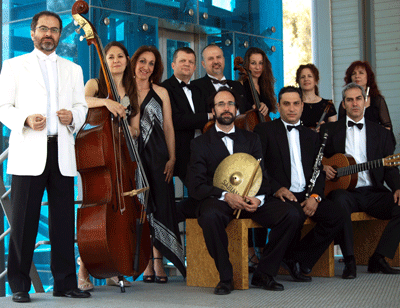
Tango Greco: The most beautiful Greek tangos from ancient Athens to our days at Badminton

 The Badminton Theater presents an evening entitled "Tango Greco", in which the most beautiful Greek tangos will be presented, on Monday 18 January 2013.

When the 1930 the "king of tango" Eduardo Bianco arrives in Athens for the first time, Athens is "tango occupied". The arrival of a leading foreign representative of Argentine tango was a great worldly event. Bianco will include Michalis Souyoul in his orchestra and they will play together in different parts of Greece…

The concert series "The Themes of Greek Music and Greek Song", conducted by the composer Michalis Koubios, presents us with the most beautiful Greek tangos. From ancient Athens to the present day. Because many old songs will always coexist with new ones, as the,what finally comes close to Art, it moves outside of time.

The tangos of composers such as: Attic, Kostas Giannidis, Michalis Suyul, Christos Hairopoulos, Manos Hadjidakis, Dionysis Savvopoulos, Eleni Karaindrou, Stamatis Kraunakis et al. they will perform four exquisite and special voices. Glyceria, Christos Thebeos, the mezzo-soprano Eleni Voudouraki and the tenor Yiannis Christopoulos, while a group of prize-winning dancers from the Academia del tango will dance them.

 Tango is a world rhythm that since its birth, loves to travel.

Tango is believed to have its roots in African rhythms. They are rhythms that traveled long distances and thus evolved, they changed. They arrived in Spain with the Arab conquerors to later migrate to the American continent. This is how the danzon and habanera were created in Cuba and the Tango in Uruguay and Argentina.

Around the 1870 tango is spreading both in and around Uruguay and Argentina 1890 settles permanently in Buenos Aires, starting with the infamous bars, mainly from those of slaughterhouses, where the gauchos (the South American cowboys) they give it their own temperament and personal nostalgia.

Initially he is banned, illegal and danced by men, but not in amorous moods, but aggressive, as they are men girded with knives dancing in a warlike atmosphere. However, tango will escape from the popular neighborhoods of Buenos Aires and will reach cosmopolitan Paris where it will be Europeanized and develop into an erotic, classy dance.

The tango from Paris is spreading quickly throughout the old Epirus and of course its waves are not long in "hitting" all of Greece. Even at the festivals of the Greek countryside, accordion viols, clarinet and lute as well as the Cretan lyre convey the melancholic thought that is being danced. Sure, what the Greek traditional orchestras played, it was but the echo of the great fashion of the Athenian salons. There, where tangos were a key ingredient in secular teas (tea) and the dance parties. Over the years, tango entered modern Greek song as well…

At Tango Greco you will hear the greatest Greek tangos, from the 1930s to the present day.

The musical performance Tango Greco is held with the support of the urban non-profit company AKOS "Cancer: Treatment of Body and Soul" in the framework of its Hellenic campaign entitled "Study in the human body - Prevention projects" for the information, the prevention and treatment of cancer. AKOS sends the message: "I love and take care of my body".

Series of concerts
"Themes of Greek Music and Greek Song"
Artistic Direction: Michalis Koubios
They sing: 
CANDY, CHRISTOS THEBIOS,
ELENI VOUDOURAKI, YIANNIS CHRISTOPOULOS
Την ATHENS CHAMBER ORCHESTRA
directed by Apollon Kouskoumvekakis
They participate:
Zoe Teganouria (accordion)
Dimitris Margiolas (bouzouki, mandolin, lute)
Award-winning dancers from the Academia del Tango group dance

Source : culturenow.gr

Irini Koumarianou has passed away

He died of old age 82 years old actress Irini Koumarianou, known to the general public from the popular TV series "To Para Pete".
Irini Koumarianou was hospitalized at Evangelismos with heart problems. "Para Pente" was one of her biggest hits. It was born 1931 in Galatsi. Student of the Hellenic Conservatory, her career began in 1951. He was one of the most important personalities of the Greek Theatre, having starred in several performances mainly of the National Theatre, while at the same time he participated in many ancient tragedies, mainly Epidaurus. He had co-starred with Aliki Vougiouklakis, Jenny Karezis, Rena Vlachopoulou and others and had to her credit 40 movies, as well as participation in the radio "Theater of Monday".

On TV, in addition to "Sto Para Pente" he appeared in series such as "Anastasia", "Betrayal", "Like Sisters",Alma libre" and "S’ love-M’ you love", as the "Saturday-born".

Source : kathimerini.gr

Mormolis, from the State Theater of Northern Greece

 The State Theater of Northern Greece presents Rainer Hachfeld's performance entitled "The Mormolis" in its Children's Stage at the Royal Theater, from Sunday 27 January 2013.

The adventures of Mormoli, of a much-loved work of young and old come to life on the stage of KTHBE, in an imaginative and tender performance with live music, dance and song that enchants children, frees their imagination and makes them sing with one voice "Mormolis, Mormolis is the element of the city"!

Case
But who is Mormolis who has upset the whole town and who tells the children what to do; Who is Mormolis who is everywhere and nowhere;
Mormolis is nothing more than... a mere box, a very simple box, who becomes the new friend and secret advisor of all the children. He is the one who tells the grown-ups what the little ones dare not tell them.
Like all children have a teddy bear, or a doll or a dog, who imagine it is alive and talk to it and listen to what it tells them, so did Ricky and Manda, while spending the holidays at their uncles house, do the same with Mormoli, upsetting not only Aunt Polyxeni and Uncle Agesilaos, but the whole city... From the neighbor Mr. Bourinia to the Minister.
And the adults, of course, they get upset after Mormolis with the help of the children, it is everywhere: transforms into a shoe, hat, or even on a stove burner!

"O Mormolis" by Rainer Hachfeld

Source : culturenow.gr

The Swedish look at the Athens of the crisis

"The city of’ in this period it is of great artistic interest" tell us the curators of the exhibition of the Swedish Institute of Athens

How four Swedes see the Athens of the crisis; The exhibition "KRIS, an artistic test on the concept of crisis" presented by the Swedish Institute of Athens highlights the value of the city as a place of artistic inspiration but also the importance of cooperation between Greece and Sweden. Curated by Antonis Bogadakis - who has participated in organizing exhibitions in Sweden and Turkey, while working in Northern Sweden- the Swedish artists Cecilia Järdemar; (in collaboration with Loukia Alavanou), Jesper Nordahl, Carl Palm and Lisa Torell were invited to come into contact with the Greek reality and express their comments through art.
 The only Greek woman participating in the exhibition, Loukia Alavanou, which won the TIE IT award 2007 and lives between Athens and London, he tells vima.gr : "Athens has a great artistic interest at this time. The political situation of the country and the images one sees in the city are reminiscent of Berlin immediately after the fall of the wall. The moment is important to carry out such initiatives as the invitation of foreign artists and the exchange of artistic ideas and opinions. Unfortunately, Nevertheless, Greece is not familiar with the institution of residency as it is called. Too bad because even countries that are not in Europe, like Cairo, have tradition p’ these practices".
  According to what Loukia Alavanou reports, the initiative will also have a second part. What will this consist of?; In the visit of Greek artists to Sweden and the creation of Greek works _ always in relation to the crisis in our country _ which will be implemented within 2013.
 According to the people at the Swedish Institute of Athens, the invitation to four Swedish artists to capture through art the comments and impressions from their contact with the Greek reality in this difficult period becomes at the same time an occasion to explore the perspective of the trenches as they have been defined by the dividing lines that have been set and widely disseminated primarily by the mass media between the north and the south of Europe. The exhibition aspires to contribute to a debate that has been open for a long time not only about the reasons for the outbreak of the crisis but also about the role that the concept of the political plays in dealing with it.
 The report is complemented by two separate discussions, one with the participating artists on Saturday 2 February 2013 (time 18:00) and the other with Aris Fioretos as guests, author and professor of Theory of Aesthetics and Literature at the University College of Sentertern in Stockholm and Alexandra Deligiorgis, writer and professor of Philosophy at the Aristotle University of Thessaloniki on Saturday 9 February 2013 (time 18:00). 
«KRIS – A visual experiment on the concept of crisis"
31.01 – 28.02. 2013
Space: Swedish Institute of Athens, Mitsai 9, Makrigianni
Tel: 210 92 32 102: swedinst@sia.gr http://www.sia.gr
 
Source : tovima.gr

"We will remember you, Pavle Matesi, as an intellectual of the high art of speech"

The writer's funeral took place from the Papagou Cemetery

Under the cypress trees of the Papagou Cemetery rests the body of Pavlos Matesi.
The funeral service was sung on Tuesday at noon in the church of Evangelistria of Papagos in the presence of his relatives and numerous writers and theater people.
Dimitris Posantzis said goodbye to the deceased on behalf of Kastaniotis publications: "We are your debtors, those of us who were lucky enough to know you well. We will always remember you as an intellectual dedicated to the high art of speech and the value of literature, as a teacher who taught dignity and deep humanity."
His body was followed by Spyros Evangeliatos, Kostas Murselas, Giorgos Dialegmenos, Thanasis Kastaniotis, Eva Karaitidis, Thanasis Niarchos, Zyranna Zateli, Eugenia and Michalis Fakinos, Lakis Papadopoulos, Grigoris Psarianos, Mimis Androulakis, Telemachus Chytiris, Nikos Sifunakis et al
Source : tovima.gr

The radiance of Apollo in ancient Corinth

Inauguration of the electric lighting of the monument on Saturday 26 January

The temple of Apollo in ancient Corinth is now illuminated and shining in the night after the completion of the project of electrification, the inauguration of which will take place on Saturday 26 January on 7 at night. The 17th Ephorate of Antiquities, which prepared the study in the summer of 2012 in collaboration with the architectural lighting company Diathlasis SA., to be subsequently approved unanimously by the Central Archaeological Council.
The projection of the monument and not the imposition of lighting on it was the basic principle of the study, but also the adaptation of the intensities both to itself and to its immediate environment, the performance of the shadings and the highlighting of the building material of its construction which was the porolit. Of course, the energy saving and the reversibility of the operation were taken into account in case it is decided to restore the temple, while an attempt was made to avoid light pollution.
The execution of the project is due to the engineer – engineer Mr. Georgios Veronikis in collaboration with the Smart Electric company, while it should be noted that it could not have been implemented without the cultural sponsorship of Club Hotel Casino Loutraki S.A., which was made following a relevant request from the ΓΖ΄ EPKA.
The temple of Apollo (550 – 540 e.g.) is an important monument, which marks the beginnings of the application of the Doric style in ancient architecture while reflecting the economic strength and commercial power of the city of Corinth in archaic times, when the city emerged as a leading power of the Greek world by establishing strong colonies.
But after the destruction of the city, the 146 B.C. and its re-establishment now as a colony of the family of the Roman emperor Octavian Augustus, the temple was remodeled, possibly to house the imperial cult. Its ruins have been visible for centuries but actually its first excavation took place in 1886 by the German archaeologist Wilhelm Derpfeld. Today, in addition to the foundation of the monument, seven columns of the western part of the occasion stand in place, as well as the southwest corner of the archway.
Source : tovima.gr

The "Hainides" in the Mill Club!

Saturday 26 January 2013

The "Chainedes" they do not aspire to give answers, but to pose the universal and eternal questions in a clear and imaginative way. Finding the truth is everyone's personal journey, as he dives into the ocean of collective existence.

The 9-member band of "Chainides" mixes places and times, rhythms and timbres, thereby contributing to the sacred CHAOS which is the only source of creation and self-organization.

Dimitris Apostolakis – Lyre, voice
Dimitris Zacharioudakis – Acoustic guitar, voice
Maria Koti – Voice
Alexis Nonis – Dowley, darbuka, daf, kahan
Dimitris Brentas – Keys, crotch, clarinet, bagpipe
Antonis Skamnakis – Bass
Michalis Nikopoulos – Bouzouki, Mandolin, Lute, Voice of Takis Kanellos – Drums
Cleon Antoniou – Electric guitar
Takis Kanellos – Drums
Cleon Antoniou – Electric guitar

Inception: 22.30
Ticket price:  10€

Mill
If. Georgiou 56,
Abattoir area, Thessalonica
Phones :2310504014, 2310541806 & 6986924600
(Monday to Friday – 10:00 with 18:00).

Source : musicity.gr