Category Archives: Uncategorized

Culture starts at school- Program of the Ministry of Culture for young people

Applying the principle, that civilization begins from childhood and from the education that each person will receive is the program, drawn up by the Ministry of Culture.

Its aim is to strengthen and enrich the educational process as well as the training and aesthetic education of young people with material from the vast national, cultural reserve. Why, as she typically mentioned in her presentation at the ICOM Greek Working Group Conference – CZECH (ICOM International Council of Museums – Greek Department and Committee for Education and Cultural Action) the general secretary of Culture Mrs. Lina Mendoni "Can education and culture be interrelated concepts and that everyone considers, that they are governed by a relationship of mutual dependence, unfortunately, however, the theoretically self-evident is not necessarily identical with the practically given". After all, the country's shortcomings in this field are huge, so the actions really target the essence of the problem.

Here are the programs designed by the Museums Directorate, Exhibitions and Educational Programs of the General Secretariat of Culture, which are included in the Operational Program "Education and Lifelong Learning" of the National Strategic Reference Framework, 2007-2013. As mentioned by Mrs. Mendoni, the basic elements of the identity of the acts performed are summarized as follows:

 – "Updating and digitizing cultural educational material to enhance the educational process", which means the renewal of existing educational programs of the Regional and Special Regional Services of the General Directorate of Antiquities and Cultural Heritage, the design of new teaching tools based on modern concepts and specifications, the selection of encyclopedic and supervisory material, etc. a. In fact, all the material will be made available in digital format through a special online hub as well as optical discs, which will be sent to all schools in the territory.

 – "In the footsteps of the Bible: the history of writing and language in the Greek area", a program that aims to study and understand the genesis and evolution of language and writing over time.

 – "Design and production of pedagogical tools to highlight the importance of theater in ancient times and today" with the aim of consolidating knowledge and strengthening students' relationship with theater, this very special and unique creation of Greek culture.

 – "The theater as an institution of education and state education in antiquity and today". This action is linked to the previous one and aims at the design and implementation of an archaeological educational exhibition, as well as experiential workshops on ancient theater, its evolution and effect over time. The installation will include replicas of ancient artefacts related to theater and performances, such as musical instruments and mask molds, which will be combined and supplemented with special explanatory constructions and multimedia interactive applications and presentations.

 – "Design and production of educational tools for the modern urban environment and architectural heritage". The purpose is to offer cognitive tools and effective teaching methods, that will help students understand the built environment of the city they live in and examine their own possibilities of intervention to improve and enhance it

 – "City and cultural identity: Design and production of educational tools to highlight the cultural heritage of the eight Convergence Regions", which concerns the design and implementation of educational tools to strengthen the teaching of Primary and Secondary Education students in the Convergence Regions included in the Priority Axis 1 (Eastern Macedonia

– Thrace, Thessaly, Continent, Ionian Islands, Western Greece, Peloponnese, North Aegean, Crete).

Source : tovima.gr

Jacques Audiard: In the crisis, instinct prevails

The French director of the film "Body to Body", of a love story in a time of crisis, it talks about its contradictions and the golden ratio between quality and commercialism

"Don't call me an artist!» shouts Jacques Audiard. "It's a very difficult word and I can't define it. For’ that's why I prefer the term “creative”, word more tangible and specific. The creator constructs something, what exactly does the artist do?;». Writer Craig Ferguson and I sit in a room at the Carlton Hotel in Cannes a few days after the world premiere of Audiard's latest film Body to Body last May. There the wonderful Marion Cotillard plays a whale trainer who loses her legs after an accident but finds the will to live again after meeting a lonely sidewalk boxer (Matias Senerts), who circulates on the French Riviera with his minor son.
Although the term "artist" does not like Odyar, "Body to Body" is an artistic film. I point out to him that at the press conference the day before he had referred to cinema using the phrase "art form". "You're right," he replies immediately. "What should I do?, I am full of contradictions! But when I hear them call me a poet… what can i say; I'm not a poet. Rimbaud and Verlaine were poets, me not".
For "Body to Body" Odyar and Ferguson used many scattered ideas from the latter's collection of short stories. "I was interested in telling a love story in a crisis situation," says Jacques Audiard, whose previous film, "The Prophet", liked it a lot in Greece. "Crisis at all levels, not only the economic one. People who eat from the garbage, people who have lost their legs, children growing up without a family. In the novel “They kill the horses when they get old” of Horace McCoy, which refers to the period of the great crisis of '29, people had to dance themselves to the death in order to survive. Today they will have to fight until the end on the road. But they still kill the horses when they get old, it is not so; In a crisis man's only weapon is his physical strength. In a crisis instinct again prevails".
For Jacques Audiard cinema is a very democratic art but it still remains an industry. A film critic he holds in high esteem once told him that there are two doors you can walk through to enter the world of cinema: one big and pop and one small, better quality. "The ideal is to enter a little bit of both. You have to think about the audience when you write, not just yourself.  For me, fer’ they said, when you decide to end a tragic movie with a tragedy, you suffer from a lack of imagination".

When & where:
The movie "Body to Body" is shown in theaters from 29 November distributed by Seven Films.

Source : tovima.gr

Our big circus, at the Royal Theatre

The Royal Theater is preparing to host the show "Our Big Circus" presented by the State Theater of Northern Greece from Friday 14 December 2012.

 "Our Big Circus", presented by the State Theater of Northern Greece, in co-production with the Acropolis Theatre, continues its triumphant march. The emblematic work of Iakovos Campanellis returns in December to Thessaloniki where it was presented for only two performances, at the request of many viewers.

The show that was described as the "social phenomenon" of the summer, after 40 stops on a tour where they watched it 100.000 spectators, but also a series of highly successful performances in Athens at the Acropolis Theatre, plays at the Royal Theater from Friday 14 December 2012.

END OF SHOWS AKROPOL THEATER: 9/12/2012

"OUR BIG CIRCUS", of Iakovos Campanellis, in music and orchestra conducting on stage by Stavros Xarhakos. Direction: Sotiris Hatzakis. They star: Tasos Nousias, Marina Aslanoglou. Singer: Zacharias Karounis.

15the Olympia Festival: All for the child

Twelve fictional films for children and adults

The text that follows attempts to take a brief look at the twelve feature fiction films that will be screened in competition during the 15th Olympia film festival for children and youth.

This year's festival takes place in Pyrgos and other areas of Ilia from Saturday 1 December until Saturday 8 of the same month (see related topic "Olympia film boom"). Naturally, it is not only these films that will be screened at the festival in whose program they are at least counted 50. But since it is long and fiction, it is natural to attract more curiosity (in the future we will come back with the presentation of the animated films).

Faithfully dedicated to films that relate exclusively to children but which at the same time are also aimed at adults, the festival appears clearly renewed this year, with a variety of events but also with as it seems beautiful films. As we see from the short summaries, fiction feature films deal with themes such as the irreconcilability of the child character, the surprise of the first discovery, the struggle of first love, the love for animals but also the childhood imagination that many times (if not most) she is inexhaustible.

It should also be noted that the film that will be distinguished at the Olympia Festival with the award for Best Film, is automatically nominated for the Best Film Award of the European Festivals awarded by the European Union of Cinema for Children and Youth (ECFA). This prize will be awarded in February in Berlin, on the days of the city's film festival. The award was established last year and was awarded to the Belgian film "In the Footsteps". The film was screened at the 14th Olympia Festival.

"Electric Children" (Electrick Children)
USA, colored, 96΄, 2012, directed by Rebecca Thomas
On her 15th birthday, a Mormon, discovers a banned tape of rock music and three months later claims to have conceived innocently while listening …music!

"Elliot and Me" (Eliot & Me)
Ireland, colored, 60΄, 2012, directed by Findan Connolly
In his Dublin 2012 a ten-year-old trying to come to terms with her parents' divorce, finds support in the dog he adopts.

"Goodbye" (Farewell)
Korea, colored, 93΄, 2011, directed by Kim Baek Joon
Two teenage siblings of Korean and Chinese descent who wait in vain for their parents to return, they meet a cruel young man who will change their lives…


"Flying Kites" / (Flight of the kites)
Iran, colored, 80΄, 2012 directed by Ali Gavitan
Teacher in remote villages of Iran, discovers that one of his students has a talent for memorizing religious hymns and helps him cultivate it.

"The Ice Dragon" / The Ice Dragon
Sweden, colored , 77΄ ,2012 directed by Martin Hogdal
The adventures of an eleven-year-old Swede, fan of whales, of hard rock and painting.


"Igor and the Crane's Journey" / Igor & the crane’s journey
Israel-Poland-Germany / colored,  90΄, 2012 directed by Evgeny Ruman
When his mother decides to immigrate from Russia to Israel, little Igor will have to learn to face new challenges, like the little crane he saw coming out of the egg…

« Cowboy: The boy with the clown" / Cowboy
Netherlands, colored, 90′, 2012 directed by Budevjin Kule
Through his friendship with a tomboy, a ten-year-old Dutch boy finds a way to break down the wall surrounding his father's heart.

"The adventures of B. Shroom" / My adventures by V. Swkwrm
Netherlands,  78΄, 2012 directed by Frukie Tan
A nine-year-old boy who wants to be a writer adopts the literary pseudonym B. Shroom and decides that his books will end wars and heal the sick.

"Death of a Superhero"/ Death of a Superhero
Germany-Ireland, colored, 97΄, 2011 directed by Ian FitzGibbon
Mix of live action and animation in the curious chronicle of a "superhero" who is different from the others since in his normal life he is sick, he feels helpless but has the talent to bring dark worlds to life with his pen…

"Stepson" / The Foster Boy
Switzerland-Germany, colored, 108΄, 2011 directed by Marcus Iboden
An orphan who dreams of having a "real family", he mistakenly believes in the family where he goes to work but there a teacher recognizes his musical talent and gives him the opportunity to play at the local festival.

"The Great Hunt" / The Great Bird Race
Denmark in color, 90΄, 2012, directed by Christian Diekjaer
A 12-year-old goes with his father to the Annual Ornithological Competition, where he decides to make his father proud by spotting the rarest bird and winning first prize.


"Tom and Hack" / Tom and Hacke
Germany, colored, 98΄, 2012 by Norbert Lechner
After the death of his parents in the war, a little boy who lives with his seamstress aunt breaks the sewing machine with which they earn their living. The replacement of the machine will give rise to an unusual Odyssey ,a bizarre "treasure" hunt, which will not lack smuggling but also love.

Source : tovima.gr

The finances of...Alexander the Great

The finances of Alexander the Great, the payrolls, or
tax reform and fiscal scandals.
He may have become world famous in his capacity
able recruit, but Alexander the Great was an equally keen economist,
with …masters in war economics, which were not offered for
weak "solvers".
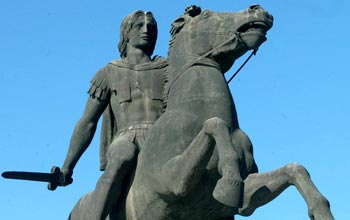
Aristotle's student demonstrated excellent management
ability, although the financial budgets of the battles included in
general lines, what those of the states also contain (and were connected directly
with them): payrolls, health and welfare, construction programs, supplies,
transfers, tax system reforms, indirect taxes and donations,
even fiscal scandals.
How his soldiers and equipment were paid for
of Alexander the Great; How many short-term loans he took out for his needs
war and why he forbade the women of Ephesus to wear jewelry; What
gift he offered to the guests at his wedding and what was her fortune
Gaza's huge perfume warehouse;
Answers to these and many more questions will be given by
Administrative Justice Appellate Dimitrios Kostopoulos, in the lecture context,
entitled "The Finances of Alexander the Great", who is organizing tonight the
Vafopouleio Spiritual Center (Deputy Mayor of Culture and Tourism
Thessaloniki). Mr. Kostopoulos gave AMPE a "taste" of the main ones
points of speech.

Multi-speed military payroll
Until the 331 e.g., the main expenses of Alexander
concerned -among other things- the following: army payroll, maintenance
equipment-siege machines, fleet creation, sustenance, transfers
and health care. The most important direct war expenditure was the
payroll, the amount of which was determined by a military payroll: the army
it consisted primarily of Macedonians, who served their country, from
allies of the Greek cities (partners) and professional mercenaries.
Although the information of historical sources does not agree
to the amount of the salary, approximate calculations lead to the conclusion
that, at the beginning of the campaign, the amount of salary of the common soldier
was rising (average) The day for the draw of the two lucky ones 1-2 drachmas per day.
"The corporals or corporals received a monthly salary 40
drachmas. The salary of the platoon was double that of the horsemen
twice as many pedestrians. According to Diodorus the horsemen received 300 drachmas monthly
and the Macedonian phalangites 100 drachmas, while for professionals
mercenaries there were additional financial incentives", notes the
Mr. Kostopoulos.

Annual payroll expense 4.000-7.000 talents
The overall figures were unfathomable: enough n’ consider
someone that the 334 B.C. crossed the Hellespont a military force of more than
35.000 of men, to which they must be added 10.000 men of Parmenion
(which preceded the 336 B.C) and the army which Alexander maintained at
Macedonia (12.000). The annual salary expense is estimated to have amounted to
4.000-5.000 talents in the first year of the campaign.
Not in the following years, increased further, in approx 7000
talent -not counting the fleet- because Alexander strengthened him
his army of mercenaries from the Greek cities of Asia Minor, while
he had to establish garrisons in territories he occupied.
After the capture of Susa and Persepolis and the acquisition
of the Treasury of Darius, spending on military payroll soared:
for the Indian campaign Alexander organized an army 140.000 of men,
while he built a fleet at least 150 ships, which they brought 3.000-5.000 men.

Engineers, bridge builders and bed makers
Beyond payroll, maintenance costs were high
and renewal of war material. Alexander's army was for the time
of a technologically advanced war machine. The army was followed by engineers,
who manufactured and maintained various war machines and the
siege org staff, who operated the "petrol guns", their
"composite towers" or "cantilevers",the well-known "heletowns", the rams,
the turtles and the mirrors. also, beside the army marched others
technicians, such as bridge builders and tent and bed makers.
The supply also required large expenses, sustenance
and transportation, not only of the army but also of their women and children
families of soldiers, for the service of which it operated
organized transport and supply corps.

A hundred talents just for medicine, but also provision for the
children of the fallen
Systematically organized - and therefore costly- was also
sanitary service of Alexander, which included doctors, botanists,
pharmacists and nurses, who were following the campaign. THE
Diodorus mentions that for the Indian campaign Alexander allocated for
medicines 100 talent.
also, Alexander was spending considerable sums on
compensations to the parents and families of the fallen, in which
granted royal estates and tax exemptions, while Justin
mentions that he continued to give his salary to the orphans of the fallen
father..

"Appeasers" or "layer keepers"
The war did not require, Nevertheless, only wages, equipment and
resupply, nor just reparations. He demanded, according to Alexander, holidays
and festivals to boost the morale of the army - and for them, the
expenses were great.
also, war budgets covered spending on
cooks, bankers and grocers, even for strangers today
properties, such as the …bedguards or appeasers, who guarded him
Alexander and the generals while sleeping.

Six hundred talents yearly for royal meals and
sponsorships for returnees
Royal meals were very expensive, for which the
Plutarch reports that Alexander was spending 600 talents annually. also,
Alexander was particularly generous in the remuneration of those who were particularly distinguished
in battles and sieges: according to Diodorus, after the victories of Issus and
of Gaugamelos were donated 3.000 talents, while for the conquest of the Ecvatans,
besides the jewels were distributed 13.000 talent.
The donations to the returnees were still large.
According to Arrian to the Greek allies, who wanted to return,
were granted with 2000 talents for wages/return expenses, while those
strove to remain they received three talents each.
Alexander was equally generous to the veterans.
According to Arrian, to the Macedonians who, due to old age or illness, became
incapable of war, a talent was also granted in addition to the wages, as
and the costs of repatriation.

Short-term loans to meet his needs
war
But where did the revenue come from to cover it all?
of these needs; At the start of the campaign, mainly from the basil
treasure of Philip, while an important source of revenue was its mines
Macedonia, which provided gold and silver for coinage.
in addition to, customs provided revenue from duties, to whom
taxes from royal lands were added.
More important, Nevertheless, source of income was lending. According to
Plutarch, in the early years of the campaign Alexander borrowed short-term
1.460 talent.
The expense of professional mercenaries was borne exclusively
the royal treasure, while the expenditure of the Macedonian army was covered in
partly by donations from the nobles, the so-called functions, and partly from
the royal treasure.
In everything,what about fleet spending, Alexander the
faced with the institution of the triarchy, during which certain cities
they undertook to contribute a number of triremes towards the expense of the crew.

Why the cities of Asia Minor were declared "unlawful"
Regarding taxation, Alexander did not impose
taxes at the expense of the Greek cities of Asia Minor, which he preached
"assydotes", because his campaign was aimed at ridding them of him
servitude tax to Darius.
With the cities that did not resist the campaign o
Alexandros made an agreement for the payment of’ those of the so-called
pension, as a federal contribution of money to meet the expenses
of the common purpose of punishing Darius.

The so-called "chore" and why the women of Ephesus
they wore no jewelry
In the cities that showed a hostile attitude to Alexander and
friendly to Darius, Alexander unilaterally imposed an extraordinary levy, the
so-called damage, that is, a kind of fine, which was either monetary or
in kind, the so-called chore.
A special case is the tax on the Ephesians,
who strongly resisted Alexander. To pay the tax
the women of Ephesus were forbidden to wear jewelry. The product, Nevertheless,
Alexander did not reap this tax, but it was made available for her
construction of a temple of Artemis in Ephesus.
The income of Alexandros showed an increase from
so-called taxes on the district, while news revenue increased
mines and customs of the conquered countries.
How Gaza's vast storehouse of perfumes pleased
to Macedonian nobles
Income also came from silversmithing and
looting, which were permitted by the applicable law of war, i.e. her
fruition of all kinds of valuables, utensils, luxury goods etc.
The case of the city of Gaza was typical, where
it was known as a vast storehouse of perfumes, which were cashed after the
her salvation. Alexander distributed these revenues to the Macedonian nobles,
as Plutarch does not mention, when Perdiccas pointed out to him that it did not last
nothing for himself, Alexander replied "I keep hope".
The untold treasures of the metropolitan vaults
of Darius
According to Mr. Kostopoulos and despite the above, until the
333 B.C. Alexander was facing financial straits. Later, but also
especially after the battle of Gaugamelos, the situation changed drastically: were delivered to
Alexander the untold treasures of the metropolitan treasuries of Darius
in Susa and Persepolis.
After the overthrow of the Persian state, the general ones
features of taxation also changed: the number of increased
taxpayers since the Persians were taxed, which previously
were exempted as sovereigns, while the same happened in the new cities which
were built by Alexander. The Greek cities of M.Asia preserved anyway
indecency.
Taxation also increased, especially the indirect one, because
economic activity and trade developed with its increase
currency and the distribution of Persian treasures, while the new works and the new ones
cities attracted new populations.

“Merger' of fiscal and fiscal
services
Alexander carried out extensive administrative reform
for the organization of the vast empire, which included and
tax and fiscal services reform: Create
four fiscal regions, Egypt's first, Libya and
Arabia, the second of the Taurus Minor Asia, the third of Phoenice,
of Syria and Cilicia and the fourth of Babylon, Suson, Persia and Media.
These new services were staffed with a large number of employees.
The "on the money" and fiscal scandals…
Alongside, Alexander appointed Chief of the Commissioners, as
quasi-Minister of Finance with responsibility for the entire state, carrying him
…eloquent title "the one on the money".
Anyway, even then there was no shortage of financial scandals, such as
that of Arpalos, who had been awarded the title of "on the money".
He, taking advantage of Alexander's absence in the Indian campaign,
he embezzled large sums and to avoid punishment he fled to Athens.
What taxes were levied?
The taxes levied were;, in principle, the immediate on
of individuals (B.C, capital tax and business tax on professionals,
which were distinguished into capital and manual). also, they were the indirect ones
taxes on consumption, which differed by satrapy, as
and customs duties, which increased significantly.
Further, the revenues from the
diverse private property of the state, the land annuities on the
of earth, the so-called tithe, i.e. the 10% on agricultural production and o
animal tax.
Beyond the treasures of Darius, it is considered that of the 18
satrapies flowed into the royal treasury 9.000-30.000 talents annually, while in
to these must be added revenue in kind and revenue from mining.
After the conquest of India, its taxes were added.

City rebuilding costs, transportation and
irrigation works
During this period, the form of expenses also changed, with the
center of gravity should now be placed on those related to public works
and rebuilding new cities. Alexander built many and
large temples, for both Greek and Asian deities, while
built many productive works, such as transportation in Klazomenes and
Red, irrigation on the Euphrates, desiccants in Kopaida.
It is estimated that the cities he founded amounted to 70,
which, in addition to fencing and town planning, kissed me in public
buildings, spreading Greek architecture and Greek arts to
East.

What gift did the guests receive at his wedding?
Alexander the Great;
The expenses of the royal court also played an important role,
which are now of royal followers and staff, they also included
the expenses for banquets and feasts which were very high, since the
Alexander followed the opulence of the Persians.
During the great ceremony of 9000 of Perso-Macedonian marriages the
323 e.g., in which he himself married the daughter of Darius, Statira, each
invited received a golden flask as a gift and saw his debts paid by
Alexander!

Source: kathimerini.gr

Antonis Mitzelos at Half Note: Extension of appearances

Antonis Mitzelos, charismatic guitarist, composer and performer among the most acclaimed and beloved, meets
on stage with AnimaCorda, consisting of Michalis Bruzos and Giorgos Behlivanoglou, two classical guitarists who have distinguished themselves with the richness of their musical ideas and timbres but also with their excellent technique in electric, acoustic and classical guitars but also with Marianna Polychronidis, which, apart from her acting talent, has a rich, well done voice, which allows her to sing comfortably, songs from many different musical cultures.

They present KITARODIA on the Half Note stage, an unexpected performance, with a unique and different harmonic effect at each concert.

The first five performances of Kitharodia have already taken place with great success in the very special space of HALF NOTE jazz club and four more Mondays with guests follow:

Monday 26/11: GEORGIA DAGAKI
Monday 3/12 : VASILIS LEKKAS
Monday 10/12 : YIANNIS KOTSIRAS
Monday 17/12 : THE CELEBRATION OF GUITARS

The three guitarists and Marianna Polychronidis, take the HALF NOTE stage with their guests, with a disposition for dialogue and improvisation, with voice and heart and attempt to communicate not only with each other but also with the viewers.

With their guitars, acoustic and classical, a world together and no longer apart, instruments polyphonic and sensual, they present and improvise on pieces from their personal discography, in well-known compositions by Antonis Mitzelos but also in selections from Greek and international rock & jazz repertoire, from Mikis Theodorakis to Al di Meola and Manos Hadjidakis to Eric Clapton, in a program that creates the most complex and rich melodic landscapes, emotions, stories… In addition, the program also includes news, unreleased songs by A. Mizelou.

Their Kitharody, contemporary and timeless, is done through its propagation ”fine guitar playing”, of lyricism, of Greekness and above all of the belief that... music is ultimately the only truth!

Source : culturenow.gr

From censorship to self-censorship

The question of censorship, of fear and self-censorship hovers over the Greek theater. Actors, directors and people of "Corpus Christi" answer whether they are finally afraid or not

The taxi driver was having fun. arriving at the Chitirio theater, in Gazi, turns around, he laughs and tells me: “Oh! This is the well-known theater; You are going to see this work; Antichrist!». I was lucky because the delivery of the speech was humorous. If I had run into someone from the group that was protesting against Corpus Christi a while ago, the word "antichrist" would fall upon me like an aphorism. Like many people, so I didn't have time to see the show to be able to rank it among those who agree or disagree with my aesthetics, because quite simply some made sure it was taken down because it offends the Divine. So, an unholy show on the Holy Road. Gods on the verge of a nervous breakdown and enraged "believers" have always existed. If you put his photos side by side 1988 from the vandalism at the Opera cinema on the occasion of Scorsese's "The Last Temptation" and those of 2012 from the Foundry, the differences are minimal. But with a closer look you will see something shocking: in today's images, there are many who give Nazi salutes. Things suddenly got serious. Or they've become completely ridiculous. And the newborn question is: We are afraid on the road. We are afraid at home. Why should we be afraid even in the theater?; And, finally, how far we are from a regime (this)censorship;

A few days ago, a misdemeanor criminal prosecution was brought against the performers of the show "Corpus Christi". "Insulting religion and malicious blasphemy jointly and consecutively" are the charges. Although Archbishop Jerome separated the official position of the Church from the theater of the absurd that unfolded outside the "excommunicated" theater, Metropolitan Seraphim of Piraeus finally filed a lawsuit, claiming that religion is defamed. The prosecutor read the text of the American Terence McNally, saw the performance taped and received statements from citizens who said they were offended by the way it portrayed Christ. And, kind of like that, the case took the road to Justice, with the articles 198 and 199 of the Criminal Code to provide for a fine up to 3.000 euros and imprisonment of up to two years respectively to the contributors. And as it usually happens, few of those affected attended the performance. The poster with the Crucified and the few words about the work were enough to send it to the fire outside.

The zealots next door

Laertis Vassiliou explains: "In the prosecution signed by the Metropolitan of Piraeus, three MPs of the Golden Dawn are also involved. Not the stars, some others". The director of the infamous show, sitting in the theater foyer, he is calm now. During the protests, he saw and heard it all: a woman waving a picture of Jesus and a bag hanging from her arm with Marilyn Monroe in the famous pose. People of all ages singing the national anthem and giving Nazi salutes. The slogan "We Messiah have Jesus the Nazarene, you Messiah have antichrist Jew". But also the most personal ones, of the type "Alvane, this will be your grave", with a large portion of the crowd referring to the country they came from before 19 years. The image of the Golden Dawn MP, Ilias Panagiotarou, on the one hand to defend thus generally "the Goddesses" and on the other hand to curse with rare mastery for approx. 2 minutes was typical.

Vassiliou believes that we have passed into a period of censorship, "informal, but very essential. With the memories of what happened in Distomo and Kalavryta still fresh, I don't understand how Greek society can turn to such a solution. See you on Facebook and Twitter, but we'd better take action, not to be afraid to speak. While it used to be almost taboo to say what you were voting for, some who were in the dark and want to return to the news are now openly in favor of the Golden Dawn. And many lifestyle discounters, without any political consciousness, they believe that if a junta comes to Greece, things will be better. In this fanaticism, art is the first to be silenced. But art is what he always said: you don't have to like what you see. Just don't eat it".

It is not the first time that the actors of a show have been taken to court as blasphemers. Based on the hilarious Monty Python movie A Prophet, what a prophet", the comedy of Yiannis Kalavrianou "I am the Divine Infant", starring a man who thought he was Jesus because he was born in a nearby manger, tried and acquitted 2008. The writer and director still remembers the inspiring words approx 100 of brothers in Christ who had gathered outside the Theater of the New World threatening to lynch the actors and spectators who were huddled behind the glass door: "Getting cancer! To cry! We will rush you! We will stone you! We will burn you alive!». The images of the saints had turned into weapons in the hands of the protesters “and if you were unlucky, you would eat Saint Panteleimon in the glory of the country" remembers Yannis Kalabrianos: "In Greece it is very difficult to prove that you are not an elephant. And even harder to prove that you are not the antichrist. The viewer should be free to watch anything. Theater has always dealt with extreme issues. We solve everyday things in the elevator. But the others, that bother and hurt, why should we forever digest them in the closet;».

Only four years have passed since his own adventure, but things seem to have changed for the worse: "You always expect extreme reactions from the extremes. The problem is when extreme reactions become the voice of the average and that these practices have begun to be legitimized. For example, I read in the review of "Odyssey" in a major Sunday newspaper the phrase "it's good again that Golden Dawn didn't notice how gay the companions of Odysseus are presented". It is obscene to bring the thuggery of a minority into the living room of the average person. This is all opportunistic: when PaSoK was at its peak, they were all PaSoK, then came SYRIZA, now they come out with something finished and say it's Golden Dawn. After all, living in cities, we trust a state. When the other doesn't respect it, we can't talk. It's a very good time to get all those mice back into their holes.".

St(r)what days

In the alternative revue "The Wild Boys", there's a tongue-in-cheek number in Golden Dawn, without fear and with a lot of humor. "With humor you disarm them, since they don't have any at all" says director Sakis Papakonstantinou. Except for that particular number, a video is also shown, starring Nicky Crane, leader of a British Nazi organization in the 80s, who the 1992 revealed that he is gay and that he had taken part in gay porn. His "companions" disowned him, declaring themselves betrayed. A year later he died of AIDS. “This footage is a very good example of what these people are hiding behind the curtain. Golden Dawn plays with fear, he wants to establish him in society. Behind the masks, Nevertheless, things are simple: homophobes are homosexuals, ostentatiously philanthropists are hypocrites and patriots fascists". At this time, he feels the numbness that prevails in the theater: "Most people feel the need to get together, not to cause. I'm tired of hearing "be careful, you go home alone, don't provoke". Very few now fight it without fear. It's not about heroism, there's no point in living otherwise".

In the performance "Athanassios Diakos – The return" of Lena Kitsopoulou, which was presented last year at the Athens Festival, Nikos Karathanos played the eponymous hero, brought to today. Two whole months after uploading, mindless and outdated – although there were not a few who combined the movement with the issue of the succession of Giorgos Loukos at the helm of the festival –, the front page of a Sunday newspaper was opening: "They brought out a kebab, horns, Spouse killer Athanasios Diakos". And all this with the blessings of the Golden Dawn, but also members of other parties who could not stand the idea that the Greek theater was crucifying Diakos as another Jesus, so many years after his death.

The actor is still embarrassed by all that happened: "From school they teach us how many things we have lost and not how much we have. We always feel despair over the disasters we have suffered, we have failed countless times as a nation. We hear about how beautiful we were as ancients and as Byzantines, but never as contemporaries. Greeks like camps, hate them, the courts, the civil war. Want, Nevertheless, to be optimistic. Now is a cleaner season, we know exactly what's going on. You used to hide behind your finger and not call it censorship. And the art world has always been afraid, much more in rich and rosy times. Leaving aside the sick minds of sick people who want help, if we think that parties are dead, we will understand that we are freer than ever".

The countless theaters of Athens look like as many hearths of fire as the fear grows. Entrepreneurs who bring in shows from abroad advise black actors and dancers not to frequent bad neighborhoods, for their own good. Theater managers advise directors not to provoke with their statements and performances, for their own good. Seasonal goats that we were used to seeing every Easter together with the stew, they expect a resurrection of the dead and favor the Golden Dawn to become relevant again. The opposite of self-censorship, cunningly minded creators will start putting on "provocative" works as soon as a person sets foot in the theater, even if he holds crosses and icons. THE,whatever happens, Nevertheless, one thing is certain: it's time to wake up and understand what is happening to us. It is not good to sleep either inside or outside the theater. No matter how tired we are.

Source : tovima.gr