Nέο Volvo V40: From 21.070 euro with withdrawal

Volvo Car Hellas has announced the suggested retail prices for the new V40, shortly before the car's official appearance at its showrooms in Greece, which is scheduled for mid-July.

With a design that stands out, the new V40 has a decidedly Scandinavian look and feel. It is expected to redefine the premium midsize segment, featuring systems derived from older Volvo models. It introduces unprecedented equipment in its category, such as the pedestrian airbag, the City Safety which now intervenes up to 50 km / h, pedestrian detection with automatic braking, the variable digital instrument panel, the glass panoramic roof, the illuminated gear selector and more.

The entry-level equipment for the new Volvo V40 is also the Optimum series. This includes among others: pedestrian airbag, the City Safety system to avoid collisions in city traffic, which in its 2nd generation has now extended its field of operation up to 50 km / h, dynamic stability and traction control system with advanced stability system, torque redistribution differential and sports mode, driver airbags, passenger, side and roof, knee airbag for the driver, side impact and neck injury protection systems, ABS with brake assist, electric steering wheel, Start/Stop system and energy recovery system, interior mirror without frame, sound system with integrated color screen, CD/MP3 player with AUX socket and much more. The basic equipment follows in detail on the next page.

For petrol versions of the new V40, there are two options, based on the engine we know from the S60/V60 1,6 liter, of course with a turbo, like all Volvo engines: The T3 version of the 1.596 κ.εκ. and 150 horsepower with CO2 emissions 125 ml/km. In the Optimum equipment level, T3 starts from 21.070 euro with withdrawal (initial 22.500)
the T4 version, also of 1.596 κ.εκ. but with 180 horses this time, with CO2 emissions 129 ml/km. with the manual 6-speed transmission. In the Optimum equipment level, the T4 version starts from 22.820 euro with withdrawal (initial 24.250).
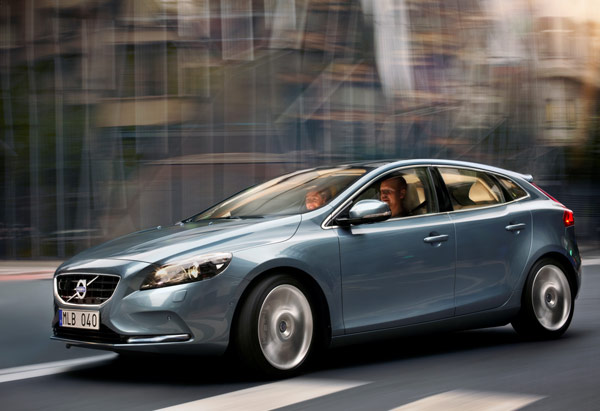
In the diesel versions, the options offered by the new V40 are even more: The D2 version with the turbo diesel engine 1.560 ml, with 115 horsepower, with torque as his main weapon: 27,5 kg. (that take place 29,05 kg. with overboost). It is worth noting that the D2 version depending on the choice of tires/rims may have CO2 emissions 94 or 99 ml/km. The consumption of the new V40 with the 94  gm/km is just 3,6 liters/100 km. in mixed traffic conditions (respectively the issue of 99 ml/km. he's got 3,8 liters/100 km). In both cases there is an exemption from road tax while the suggested retail price remains the same, which starts from 21.970 euro with withdrawal (initial 23.400). Note that the price of the D2 version is just 900 euro greater than the as well 1,6 liter petrol version T3. The D3 version with the 5 cylinder turbo diesel engine 1.984 ml, with 150 horsepower, which starts from 25.750 euro with withdrawal (initial value 28.550), in the Optimum version with a 6-speed manual gearbox. CO2 emissions are 114 ml/km. The D4 version with the 5 cylinder turbo diesel engine 1.984 ml, with 177 horsepower, which starts from 28.980 euro with withdrawal (initial value 31.780), in the Kinetic version with a 6-speed manual gearbox. CO2 emissions are 114 ml/km.

Source : 4troxoi.gr
The ancient Greek past of the Burrot in the light

The research has been conducted since last May by an American University

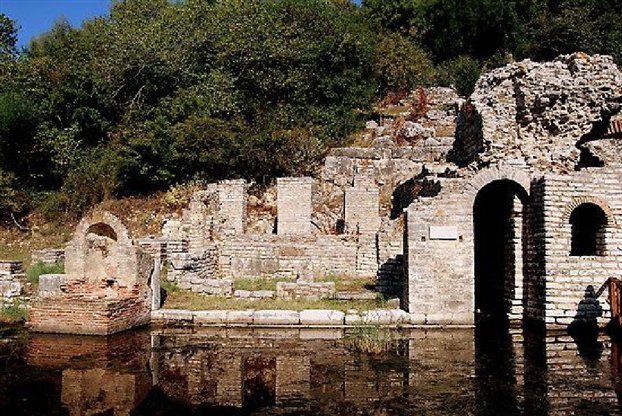
A wooden plow of the 7th BC. century they traced to 6,5 meters deep the members of the American archaeological mission of the University of Notre Dame in the ancient city of Buthroto in Albania. The object came to light during last week's excavations and is of great importance, as it is the first wooden find not only in the area but in the entire Balkans.

Besides, it should be considered, that it is Greek, as in the 7th BC. century the Greek colony of Bouthrotos was founded, which later in the Roman era also experienced a great flourishing and subsequently acquired a Christian diocese.

This plow that is, which was kept submerged in water, like all the ruins of the ancient coastal city it comes from the first Greek years of Vothrotos' life. Something very important, because the surviving remains of the city date back to the Roman and Byzantine eras.

The research has been carried out since last May by the American archaeological mission of the University Our Lady of Indiana under the archaeologist David Hernandez, which he first collected for this purpose 55 experts including archaeologists, anthropologists, bioarchaeologists, geneticists, historians as well as students from Albania, USA, Italy, Hungary, Hellas, Czech Republic etc. An important find this year was also the propylon of a building that had high columns and a floor paved with stone slabs.

also: More than 250 were the coins of various eras that came to light testifying to the developed relations of Bouthrotus with the countries of the Mediterranean throughout antiquity. The vessels, especially those of the 4th and 3rd BC. century is of exceptional quality and art, a proof of the high standard of living of the inhabitants but also of the range of trade. Copper objects, buckles, jewelry and glassware, spatulas but also parts of sculptures (mainly extremities: hands and feet) complement this year's harvest, while a pleasant surprise from the Middle Ages was a whistle that was probably used to call hawks.

Moreover, the surface archaeological research in the area proved to be particularly important, during which Paleolithic and Neolithic bones and objects were collected, such as ceramics, which prove the oldest habitation in the area.
Bouthroto is in the distance 20 about kilometers from Agioi Saranda and was a city that was preserved over the centuries by changing rulers.

After the Romans in the early Christian years it was one of the twelve cities that made up the province of Epirus, in the Middle Ages it is even mentioned as an important fortress. After the conquest of Constantinople by the Franks, it passed to the Despot of Epirus while the conquerors alternated (Sicilians, Navarros, Venetians Mr. a.) with interest mainly for its rich fish farms. As a city it was abandoned in the 15th century due to its wet soil.

Source: tovima.gr

The ancient Greek past of the Burrot in the light

The research has been conducted since last May by an American University

A wooden plow of the 7th BC. century they traced to 6,5 meters deep the members of the American archaeological mission of the University of Notre Dame in the ancient city of Buthroto in Albania. The object came to light during last week's excavations and is of great importance, as it is the first wooden find not only in the area but in the entire Balkans.

Besides, it should be considered, that it is Greek, as in the 7th BC. century the Greek colony of Bouthrotos was founded, which later in the Roman era also experienced a great flourishing and subsequently acquired a Christian diocese.

This plow that is, which was kept submerged in water, like all the ruins of the ancient coastal city it comes from the first Greek years of Vothrotos' life. Something very important, because the surviving remains of the city date back to the Roman and Byzantine eras.

The research has been carried out since last May by the American archaeological mission of the University Our Lady of Indiana under the archaeologist David Hernandez, which he first collected for this purpose 55 experts including archaeologists, anthropologists, bioarchaeologists, geneticists, historians as well as students from Albania, USA, Italy, Hungary, Hellas, Czech Republic etc. An important find this year was also the propylon of a building that had high columns and a floor paved with stone slabs.

also: More than 250 were the coins of various eras that came to light testifying to the developed relations of Bouthrotus with the countries of the Mediterranean throughout antiquity. The vessels, especially those of the 4th and 3rd BC. century is of exceptional quality and art, a proof of the high standard of living of the inhabitants but also of the range of trade. Copper objects, buckles, jewelry and glassware, spatulas but also parts of sculptures (mainly extremities: hands and feet) complement this year's harvest, while a pleasant surprise from the Middle Ages was a whistle that was probably used to call hawks.

Moreover, the surface archaeological research in the area proved to be particularly important, during which Paleolithic and Neolithic bones and objects were collected, such as ceramics, which prove the oldest habitation in the area.
Bouthroto is in the distance 20 about kilometers from Agioi Saranda and was a city that was preserved over the centuries by changing rulers.

After the Romans in the early Christian years it was one of the twelve cities that made up the province of Epirus, in the Middle Ages it is even mentioned as an important fortress. After the conquest of Constantinople by the Franks, it passed to the Despot of Epirus while the conquerors alternated (Sicilians, Navarros, Venetians Mr. a.) with interest mainly for its rich fish farms. As a city it was abandoned in the 15th century due to its wet soil.

Source: tovima.gr

Bofiliou, police & Golden Dawn

The reactions from Golden Dawn supporters, in a tweet written by Natassa Bofilou, they forced her to call the police on her live.
After the May 6 elections, the "rise" of the goldsmiths at the entrance of Nikos Michaloliakos in the press conference, angered Natassa Bofiliou, who did not let it go that way. That's why she wrote her opinion on twitter, saying “beasts, bums, you were also given importance. To die fascists, members and voters, as a sign of respect for human dignity ". That was enough, to provoke the reaction of hundreds of people, to the point of sending threatening messages to her and forcing the famous singer to call the police at the concerts - more because she was afraid for the spectators, as it says.
"I was talking about political and ideological death and not biological. Ε, and they fell to eat me, I had too many threats. "They sent me e-mails that read 'baby, we will hang you from your guts in the Constitution' and various such obscenities," he says today about this incident and adds: "The truth is that I was scared and in my appearances at that time I always called the police precautionarily. I was mainly afraid of the people who had come to see me ".

Source : pkool.gr

Hamilton: 'Bad day at work'

He described it as a bad day at work Lewis Hamilton the grand prix at the Valencia circuit. The British pilot retired one lap before the checkered flag, because of the accident with Pastor Maldonado.

However, the Brit admitted that this is how racing is, adding that the positive thing is that other contenders for the title also lost valuable points.

"I had a bad day at work, but that's how racing is. A lot has changed in the state of the league, we lost a lot of points, but fortunately the pilots who are still within the title battle, like Sebastian they lost points, but that makes the situation more difficult", were the words of the British pilot to fill in afterwards.

"You put your heart and soul into achieving something and in the end you don't achieve what you want, but such is life. You compromise and move on, there are still many matches", he added.

Hamilton is third in the standings, abstaining 23 points from the pioneer, Fernando Alonso.

Source : sport-fm.gr

The theater director D. has passed away. Exarch

At the age 57 years, Dimitris Exarchos breathed his last today, theater director with a presence at the National Theater and in elementary schools – regional theaters.

Dimitris Exarchos, son of the actor Theodoros Exarchos, born in 1955 and studied theater in England. He had been working in Greece since he was ten years old 1980. At the National Theater he had directed shows such as David Storey's "Asylum" and Erik Ibsen's "Vampires".

At the end of his decade 1990, the director's life took a very unpleasant turn due to a fatal accident. Specifically, in March 1999 in Crete, riding his motorcycle, he tried to avoid a pedestrian and fell, hitting his head. The blow left him paralyzed, resulting in him not being able to walk again and speaking with difficulty. So, he spent the last ten years of his life in the Aniaton Asylum in Kypseli.

The last goodbye to Dimitris Exarchos, from relatives and friends, will be given tomorrow, Wednesday 27 June, at 11 in the morning at the Byron Cemetery. His family is appealing for those interested, instead of sending wreaths, to allocate the corresponding money to the Aniaton Asylum.

Source : protothema.gr

The theater director D. has passed away. Exarch

At the age 57 years, Dimitris Exarchos breathed his last today, theater director with a presence at the National Theater and in elementary schools – regional theaters.

Dimitris Exarchos, son of the actor Theodoros Exarchos, born in 1955 and studied theater in England. He had been working in Greece since he was ten years old 1980. At the National Theater he had directed shows such as David Storey's "Asylum" and Erik Ibsen's "Vampires".

At the end of his decade 1990, the director's life took a very unpleasant turn due to a fatal accident. Specifically, in March 1999 in Crete, riding his motorcycle, he tried to avoid a pedestrian and fell, hitting his head. The blow left him paralyzed, resulting in him not being able to walk again and speaking with difficulty. So, he spent the last ten years of his life in the Aniaton Asylum in Kypseli.

The last goodbye to Dimitris Exarchos, from relatives and friends, will be given tomorrow, Wednesday 27 June, at 11 in the morning at the Byron Cemetery. His family is appealing for those interested, instead of sending wreaths, to allocate the corresponding money to the Aniaton Asylum.

Source : protothema.gr

our breath, Your review