Tag Archives: tovima.gr

Greek-German teenage alliance

Documentary film production workshop with Greek and German students during the crisis

What could be the result of a collaboration between Greek and German students?, the common characteristic of which is that they prefer to see the world through the lens of the camera; What would the Greek children like to show the Germans from their country; But also what would the Germans like to show the Greeks from their own country;
 
Questions like the above have been put on the table for a few months now through an ambitious plan of "cultural cooperation and exchange of hospitality" between Greece and Germany. Greeks in Germany and Germans in Greece under the veil of support of the Creative School in Bergis Gladbach, Germany (in collaboration with the Screenagers creative network), of the Goethe Institute of Athens and Story Doc, of the Greek educational institute for the promotion of the documentary.

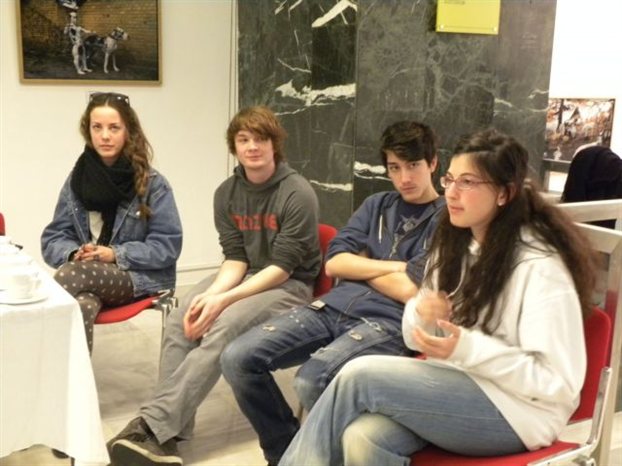
Six German kids from Bergis Gladbach, Cologne and six Greek kids from Athens (ages range from 15 to 20 years) shared endless hours in Athens and Bergis Gladbach for a joint exploration of their countries. The results are recorded by their cameras. Everyone's goal is to reveal unknown aspects of Greek and German life and reality in the time of the economic crisis.

In order to find the children who would represent Greece, visits were made to 22 schools of the Attica basin (indicatively the Zografou High Schools, Byron, Keratsini and Nea Ionia). During the seminars that followed in four schools (20 children per school), the "tremendous awareness of children in machines of digital capabilities" was noticed, said Mr. Costas Spyropoulos of Story Doc, who co-directed the seminars. “It was incredible to see how perfectly the children handled valuable cameras 27.000 euro". The children were selected based on the script they had written, while the production direction of the overall program is Dieter Bongaardz, German screenwriter, documentarian and writer and his compatriot Vera Scheffler who runs the film institute in Greece and Germany. From the Greek side, the participation of the Goethe Institute is extremely important for the successful development of the project thanks to the tireless efforts of Mrs. Sofia Michailidou and the cultural events manager Mrs. Juliane Steiner.

Euro crisis and debt relief articles are multiplying at an alarmingly rapid rate and with them buried memories, prejudices and intolerances come alive again. The historical memories and experiences of the two world wars come to the fore, with the Germans once again playing a dominant role in a ruthless economic war that we now experience on a daily basis. Opinions and attitudes favor the generation of new conflicts. But also collaborations.

In yesterday's (Monday 20 February) presentation held at the Goethe Institute, Greek and German children participating in the process spoke to representatives of the press about their effort. "We are together to find a common language" characteristically said 18-year-old Michael. "We are not talking specifically about Merkel but we are working together and that is the important thing".

"We all know what's happening in Greece because the Mass Media take care of it," 15-year-old Anastasia told us. “But the news of civilization does not travel. It wouldn't matter to talk about Merkel. Better to learn what you don't know than to reproduce what you do know".

Therefore, the unknown aspects of the social life of both countries were in the priorities of the four-member teams who undertook the creation of the films. The ultimate goal of the effort is mutual understanding and contribution to an inter-ethnic/intercultural dialogue in order to overcome prejudices, misinterpretations, even hostilities, which are cultivated, sometimes exaggerated in the public sphere by opinion leaders and individual media outlets.

The first and second films were shot in Germany. At one, through the personal stories of two young people we follow the events in a house under occupation in Cologne. The second film shot in Germany concerns the activities of a musical band created by second-generation Spanish immigrants with Cuban roots.. Their parents were in their thirties during the Spanish Civil War when they immigrated to Germany.

The subject of the third film is the meeting itself 12 children who program. The first part of it was shot in Germany and the second will be shot here by the same group. The core of the second part will be the revelation to the Germans of how hard a 17-year-old Greek student works while trying to enter the University.

Future film plans to be shot in Greece will be a film about an astronomer set against the backdrop of the Observatory, one for the case of a teacher who teaches hearing impaired children free of charge and one for the construction of the footbridge in Kifissia at the height of the College from the voluntary work of the students and donations from the family who lost their child at the same spot.

"We went to Germany to dispel stereotypes," said 16-year-old Marianna. "To show that we can do things together".
The recent events in the center of Athens with the destruction of the Atticon hall and other buildings, they did not discourage the children. On the contrary, one of the projects they would like to work on is a film about the buildings between Syntagma and Omonia. "The attack on the halls brought out a different one “quality” violence," said 21-year-old Ruben, one of the oldest children in the group.

What does Greek mean to Germans and what does the opposite mean?; "We cannot judge two nations by the behavior of two heads of state, i.e. two people" believes Anastasia. "Things must be said objectively. Judgments should be everyone's business." For Michael, however, "Greeks have ugly gray buildings, but inside you are colorful. On the contrary, we have beautiful buildings but inside we are gray".

"I have heard of the Germans that they are arrogant, narrow-minded, with absolute ideas for the Greeks" says 15-year-old Eleni for her part. “Gee’ they think that all Greeks are lazy, irresponsible and thinking only of their own interests".

Maybe with this joint effort, some will begin to think differently.

Source : tovima.gr

Greece is on everyone's mind

The Greek crisis monopolized the interest at the 62nd Berlinale

"Congratulations, Gentleman" ("Congratulations, Sir"). Monday noon on the fourth floor of the "heart" of the Festival, in the Berlinale Palast hall. Vittorio Taviani takes out his briefcase and says the above words to me as he shakes my hand tightly as he bids me farewell. Our interview with his brother Paolo has preceded.
The inseparable duo of veteran Italian creators ("Father Master", "Chaos", "Alonzanfan") was in Berlin for the presentation and promotion of the movie "Caesar Must Die". But when they heard that someone from the small group of journalists in front of them was Greek, showed undivided interest. «The Greece, the Greece…Vittorio murmured plaintively.

It had only been a few hours before the night Athens turned into hell. The nightmarish images had been beamed across the planet and the Taviani were aware, like everyone else. "A lot of bad things in Greece at this time" Paolo Taviani told me. “I still mourn the good man, my very good friend, this great director and man, Theodoros Angelopoulos. And now this disaster… In Italy we are afraid. We are afraid of what we see happening in Greece and what we cannot predict will happen. Maybe I'm naive, but I still believe in Europe, in the European Union and in the capacity of this institution, through capital and banks, to solve the problem of debt and the financial crisis".

"Spain's position is worse"
This year in Berlin, every time you said you were from Greece, the looks were changing. Others joked (black), others assumed a mournful tone, others were surprised to see me there, while some were of the opinion that Greece was the easy target, the weak link, the scapegoat of the European Union.
Talking to Spanish actor Juan Diego Boto, who played the inquisitor in "El Greco" by Yiannis Smaragdis (and whom we will see in the latter's next film "And God Loves Caviar"), I was surprised by the severe criticism he leveled at his own country: “Our position is worse than yours, because today in Spain the opinion of the people does not count at all" said Boto, giving as an example the demand of the European Union that his country include in its Constitution the control of its deficit.
"The Constitution of Spain prohibits changes unless voted by the people. So what they did was to change the Constitution so that the people didn't have to be asked. They changed the Constitution so they could… to change the Constitution. After that I stopped believing in a cheating system".

"The only solution, let the streets burn"
"My opinion is that the collapse of the communist system can only lead to the collapse of the capitalist one," German director Christian Petschold told me., who was also competing with the film 'Barbara', the story of an East German doctor (Nina Hoss) who is determined to escape to the West. "The only real chance for things to change and for the rotten system to die that is not only suffering Greece but the whole world is in the lower layers, to the people themselves. But this will be a very bloody business and people are afraid of it, as I fear her too".

Petschold, however, is in favor of extreme demonstrations in Greece. "The roads must be burned, this is your only chance" he said referring to last Sunday's events. "You saw how the Socialist Party of Germany reacted; It is against the oppression that Greece receives. We Germans must show solidarity towards the Greeks. The workers must stand with the workers. This is not a war of states but a sign of solidarity among the workers of all peoples".

"Despair is not an option"
The positive in all this ominous situation is that a Greek-speaking film represented our country in the official competition program of the 62nd Berlin Film Festival. "Meteora" by Spyros Stathoulopoulos, co-production of Greece / Germany, they refer to the love of a monk and a nun of Meteora (Theo Alexander – Tamila Kulieva). "Everyone has their own opinion on the crisis," the young director told reporters. "I can only be objective when I see and hear everything,what is going on inside my own house. The strict austerity measures have affected everyone in Greece, a fact I experienced seeing my grandmother's pension halved. For’ that's why I decided to give her a role in my film" he concluded, causing a lot of laughter in the room. Referring to the unpleasant phase that Greece is going through, Theo Alexander in the same interview said the most hopeful thing. The actor, who is currently making a good career in America (plays one of the vampires in the hit TV series 'True blood'), found a way to combine film with reality: "I think that in their hearts the “Meteora” they say that in the dark times we live in these times, despair is not an option. We are lucky to be among the living. And as the living we have a duty not to give up and to fight".

Source : tovima.gr

The Olympia Museum was robbed at gunpoint – Resignation of Geroulanos

The Minister of Culture submitted it to the Prime Minister – There is still no response from Maximos

From the closed circuit surveillance images of the old archaeological museum in the center of the city of Olympia, the Security officers hope that they will derive useful information, which will lead them to the tracks of the two hooded men, who early on Friday morning grabbed approx 68 ancient objects.

According to the first information, the two men wearing camouflage uniforms broke into the museum on 7.30 in the morning they immobilized the security guard at gunpoint, who is an employee of the Ministry of Culture, they tied her up – according to the information of the prosecuting authorities – to one of the statues and gagged her. In broken Greek they started asking her to show them where there is a "wreath of gold" and coins. The employee insisted that there are no such objects in the Museum, and then the robbers began to break the display cases around them and grab everything,what were they finding.

According to the police, most of the items were copper and clay, while it seems that between f’ but the perpetrators also took a gold ring – although an accurate picture of the antiquities that have been removed is expected after the autopsy that is currently being carried out by the curators of the Museum is completed.

As the same information states, the police do not know how and in which direction the perpetrators escaped and for this reason they are looking for information throughout the city from people who may have seen them.

He submitted his resignation to the Prime Minister Mr. L. Papademos, the Minister of Culture, Mr. P. Gerulanos. Megaro Maximos has not yet responded.  Meanwhile, a police force left Athens to assist the local department in the search for the perpetrators. The Prosecutor of First Instances of Ilia, Mr. P. Maidanis.

History of the Museum

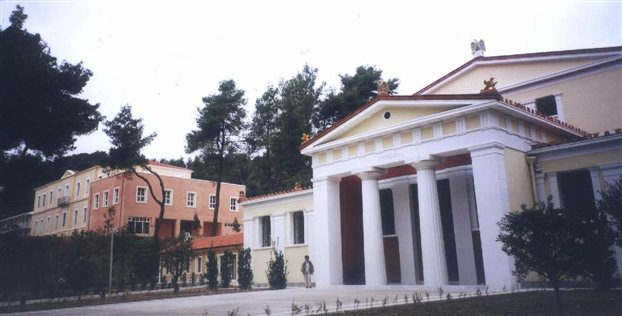
The thematic Museum of Ancient Olympia is located at the edge of the city (that is, it is not located inside the archaeological site) and is the first Museum to be restored on the occasion of the Athens Olympics 2004 to house the finds from the ancient Olympic Games.

In the showcases and in its premises they are found 463 works from the Sanctuary of Zeus of Ancient Olympia but also objects related to the Olympic Games from other Museums of Greece. The exhibits start from the second millennium BC. and reach up to the 5th century AD. It has clay and bronze figurines of warriors and chariots, various items used by athletes such as discs, dumbbells, sycophants, strands ( copper scrapers for cleaning the body), inscriptions, bronze figurines…

Source : tovima.gr

New life for the ancient theater of Larissa

It literally emerged from under the buildings of the modern city

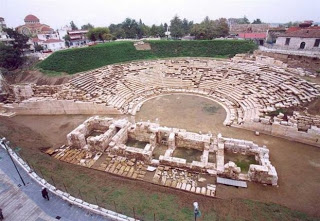
The ancient theater of Larissa is slowly acquiring a part of its lost glory, which literally emerged from under the buildings of the modern city, to start a wide program of maintenance and restoration a few years ago. Next step now, it is the restoration of its scales but also of one of its sides, interventions that will significantly contribute to the image of the monument, both aesthetically and in its understanding.

The studies, which were approved on Tuesday by the Central Archaeological Council are certainly intended first to strengthen the static adequacy of the main theater by preventing the seats from falling. In addition, it will be possible for visitors to move around the area, something that is currently impossible due to the discontinuity of the tiers, while the totality of the interventions will essentially contribute to the restoration of part of the theater's lost acoustics.
To achieve the specific task, archaeologists and architects have completed the identification of all the scattered architectural members, coming from the ranks, their maintenance and welding has been done while, where required, additional new marble from the ancient quarry located in Kastri Larissa will be used.

In order to restore the slopes, several older structures will first have to be removed, as well as the fencing made of iron pipes _an important aesthetic nuisance for the monument today_, while an excavation will be made in the area of ​​the original building of the military bakeries that were located above the theater, in depth at least 1,50 measures in order to look for architectural members. But some of them, are already visible while others will certainly be sought, which may be scattered in the area. Finally, the slope will be restored with backfilling.

The 1st ancient theater of Larissa was built in the 3rd BC. X. century, extends on the southern slope of the hill of Ag. Achilleiou (ancient Acropolis) and operated for six centuries, during which it underwent various transformations. On the 2nd. X. century the stage building was completed with a proscenium and during the Roman era the building suffered serious alterations: From the 1st p. X. century that is, it was used as a Roman arena while at the end of the 2nd AD. X. the first four rows of seats were removed to enlarge the orchestra. A free throw at the building ended it, an earthquake in the 7th AD. X. century, when much of the amphitheater and the second floor of the stage collapsed. However, during the years of the Turkish occupation, a large part of it was visible. On the 1st p. X. century, however, a second one had also been built, smaller and modest theater in Larissa, which was discovered the 1978 within the city as well.

Excavation began in the decade 1980 but he proceeded slowly, as expropriations and demolitions of the properties located on the monument had to be preceded. The restoration project is part of the Credit Management Fund for the execution of Archaeological Projects.

Source : tovima.gr

Report on the "irrational truth" of Papadiamantis

One hundred and thirteen artists participate in the tribute to the Archaeological Museum of Patras

From Nikos Stefanos to Yiannis Psychopaidis, and from Alexis Veroukas to Michalis Madeni. One hundred and thirteen artists talk about the 'absurd truth' of an ever-fascinating writer, of Skiathite Alexandros Papadiamantis. Of the walker with 'the messy beards, the unkempt surroundings, the muddy shoes, the faded half-high, the papadist barrel with the silver handle and the improvised collar with the black cord".

The exhibition "Visual Tribute to Alexandros Papadiamantis: The truth is always absurd" is already hosted by 9 February at the Archaeological Museum of Patras and will last until 18 Of March.

After her very successful presentation in Athens at the Melina Cultural Center last December, the dedicated exhibition to the leading Greek writer organized by the artistic company Mikri Arktos is transferred to the new Archaeological Museum of Patras organized by Art in Progress "with the conviction that Papadiamantis today, frugal and at the same time extremely penetrating and self-aware both in his life and in his work, remains as relevant as ever". The 6th Ephorate of Prehistoric and Classical Antiquities and the University of Patras collaborate.

The 113 participating artists create wall and sculptural works starting with Alexandros Papadiamantis, attempting to penetrate small aspects of his life and work: to talk about Papadiamantis, the quirky and bohemian in his private life, the more ecclesiastical than religious, the “lonely, unloved and suffering", the reckless spendthrift in the disposal of his hard-earned money though extremely unnecessary in terms of his daily needs, the savior and not the devourer of souls, the user of a rare private language that draws from both the vernacular and the pure, the "saint of Greek letters" and "dark sparrow" of his own stories, the patron of the Dexameni cafe, the solitary walker of Psyrris and regular chanter of Agios Eliseus who sometimes commemorates the autobiographical landscapes and the humble but full of dark passions of Skiathos and sometimes meticulously sketches the slums of Athens and its strange inhabitants.

Archaeological Museum of Patras New National Road of Patras – Athens Tel: 2613 616100

Entrance to the exhibition is free

Source : tovima.gr

Adel: The winner of this year's Grammys

Won the award for song of the year with 'Rolling in the Deep'

British soul singer Adele won the Grammy Award for song of the year, with "Rolling in the Deep", for Best Pop Solo Performance, with "Someone Like You" and two other awards at the ceremony held at the Staples Center in Los Angeles.

The ceremony began with emcee El El Cool J offering his condolences to Whitney Houston's family and praying on stage for’ her. Houston's death almost monopolized the talk before the event while it was constantly referenced during it.

Adele receiving the first awards thanked the surgeons who removed a polyp from her vocal cords.

Rock band Foo Fighters were also among the big winners, winning four awards, among them this one for Best Rock Performance with 'Walk'. The leader of the Foo Fighters, Dave Grohl, pointed out that their last record was not recorded in a studio, “but in my garage, with some microphones and a cassette player. ..»

This "shows that the human element is important" in music, he added.

The reports in Houston, who was found dead yesterday in a hotel in Los Angeles aged 48 years, they were continuous. Melanie Fiona, which won the award in the R performance category&B with the song "Fool For You" said that the deceased was her source of inspiration. "I wouldn't be standing here if it wasn't for you", he said.

Among the rest of the winners - in total 75 categories- it was also Jay Z and Kanye West for the rap song 'Otis', who, however, did not show up to receive their award.

Source : tovima.gr

Nikos Kalamos: I was trained to play the stink with color

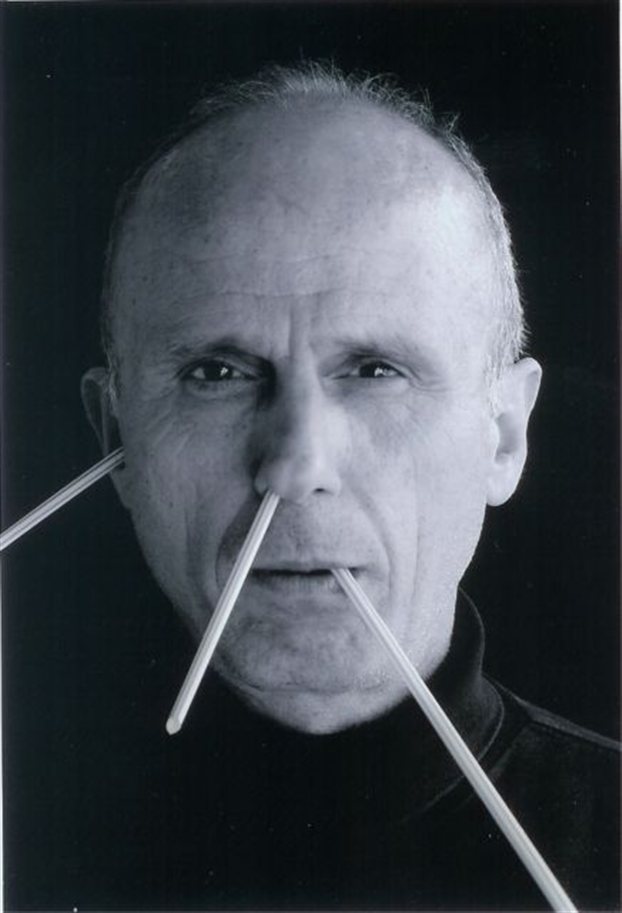
With baggage from his six-year stint next to Stella Adler in New York and what the teacher has said - such as that "the last stage of vanity is success" - Nikos Kalamos is a modern hermit of the theater. The last ones 16 years living in the heart of nature, in Ellanion Oros in Aegina, and is confronted with texts of world literature. The creator of the Theater Nursery of Aegina, where amateurs of all ages and professions are trained, states an apprentice actor, he repairs furniture to secure a living and presents a series of monologues in Athens, after first "trying" them on the island, in a series of paradoxical spaces, such as the auditorium of the Wild Bird and Animal Sanctuary.

I started…
To learn what real theater means next to the great Stella Adler, who together with the Clermans, Strasberg and Kazan founded the Group Theater until McCarthyism stopped them in the 1930s. My studies in New York are the big station of my CV. I first met her in Hollywood in the early 80s, when I was acting in some small theaters with the little English I knew and he asked to see my work – I remember that it was a monologue that Titos Vandis had pointed out to me. And then she told me to come to New York to study text analysis at her studio. I stayed six years with Stella. Yes, she was old and had told reporters not to tell her real age. I met her when she was 93. He died 13 years later. Pass them 100 teacher.

I learned…
To be steely in the face of criticism. Adler criticized us harshly. also, he used to tell us that the last stage of vanity is success. “I want you to make your own group. Don't go to every producer and director" he told us. He hated film directors… Along with studies, I gained access to off and off Broadway theaters. I played you 18 foreign productions in New York and three in Los Angeles.

I'm back…
In Greece the 1990. Five years later I created the Theater Nursery of Aegina. I work with amateurs of all ages and classes. We had a doctor, we have teachers, people working in the Municipality of Aegina, students etc. This gives me my independence – and this I consider to be the success of the craftsman: to be independent of producers. When you have your own team, he chooses the texts he wants and has unlimited time to work. The last work we did at the Nursery was Beckett's 'Catastrophe'. To present a seven-minute play, we worked for six months.

I never forgot…
What Adler told us when she was at the theater to watch the performance of "The Lust Bus" with Marlon Brando. When asked if he has decided how he will play Kowalski, he told her: "Stella, not yet". This means that Brando, until it comes out on the board, he had at least ten options on how to play – notable, he was Stella's student and later they became lovers. Out of generosity, later, brando made up with her daughter.

I directed…
The five monologues that I present at venues such as Topos Allou or the Michalis Kakogiannis Foundation. No, I don't hate directors either, I just find that monologues give me a freedom. I take the cassock of the hieromonk and take the works wherever I want.

Consider…
That in the works I present there is what is called "invisible geometry". These are very important texts. Seven years and I didn't understand what "The Woman of Zakythos" by Dionysios Solomos wanted to say. It's a dark one, elliptical work. And the most important comment I got from soloists when I presented it in the past is that I glossed over aspects of it.

Start…
With "The Penultimate of the Monikins" by Pari Takopoulos in Topo Alou. I have presented it in the theater of Giorgos Armenis, at the Edinburgh Festival and two years ago at the London International Festival. I am also presenting "The Woman of Zakythos" at the Michalis Kakogiannis Foundation on 29, 30, 31 March and on 1, 2 and 3 April. Subsequently, in early May, I will upload Eric Boghozian's "Drinking in America" ​​to the Michalis Kakogiannis Foundation. These are ten short monologues – a hard task, but we have been trained to play stink with color. Now I have found a new friend, the Homer. I upload Rhapsody A’ of "The Odyssey" translated by Dimitris Maronitis at the Kakogiannis Foundation in early June. End, the 2013 I will upload the work of Iros Diamantourou "A night without Sancho", also at the Kakogiannis Foundation. I will present the texts for the first time in the summer in Aegina, in a magnificent amphitheater on Hellanion Oros.

I chose…
To live close to nature, because one becomes more essential in’ her. It demystifies many things. Like death, which is an existential station. Nature is the measure of life and I live in the heart of nature, on a mountain. No man steps here, just no friend. You know, Aegina is a place of hidden people. A lot of serious people live here. It is a small Greece.

Declare…
Apprentice actor. And I don't say that out of modesty. It must be very difficult to be a professional actor in Athens. Because you might be forced to do something that doesn't represent your deepest art, to pay your rent. In order to support myself, I repair old furniture. And that's how I survived in New York. But that satisfies me because I'm doing something with my body.

Believe…
That the Greek is born for the stage. Language is a vehicle for the actor, plus it also has this huge collective memory – all the tribes have passed from this place. Fri.’ I say all this to the actors of Phytorio: "Leave Greece for a while and go live in London or Dublin, which is the best theater in the world, or in New York". I also graduated from the drama school of Vafias in Athens, but it took me three years in America to… to forget,what I had learned. We were playing, remember, with a blunt, we didn't do text analysis and the professors kept their minds on when they were going to get paid. That was their only concern.

Note…
That the world needs new heroes, new standards. Now more than ever. I realize this because I have seen performances in Athens with full houses – Fri.’ the whole crisis. Well, people are looking for something to find. His lost spirituality, perhaps. Bad lies, first we lost something else and then our money.

when and where
"The penultimate of the Monikins" by Pari Takopoulos.
Elsewhere, Cephalonia 17.
At 13, 14, 20, 21 and 28/2, at 9.30 p.m.
Information on tel. 6974 521.213

Source : tovima.gr