|
He may have become world famous in his capacity
able recruit, but Alexander the Great was an equally keen economist,
with …masters in war economics, which were not offered for
weak "solvers".
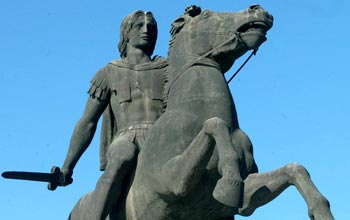 Aristotle's student demonstrated excellent management
ability, although the financial budgets of the battles included in
general lines, what those of the states also contain (and were connected directly
with them): payrolls, health and welfare, construction programs, supplies,
transfers, tax system reforms, indirect taxes and donations,
even fiscal scandals.
How his soldiers and equipment were paid for
of Alexander the Great; How many short-term loans he took out for his needs
war and why he forbade the women of Ephesus to wear jewelry; What
gift he offered to the guests at his wedding and what was her fortune
Gaza's huge perfume warehouse;
Answers to these and many more questions will be given by
Administrative Justice Appellate Dimitrios Kostopoulos, in the lecture context,
entitled "The Finances of Alexander the Great", who is organizing tonight the
Vafopouleio Spiritual Center (Deputy Mayor of Culture and Tourism
Thessaloniki). Mr. Kostopoulos gave AMPE a "taste" of the main ones
points of speech.
Multi-speed military payroll
Until the 331 e.g., the main expenses of Alexander
concerned -among other things- the following: army payroll, maintenance
equipment-siege machines, fleet creation, sustenance, transfers
and health care. The most important direct war expenditure was the
payroll, the amount of which was determined by a military payroll: the army
it consisted primarily of Macedonians, who served their country, from
allies of the Greek cities (partners) and professional mercenaries.
Although the information of historical sources does not agree
to the amount of the salary, approximate calculations lead to the conclusion
that, at the beginning of the campaign, the amount of salary of the common soldier
was rising (average) The day for the draw of the two lucky ones 1-2 drachmas per day.
"The corporals or corporals received a monthly salary 40
drachmas. The salary of the platoon was double that of the horsemen
twice as many pedestrians. According to Diodorus the horsemen received 300 drachmas monthly
and the Macedonian phalangites 100 drachmas, while for professionals
mercenaries there were additional financial incentives", notes the
Mr. Kostopoulos.
Annual payroll expense 4.000-7.000 talents
The overall figures were unfathomable: enough n’ consider
someone that the 334 B.C. crossed the Hellespont a military force of more than
35.000 of men, to which they must be added 10.000 men of Parmenion
(which preceded the 336 B.C) and the army which Alexander maintained at
Macedonia (12.000). The annual salary expense is estimated to have amounted to
4.000-5.000 talents in the first year of the campaign.
Not in the following years, increased further, in approx 7000
talent -not counting the fleet- because Alexander strengthened him
his army of mercenaries from the Greek cities of Asia Minor, while
he had to establish garrisons in territories he occupied.
After the capture of Susa and Persepolis and the acquisition
of the Treasury of Darius, spending on military payroll soared:
for the Indian campaign Alexander organized an army 140.000 of men,
while he built a fleet at least 150 ships, which they brought 3.000-5.000 men.
Engineers, bridge builders and bed makers
Beyond payroll, maintenance costs were high
and renewal of war material. Alexander's army was for the time
of a technologically advanced war machine. The army was followed by engineers,
who manufactured and maintained various war machines and the
siege org staff, who operated the "petrol guns", their
"composite towers" or "cantilevers",the well-known "heletowns", the rams,
the turtles and the mirrors. also, beside the army marched others
technicians, such as bridge builders and tent and bed makers.
The supply also required large expenses, sustenance
and transportation, not only of the army but also of their women and children
families of soldiers, for the service of which it operated
organized transport and supply corps.
A hundred talents just for medicine, but also provision for the
children of the fallen
Systematically organized - and therefore costly- was also
sanitary service of Alexander, which included doctors, botanists,
pharmacists and nurses, who were following the campaign. THE
Diodorus mentions that for the Indian campaign Alexander allocated for
medicines 100 talent.
also, Alexander was spending considerable sums on
compensations to the parents and families of the fallen, in which
granted royal estates and tax exemptions, while Justin
mentions that he continued to give his salary to the orphans of the fallen
father..
"Appeasers" or "layer keepers"
The war did not require, Nevertheless, only wages, equipment and
resupply, nor just reparations. He demanded, according to Alexander, holidays
and festivals to boost the morale of the army - and for them, the
expenses were great.
also, war budgets covered spending on
cooks, bankers and grocers, even for strangers today
properties, such as the …bedguards or appeasers, who guarded him
Alexander and the generals while sleeping.
Six hundred talents yearly for royal meals and
sponsorships for returnees
Royal meals were very expensive, for which the
Plutarch reports that Alexander was spending 600 talents annually. also,
Alexander was particularly generous in the remuneration of those who were particularly distinguished
in battles and sieges: according to Diodorus, after the victories of Issus and
of Gaugamelos were donated 3.000 talents, while for the conquest of the Ecvatans,
besides the jewels were distributed 13.000 talent.
The donations to the returnees were still large.
According to Arrian to the Greek allies, who wanted to return,
were granted with 2000 talents for wages/return expenses, while those
strove to remain they received three talents each.
Alexander was equally generous to the veterans.
According to Arrian, to the Macedonians who, due to old age or illness, became
incapable of war, a talent was also granted in addition to the wages, as
and the costs of repatriation.
Short-term loans to meet his needs
war
But where did the revenue come from to cover it all?
of these needs; At the start of the campaign, mainly from the basil
treasure of Philip, while an important source of revenue was its mines
Macedonia, which provided gold and silver for coinage.
in addition to, customs provided revenue from duties, to whom
taxes from royal lands were added.
More important, Nevertheless, source of income was lending. According to
Plutarch, in the early years of the campaign Alexander borrowed short-term
1.460 talent.
The expense of professional mercenaries was borne exclusively
the royal treasure, while the expenditure of the Macedonian army was covered in
partly by donations from the nobles, the so-called functions, and partly from
the royal treasure.
In everything,what about fleet spending, Alexander the
faced with the institution of the triarchy, during which certain cities
they undertook to contribute a number of triremes towards the expense of the crew.
Why the cities of Asia Minor were declared "unlawful"
Regarding taxation, Alexander did not impose
taxes at the expense of the Greek cities of Asia Minor, which he preached
"assydotes", because his campaign was aimed at ridding them of him
servitude tax to Darius.
With the cities that did not resist the campaign o
Alexandros made an agreement for the payment of’ those of the so-called
pension, as a federal contribution of money to meet the expenses
of the common purpose of punishing Darius.
The so-called "chore" and why the women of Ephesus
they wore no jewelry
In the cities that showed a hostile attitude to Alexander and
friendly to Darius, Alexander unilaterally imposed an extraordinary levy, the
so-called damage, that is, a kind of fine, which was either monetary or
in kind, the so-called chore.
A special case is the tax on the Ephesians,
who strongly resisted Alexander. To pay the tax
the women of Ephesus were forbidden to wear jewelry. The product, Nevertheless,
Alexander did not reap this tax, but it was made available for her
construction of a temple of Artemis in Ephesus.
The income of Alexandros showed an increase from
so-called taxes on the district, while news revenue increased
mines and customs of the conquered countries.
How Gaza's vast storehouse of perfumes pleased
to Macedonian nobles
Income also came from silversmithing and
looting, which were permitted by the applicable law of war, i.e. her
fruition of all kinds of valuables, utensils, luxury goods etc.
The case of the city of Gaza was typical, where
it was known as a vast storehouse of perfumes, which were cashed after the
her salvation. Alexander distributed these revenues to the Macedonian nobles,
as Plutarch does not mention, when Perdiccas pointed out to him that it did not last
nothing for himself, Alexander replied "I keep hope".
The untold treasures of the metropolitan vaults
of Darius
According to Mr. Kostopoulos and despite the above, until the
333 B.C. Alexander was facing financial straits. Later, but also
especially after the battle of Gaugamelos, the situation changed drastically: were delivered to
Alexander the untold treasures of the metropolitan treasuries of Darius
in Susa and Persepolis.
After the overthrow of the Persian state, the general ones
features of taxation also changed: the number of increased
taxpayers since the Persians were taxed, which previously
were exempted as sovereigns, while the same happened in the new cities which
were built by Alexander. The Greek cities of M.Asia preserved anyway
indecency.
Taxation also increased, especially the indirect one, because
economic activity and trade developed with its increase
currency and the distribution of Persian treasures, while the new works and the new ones
cities attracted new populations.
“Merger' of fiscal and fiscal
services
Alexander carried out extensive administrative reform
for the organization of the vast empire, which included and
tax and fiscal services reform: Create
four fiscal regions, Egypt's first, Libya and
Arabia, the second of the Taurus Minor Asia, the third of Phoenice,
of Syria and Cilicia and the fourth of Babylon, Suson, Persia and Media.
These new services were staffed with a large number of employees.
The "on the money" and fiscal scandals…
Alongside, Alexander appointed Chief of the Commissioners, as
quasi-Minister of Finance with responsibility for the entire state, carrying him
…eloquent title "the one on the money".
Anyway, even then there was no shortage of financial scandals, such as
that of Arpalos, who had been awarded the title of "on the money".
He, taking advantage of Alexander's absence in the Indian campaign,
he embezzled large sums and to avoid punishment he fled to Athens.
What taxes were levied?
The taxes levied were;, in principle, the immediate on
of individuals (B.C, capital tax and business tax on professionals,
which were distinguished into capital and manual). also, they were the indirect ones
taxes on consumption, which differed by satrapy, as
and customs duties, which increased significantly.
Further, the revenues from the
diverse private property of the state, the land annuities on the
of earth, the so-called tithe, i.e. the 10% on agricultural production and o
animal tax.
Beyond the treasures of Darius, it is considered that of the 18
satrapies flowed into the royal treasury 9.000-30.000 talents annually, while in
to these must be added revenue in kind and revenue from mining.
After the conquest of India, its taxes were added.
City rebuilding costs, transportation and
irrigation works
During this period, the form of expenses also changed, with the
center of gravity should now be placed on those related to public works
and rebuilding new cities. Alexander built many and
large temples, for both Greek and Asian deities, while
built many productive works, such as transportation in Klazomenes and
Red, irrigation on the Euphrates, desiccants in Kopaida.
It is estimated that the cities he founded amounted to 70,
which, in addition to fencing and town planning, kissed me in public
buildings, spreading Greek architecture and Greek arts to
East.
What gift did the guests receive at his wedding?
Alexander the Great;
The expenses of the royal court also played an important role,
which are now of royal followers and staff, they also included
the expenses for banquets and feasts which were very high, since the
Alexander followed the opulence of the Persians.
During the great ceremony of 9000 of Perso-Macedonian marriages the
323 e.g., in which he himself married the daughter of Darius, Statira, each
invited received a golden flask as a gift and saw his debts paid by
Alexander!
|


