Category Archives: Uncategorized

Jean Genet is still looking for "some paradise"

Vana Pefani attempts to immerse herself in the universe of the provocative creator

Having chosen, and very reasonable, the prison as the main theatrical space, the show "Somebody's Paradise 2" introduces us and takes us on a tour of the life and work of Jean Genet, wanting to bring us face to face with both the harsh world of the French writer and our wild world.

With questions about justice, punishment and reward, and mainly with the subject of good and evil, Vana Pefani attempts to immerse herself in the universe of this misunderstood and provocative creator who managed to "find beauty in evil", as Baudelaire would say, and make it a theater, novel, poem.

In the theatrical version that we will see from 10 September at the Michalis Kakogiannis Foundation, Vana Pefani brings Genet himself into focus, where imprisoned again, he is trying to finish another book of his. And there, between reality and fantasy, all his heroes spring up, they either love or hate their creator, creating a new universe, ours.

Marginalized, imprisoned, murderers, whores, slaves and masters make the puzzle of searching for a paradise _elusive perhaps, but absolutely necessary.

Unknown father, inmate of reformatories and prisons, petty thief and petty swindler, deserter and homosexual, Jean Genet found an outlet in writing and managed to turn the violence and ugliness of life into words, verses, pictures.

Born in 1910 (died in Paris on 1986) it did not take long to find an outlet in writing. He became famous through novels ("The Name of the Rose", "Our Lady of Flowers", "Diary of a Thief", "Death processions" etc.) as well as from his plays ("High Surveillance", "The Slaves", "The Balcony", "The Negroes", "The Screens"), while in the monumental work dedicated to him by Jean-Paul Sartre "Saint Genet: Commodus and Martyr" owes part of their recognition from the international philological community.

The project "A certain paradise 2" was first staged in Patras in March 2012 with the same title, but without the number 2, which signals the fact that the extension has been reworked and is returning….

WHEN & WHERE
"Some Heaven" – an ongoing performance based on the life and work of Jean Genet
Michalis Kakogiannis Foundation – Piraeus 206, Taurus
Premiere 10 September on 21.30 _performances as 23/9
Room: Specially Designed Underground Space
Unsuitable under 18 years
Tickets 12 – 9 euro

PERFORMANCE IDENTITY
Text-directed by Vana Pefani, scenery Giorgos Lyntzeris, costumes by Ioanna Zafeiropoulou, lighting design Katerina Maragoudaki, video Nikos Giavropoulos, music by Panagiotis Kalatzopoulos, lyrics by Aris Davarakis , edited by Sofia Michael. They play: Panagiotis Petrakis, Kyriakos Kosmidis, Hieronymos Kaletsanos, Kostas Falelakis, George Striftaris, Vassilis Afentoulis, Vana Pefani, Nikolina Mouaimi, Dimitris Katsis, Stavroula Oikonomou, Margarita Papantoni

Source : tovima.gr

Notis Mavroudis at the Badminton Music Court, for a concert

The Badminton Music Court will host, in the framework of the titled events "Personal Routes" Noti Mavroudi, ο οποίος πλαισιωμένο από τη Γιώτα Νέγκα και το Χρήστο Κωνσταντόπουλο θα παρουσιάσει μια μουσική παράσταση με τίτλο «Ποτάμι ο καιρός», at 4 and 5 September 2012.

Ο Νότης Μαυρουδής μπήκε στη δισκογραφία το 1964 με τα τραγούδια «Άκρη δεν έχει ο ουρανός» και «Τα γιορτινά σου φόρεσε», σε στίχους του Γιάννη Κακουλίδη με ερμηνευτή τον Γιώργο Ζωγράφο.

Γιορτάζοντας πέντε δεκαετίες στο χώρο της μουσικής, he comes to the Music Courtyard to anthologize for us his rich recording career that makes him an important chapter of modern Greek musical creation. Με έργα για κιθάρα και κοσμοαγάπητα τραγούδια. Έρχεται και πάλι κοντά μας με οδηγό τις κιθάρες και τις φυσαρμόνικες, with colors, whispers and squeals. Looking for communication through songs that have marked the common sensibility throughout time, within time, in the light of night...

Source : culturenow.gr

“Who Killed the Dog at Midnight;» at the Concert Hall

Mark Haddon's novel live from the England National

A 15-year-old autistic boy, mathematical genius, decides to discover the killer of his neighbor's dog and in the course of his investigation unravels the disorders of "normal" people while at the same time confronting his own demons through his personal view of reality.
All this in "Who Killed the Dog at Midnight;» by Mark Haddon. A touching one, tender and humorous portrait book of young Christopher's life, which has sold more than two million copies worldwide and is a reference text for anyone trying to understand the conditions and manifestations of autism. Award-winning author Simon Stephens brings the novel to the stage of England's National Theater in a performance that can be watched live by Athenians on 6 September (at 21.00) on the screen of the Athens Concert Hall (Alexandra Trianti Hall).

The play "Who Killed the Dog at Midnight;" is the first of the broadcasts of this year's series from the National Theater of England, which the Concert Hall offers for the third year in a row to the Athenian audience in collaboration with the British Embassy and the British Council. The show is directed by Marianne Elliott and stars Luke Trendaway.

Source : tovima.gr

Imany in Technopolis for a concert

Sunday 2 September 2012, Technopolis of the Municipality of Athens

A true music star, or Faith returns to Athens for another sensational concert at the Technopolis of the Municipality of Athens on Sunday 2 September 2012.


Guest Οpening Acts: Imam Baildi, Marietta Fafouti, Penny & the Swingin’ Cats

The beautiful French woman who enchanted the audience with the two sold out performances in the winter at gazArte, returns to Greece and appears in Athens, at 2 September, as part of a short tour that will include stops at 3 still cities.

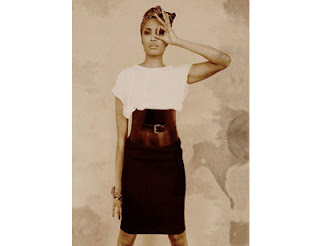
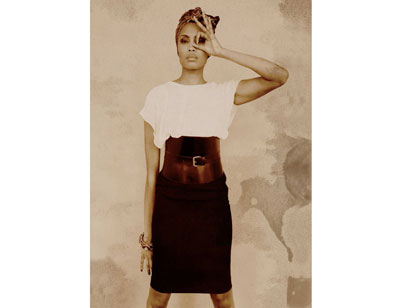
Imany (Nadia Mladjao, her real name) or Nadia who became "İmany", proved to us on stage in two amazing concerts that small... miracles can happen when you believe in your dreams. Her name means "faith" in Swahili. A similar miracle was experienced by all of us who were at gazArte in February, he promises us something similar now that he is returning to Athens again. Public and media, they bowed to her beauty and performance discovering in her more than the success of a single song. "You will never know" may have made her famous overnight but Imany is not just that. So beautiful that you can't take your eyes off her. So rhythmic, so that she can seduce you with her dance in an endless rocking (and this is something you don't expect). So confident on stage as she is surrounded by a strong group of musicians who give it their all playing with passion and fun. But also so communicative, she seems to befriend everyone who has come to see her, he tells them stories and "conspires" with them for many hours of music… Imany with her bass and sensual voice takes off with her interpretation of the songs from her unique album, το soul – folk «Shape of a Broken Heart».

For the record, a few words about how the French beauty got here:
Imany was a model who decided to leave the glamor of New York and pursue another dream, more complex and more introverted. He returned to Paris, having beautiful clothes in her luggage, a portfolio with photos as well as a demo CD with six songs that she herself had edited. Then, decided to be more actively involved in music and try her hand on stage. Her first appearances in Paris quickly created a loyal core of fans.  Reviews made special mention of the melancholy sweetness of her voice, while comparisons with Tracy Chapman and Billie Holiday were not lacking. The name Imany began to be discussed outside of Paris. He gained fame, he also had ready-made songs, the road now seemed open. She immediately recorded her first album, managing to surprise Europe with the sincerity of her songs. Soon most noticed her voice despite her beauty. He had won the bet…A bet that won in her first appearances in Athens, and it remains to win it again in the same city, inviting all Athenians in the wake of summer on 2 September in the open area of ​​"Technopolis".

Welcome Imany to Athens, at 2 September, in "Technopolis" live, for another sensational appearance. You will never know..for those who saw her and for those who didn't get to see her, it's worth getting to know a real star up close at the moment she is born!

The concert will open with guest appearances 4 popular names of the Greek music scene, thus giving a "festival" tone to Imany's big concert:   Imam Baildi, Marietta Fafouti, Penny &The Swingin’Cats

"Now, so we saw her live, i can say that: Rightfully so. Imany, the beautiful French singer with one big hit - for now- song, του «You Will Never Know», it's here to stay. It's worth it. She was amazing. We saw, one of the best concerts of the year. He got the whole club fired up, the audience won it over easily, first time I saw Gazarte standing up at the end, to dance and sing… Imany was a star!” www.e-tetradio.gr

Source : culturenow.gr

The Roman triliza below Thessaloniki

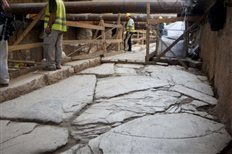
You imagine a wide road (latitudinal 10 and more meters), layered with thick, heavy marble slabs, bordered by marble curbs and colonnades, and on this road move chariots and pedestrians and animals and soldiers and emperors and…

And on a street corner – of the not so crowded despite the "maximus" of his character – to be engraved, almost artificial, a huge frenzy; Yes, the famous game that is still played today. And... I was thrilled to see Roman soldiers and centurions playing in the middle of the street;

The oversized trill of decumanus maximus (ancestor of today's Egnatia street) was located at the height of today's Agia Sophia street, just a few meters below the pavement of the polypath – and from the subway opening works – Egnatia street and has a diameter of about two meters.
Archaeologists working as part of the excavations to open the subway tunnel have not arrived at the exact dating of the impressive find, as the street on which it was located was allegedly "carved" after the 3rd AD. century and was preserved for at least three centuries later (until the 6th AD).
It is a monumental road of Roman character (decumanus is the Latin term that referred to large streets of Roman cities that were oriented from east to west and were usually decorated at the beginning and end with piazzas). The revelation of the excavations concerns a section of the length of the road 82,5 and width 10 meters.

The "birth" of the street dates back to the 3rd BC. century – when the city was founded by King Kassander. The traces of the ancient Macedonian road are about two meters below the cobbled and obviously wider and more luxurious Roman road that was "built" on top of it around the 3rd AD. century.
For more than four centuries the road, which is re-engraved with the Hippodamian system of town planning, turns into a main thoroughfare of the city.

THE the greatest decumanus of Thessaloniki is paved with thick marble slabs 15 centimeters and is bordered by wide marble curbs 4,7 meters. In its southern part (the northern one was not excavated as it 'approaches the limits of the station pit) the ruins of buildings are preserved, while between the road and the buildings it intervened, as is the case today in cities, dense network of built clay and lead pipes, which served the needs of water supply and drainage. It is even characteristic that the perfectly insulated water supply pipes passed through the sewer pipes without ever leaking. The road changes shape (width, length, use) throughout the centuries. The Roman road, after its earthquakes 620 A.D. and the destruction of many monuments of the city, "narrowing", during the Turkish occupation it became a path again, in the 19th century it is paved with Italian cobblestones and on it are laid the lines of the tram which also passes under the arch of Galerius, as seen in photographs of Thessaloniki from the beginning of the previous year (20uh) century.
The excavation was carried out as part of the archaeological work carried out by the 9th Ephorate of Byzantine Antiquities alongside the work for the opening of the Thessaloniki metro. During the same excavation (jurisdiction of the 9th Ephorate of Byzantine Antiquities) who started it 2007 and continues, a number of mobile finds were uncovered (jewelry, Christian symbols and church utensils, tools etc. of Byzantine Thessaloniki) and hundreds of gold and copper coins.

Source : tanea.gr

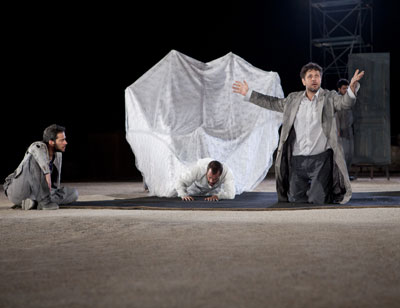
The play Oedipus the Tyrant at the Ancient Theater of Philippi

The show "Oedipus the Tyrant" directed by Tsezaris Grouzinis continues its extremely successful tour. As part of its summer tour, the show will be presented on 24 and 25 August in the Ancient Theater of Philippi.

The artivities company and the VOLOU REGION, in the framework of the ATHENS FESTIVAL they present his summer 2012 to the audience of Epidaurus, of Herodion and the largest cities of the region of Greece, the tragedy of Sophocles OEDIPUS TYRANTUS, directed by Cesaris Grouzinis, with Konstantinos Markoulakis and Emilios Chiilakis in the leading roles.

Cesaris Grouzinis, the Lithuanian director known to the Greek theater audience, tackles the emblematic tragedy with the translation of Minos Volanakis as his weapons, the group way of storytelling and actors trained in the ancient Attic speech.  

Kenny McLellan on sets and costumes, Dimitris Theocharis in the music composition and Nikos Vlasopoulos in the lighting, will be his valuable collaborators to highlight the tragedy of the man who receives the harshest blows of the Divine Judgment for an insult he unknowingly committed.

A terrible pestilence afflicts Thebes. The oracle states that the city will only be saved if the murderer of the previous king Laius is punished. Oedipus, who reigns now, he asks to find the one who killed Laius. The seer of Tiresias accuses Oedipus of being the city's miasma. Oedipus is enraged and suspects a conspiracy against him. In the course of the search for the killer, the truth is gradually revealed, the hero discovers who he really is. Son and murderer of King Laius but also husband of Jocasti's mother. After the tragic and inevitable fate is revealed, Jocasta is hanged. Oedipus blinds himself.

In the last words of the dance Sophocles writes: "...For that which dies wait for its narrow day, before you bless it…” This evocative story, which matured her for thousands of years, it reveals how ephemeral human prosperity and glory are. How fragile is our hope for an eternal and stable sense of security and peace.

However, the intention of Cesaris Grouzinis in putting on this show, it is not didactic (though wise) proclamation of the need to obey one's destiny.

Especially now, especially here, he is attracted by the opportunity to speak about the inalienable right and the opportunity for man to remain proud even in the most disastrous situation and accept any curse with dignity.

In other words, to give honor to a man, who bows to his terrible fate, without being humiliated.

Actors play: Emilios Cheilakis, Konstantinos Markoulakis, Christos Sapountzis, Kostas Koroneios, Alberto Feis, Kostas Seiradakis, Yannis Tsemberlides, Panagiotis Exarcheas, Onik Ketsoyan, George Papandreou, Jeff Maarawi.

PROGRAM OF PERFORMANCES
 Date.            Location Tickets Presale Time
24/8  Ancient Theater of Philippi €14 – 17€ 14 € 21:00
25/8  Ancient Theater of Philippi €14 – 17€ 14 € 21:00
26/8  Outdoor Municipal Theater of Xanthi €14 – 17€ 14 € 21:00
27/8  Egnatia Open Air Theatre (Alex/polis)     14€ – 17€ 14 € 21:00
28/8  Dasous Theater of Thessaloniki €14 – 17€ 14 € 21:00
29/8  Dasous Theater of Thessaloniki €14 – 17€ 14 € 21:00
31/8  Ancient Theater of Messina €14 – 17€ 14 € 21:00
6/9    Herod Atticus Conservatory €14 – 17€ 21:00
7/9    Herod Atticus Conservatory €30 – 15€ 21:00
8/9    Old Eleirgeio Theater of Elefsina €14 – 17€ 14 € 21:00
10/9   Rematia Theater of Chalandrio €14 – 17€ 14 € 21:00
11/9   Rematia Theater of Chalandrio €14 – 17€ 14 € 21:00
12/9   Municipal Theater of Alsus Ilioupoli 15 € 15 € 21:00
13/9   Municipal Garden Theater of Papagos €14 – 17€ 14 € 21:00
14/9   Veakeio Theater Piraeus €14 – 17€ 14 € 21:00
15/9   Petra Theater of Petroupoli €14 – 17€ 14 € 21:00
17/9   Veikou Grove, Galatsi 15 € 15 € 21:00
18/9   Alexis Minotis Theater €15 15 € 21:00

Source : culturenow.gr

The way to return fragments of the Parthenon opens

Discussion begins between the Acropolis Museum and the British Museum

"Stray" fragments of the Parthenon, from its sculptural decoration mainly, which are in the British Museum may return to Greece _if not in their entirety, but at least some of them _ as long as cooperation is achieved, which he proposed at the last UNESCO session last June, the Acropolis Museum.

The issue was raised for the first time and is of course independent of Greece's constant and ongoing request for the reunification of the Parthenon Sculptures. In this particular case, the president of the Acropolis Museum, professor Mr. Dimitris Pandermalis proposed the special request for a first reunification of "stray" fragments, which are in the British Museum with the sculptures exhibited in Athens.

In the intentions of the Acropolis Museum like this, is the invitation in the autumn of representatives of the British Museum, in order to see the exhibition of the Parthenon Sculptures together in order to form their own opinion about the possibility of re-positioning fragments found in the British Museum in the places from which they are missing. The main argument of the Greek side is, that the recovery of the overall image of a sculpture, even with the addition of a small broken marble is a matter, first of all, scientific ethics.

But what kind of fragments are these?; For example the back part of the upper torso of Poseidon from the west pediment of the Parthenon (the front part is exhibited in the Acropolis Museum).

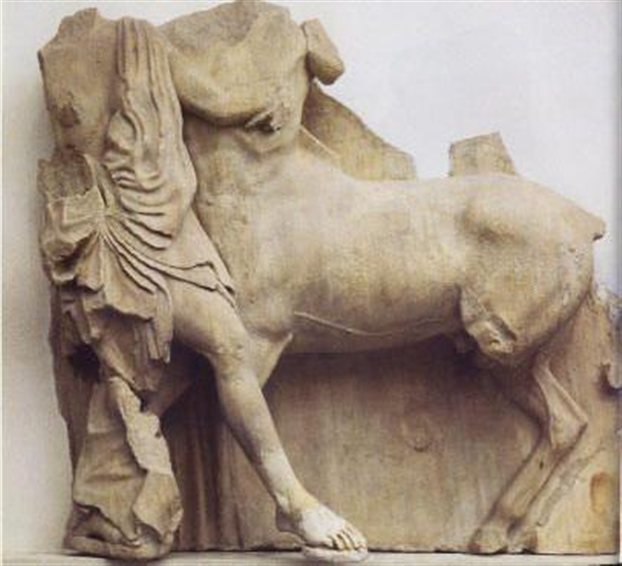
 Part of the leg of a Lapithidos being seized by a Centaur from the 12th south pediment of the temple (the composition is preserved almost entirely in the Acropolis Museum).

Part of the chest of a warrior depicted on the frieze, as well as other stray fragments of sculptured heads, hands or feet. Of course, there are also some very small fragments.
Of course, many discussions will need to be held in order to have a positive outcome, but the beginning was made and indeed with a positive sign.

In any case, the willingness of the British side to cooperate on such a delicate issue is highly welcomed. It is also noted that according to the standard practice applicable to the Intergovernmental Commission of UNESCO, the two sides negotiated on the sidelines of the Meeting a relevant "Recommendation" draft (Recommendation), which was unanimously adopted by the Commission.

In addition to this, the representative of the British Ministry of Culture Mrs. Bower positively assessed the Greek proposal for a 3D digital scan of the Parthenon frieze in terms of its parts that are in the British Museum. The digital scanning of the stones found in the Acropolis Museum is already being completed in the autumn - it started about a year ago - and at the end the digital composition of the entire frieze will be done in order to obtain "more accurate scientific knowledge", as Mrs. Bauer mentioned.

The same, however, in Greece's constant request for the return of the Sculptors, which was presented at the meeting by the general director of Antiquities and Cultural Heritage of the Ministry of Education and Culture Mrs. Maria Andreadaki – Vlazakis and professor Mr. Pandermali repeated the familiar arguments of the British side, that this matter falls under the exclusive supervision and management of the Board of Governors of the British Museum.

As for the fragments of the Acropolis, however, it should be noted that they have already started to be returned to Greece. We recall the marble part of the corner capital, which was in the possession of a Dutch privateer, who had taken it as a souvenir on a visit in his decade’ 50. Another large fragment from the north frieze of the Parthenon depicting a man's head and part of a boat supported by him, which was returned by the Vatican (it was in the Etruscan Museum of the Vatican).

One foot man, fragment of the north frieze returned by the University of Heidelberg. And even on loan from the Salina Museum of Palermo, Italy, found for a few months in the Acropolis Museum a fragment of the relief decoration of the Parthenon in which the extreme right leg and the fringes of the garment of the goddess Artemis are depicted. Fragments of the Parthenon frieze can be found in many European cities: Paris, Vienna, Copenhagen, Munich and Würzburg.

Very often, however, the political leadership of the Ministry of Culture had expressed the country's willingness to provide "in return" in the event of a donation or long-term loan, even of fragments of the Parthenon sculptures, and to cooperate in the organization of exhibitions in foreign museums by lending antiquities..

A problem that has not been solved yet is the embargo of the Greek Ministry of Culture (current Secretariat) to the British Museum. A tactic, which was adopted in the 80s by Melina Merkouri, perfectly understandable and useful for that time, when the request for the return of the Sculptures was first raised, όχι όμως απαραίτητα και σήμερα.

Οι καιροί έχουν αλλάξει, οι άνθρωποι επίσης, ακόμη και τα μέσα διεκδίκησης, so that now the embargo creates problems instead of acting as a bargaining chip. Η αδυναμία επίσημης συνεργασίας με το Βρετανικό Μουσείο «απαγορεύει» ακόμη και την απ΄ ευθείας συζήτηση ανάμεσα στα δύο μέρη, δυσκολεύει την συνεννόηση, exchange of views and communication, let alone the organization of joint exhibitions or other cultural activities. Something that does not apply to private Greek museums, which do not follow this line.

However, the development of relations is now imperative and this is of course not related to the request for the return of the Sculptors, που θα παραμένει πάντα στην πρώτη γραμμή ώσπου να ικανοποιηθεί.

Source : tovima.gr