Category Archives: Uncategorized

A Minoan mansion was discovered in Ierapetra

At altitude 900 meters – Dated from 1.600 up to 1.400 B.C.

Minoan building, dating from 1.600 up to 1.400 B.C. brought to light by the archaeological hoe at the site of Gaidourofas, in East Ierapetra, in altitude 900 meters.

The first indications, according to archaeologists, they speak of an important building, which with the so far features resulting from the excavation, it could be classified as a mansion.

And the British archaeologist Arthur Evans when he passed by the point 1898, he noted in his diary that he found that in the area - and despite the embankments- there were architectural elements that testified to the presence of a Minoan building.

During this year's first two-week excavation period, archaeologists managed to excavate, down to the floor, the interior of two rooms.

The building – according to archaeologists- he saves all his embankments, it has not been subjected to subsequent circulation and the main thing, the occupants left it after its destruction without taking with them the objects that were inside it.

The causes of destruction and the reasons for the building's abandonment have not yet been clarified and further evidence is expected to emerge as the excavation progresses., according to them.

Yet, as they emphasize, archaeologists such mansions exist in other parts of Crete but so far they have only been recorded and excavated in lowland areas, at an altitude of up to 400 meters, where they are traditionally associated with agricultural cultivation.

On the contrary, the building in the East is much higher, and is the second building to be excavated at such a high altitude after the one in Zominthos by Yiannis and Efi Sakelarakis.
The excavation is carried out as part of a five-year research program implemented and financed by the University of Athens, with the financial support of institutions from Greece and abroad, led by the Prehistoric Archeology lecturer at the Department of History and Archeology Yiannis Papadatos, and Gerapetri archaeologist Kostis Halikias as deputy director, PhD from the University of Heidelberg.

"With this excavation we are trying to understand the importance of the mountains for the Minoan economy, i.e. the natural resources and wealth-producing sources that the Minoans exploited at these altitudes, emphasizes the head of the excavation, Yiannis Papadatos.

Mr. Papadatos emphasized that "the second goal is to begin to understand what was happening in Minoan Ierapetra where the evidence is minimal. Despite the timeless importance of the Ierapetra plain, we have not the slightest idea about the location of the Minoan settlement, and we do not know whether there was any kind of administrative or even palatial center, such as those excavated at neighboring sites, in Gournia, in Makri Gialos and Myrtos.

» Yi’ this and we are looking for indirect evidence in the mountains hoping that the excavation in the East will provide us with it".

Source : tovima.gr

Yannis Kotsiras and Estoudiantina, for a concert in Technopolis

The "Technopolis" of the Municipality of Athens will host Giannis Kotsiras, who, together with the Studiadina of Nea Ionia Volos, will present a concert entitled "The Smyrna of Love", who wake up 90 years of memory with Smyrna songs, at 6 September 2012.

ORCHESTRA ARTISTIC DIRECTOR : ANDREAS KATSIGIANNIS
Performers Thodoris Mermigas and Irini Tumbakis participate

The Student of Nea Ionia Volos and Yiannis Kotsiras , on the occasion of 90 years of memory in Smyrna and the recent release of their album "SMYRNI TOU EROTA", present on Thursday, September 6 at "Technopolis" of the Municipality of Athens on 21:00 a great concert dedicated to the folk tradition and artistic creation of Smyrna. The show's repertoire consists of songs that have marked the 20s, while their traces reach up to World War II. Where can I find a woman who looks like you?, Beautiful Smyrnia,  Antonis Varkaris, Misirlou, The Gelekaki, Micromarried etc.  Elements so different from each other become one in the music that flourishes at the end of the 19th century and the beginning of the 20th in the region of Istanbul and Izmir. Songs that were the forerunner of Piraeus [rebetiki] school, σπουδαίων συνθετών, such as Kostas Skarvelis, Δημήτρης Σέμσης, Panagiotis Toundas, Σπύρος Περιστέρης, Νίκος Ρουμπάνης, Yannis Dragatsis or Ogdontakis, Γιάννης Νταλγκάς, Κώστας Κοφινιώτης, Apostolos Hatzichristos and quite traditionally unknown authors. These songs were not written only in Smyrna. They are songs that have every kind of connection with Smyrna. Είτε γράφτηκαν εκεί, whether they come from Smyrna creators in the Greek area.

Η καταστροφή του 1922 after all, was to change the course of Greek history in many ways. Ανάμεσα στα άλλα, he was supposed to bring the great masters of Smyrna from the shores of Asia Minor to cross their art with the Greek musicians. The music performed by the Students, the orchestras that were the biggest "study" where great Asia Minor creators taught and learned, arrived in Greece around 1870, at first on the outskirts of Athens and very soon it also conquered the center of the city of Athens. This kind of orchestra became the first and most authentic musical bridge, harmoniously combining the disparate nationalities, musically, cultural and creative elements of two such different worlds.

The proposed performance is a modern interpretation approach, with one of the most important Greek performers, Yiannis Kotsiras and with the Nea Ionia Volos School under the artistic direction of Andreas Katsigiannis, an excellent orchestra that genuinely and sensitively continues the tradition of the great orchestras that flourished in Asia Minor. With a Mediterranean temperament, excellent interpretations and with the orchestra's particular orchestral eye, the deep eroticism hidden in these songs is shown, with absolute respect for the original musical writing. Thodoris Mermigas and Irini Tumbaki participate in the interpretation.

Source : culturenow.gr

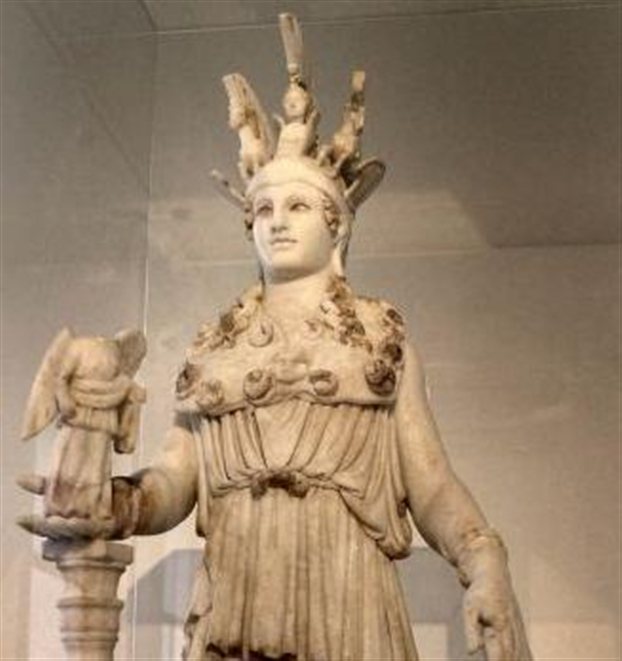
The Virgin Mary of the ancient Greeks

How with the transition to the Christian world the goddess Athena was "replaced" in the religious consciousness by the Virgin Mary

General, patron saint and virgin. She is the goddess Athena or the Virgin Mary; Protector of women, of children and childbirth. It is Artemis the Child-giver and Midwife or perhaps the Virgin Mary; Prudent, worlds, benevolent, gentle and merciful, who experienced unbearable pain and experienced much suffering. Is it the goddess Isis or is it the Virgin Mary, mother of Christ;
There, in the turning of the Greek world from polytheism to Christianity, when the latter slowly began to prevail in religious consciousness and devotional practice, mixing elements of the pagan past with the new religion would not only not cut it, but it would greatly contribute to its consolidation. Standards of centuries, besides, were difficult to remove. On the contrary, their assimilation by Christianity was the connecting link that people needed to accept it more easily. Result, many of the ancient deities and rituals to remain in the Christian calendar and to adapt to the formality and traditions of the new religion.
It is a coincidence that the great feast of Panagia on the fifteenth of August coincides with the birthday of the goddess Athena on 28 of the ancient month of Hecatombaion (mid July – mid August), when the Panathenaia was celebrated, the biggest celebration of ancient Athens; Or is it a coincidence that the temple of the virgin Athena on the Acropolis was transformed into a temple of the Virgin Mary; Besides, it was not only the Parthenon that became a Christian church, since according to Justinian's decree all ancient sanctuaries had to be converted into temples in order to purify. In many of them, where women were worshipped, pagan deities, temples were built dedicated to the Virgin Mary, which very often also took on the attributes of the ancient deities.

The properties
The recurring seasonal cycles of death and rebirth and the cults associated with the land, vegetation and a good harvest were also associated with the Virgin Mary, as the great folklorist Georgios Megas has written. The Entrances of the Virgin are associated with sowing and the Virgin takes on the characteristics of the goddess Demeter, sometimes acquiring the nickname Aposporitissa and sometimes Mesosporitissa. In fact, the ancient custom of panspermia remains, the polyspores, as we say today.
Aeiparthenos, such as the ancient goddesses Athena and Artemis, it was called Panagia from the 6th century. But at the same time, she is the protector of pregnant women who, in order to have a good delivery, keep a plant amulet, "the grass of the Virgin Mary", as it is called. There were other ancient mother deities: Astarte, Leto, Gaia, the Isis, with roots lost in the depths of the Neolithic era. The archetype of all, however, is considered to be the Great Mother or Mother Earth or Great Mother Goddess, which according to Jung is a matriarchal model that exists in humans before and from conception.
After all, the Great Mother was the main deity in Minoan Crete, from a certain time even alongside the "young god" (either as her "uncle infant" or as her husband). According to nature's cycle of death and rebirth the Great Mother continually marries the young god who is born and dies each year.

Protectors
General of generals, the Virgin Mary protects her faithful – as did the goddess Athena the Athenians – in every difficult moment. The 626, in the siege of Constantinople by Avars and Persians, the faithful who have gathered in the Great Church will suddenly see in front of them the Virgin Mary has spread her protective veil over the city (remember Athena's veil at Panathenaia). And the biggest proof: "I fight the battle, I strategize the victorious ones" sing the besieged Christians at the last mass of Hagia Sophia, the 1453.
The Akathistos Hymn, however, is somewhat similar to the "equal aretalogies", that is, the hymns to the goddess Isis, as the Archeology professor says. Michael Tiberios. Many of the characteristics of the Egyptian goddess, which had been Hellenized, they also went to Panagia. "Like the Virgin Mary, so this goddess acquired a myriad of nicknames, in other words, she was myrionymi, such as “almighty” and “queen of the sky, of the earth and the underworld”" notes Mr. Tiberius.

The Parthenon Basilica
It is unknown exactly when the Parthenon was converted into a Christian temple, but what is certain is that under Justinian (482-565) consecrated and designated as the "Catholic Church of Athens". The cult of the pagan virgin thus gave way to the Christian Virgin and the church took the name Panagia Athiniotissa. Indeed, for this purpose and in order to serve the needs of the new cult, the Parthenon underwent many operations and was transformed into a three-aisled basilica.
The prestige of the temple was great, since even Vasilios B’ Bulgaroktonos celebrated his victory against the Bulgars at Panagia Athiniotissa. After all, it was a magnificent temple, with the golden icon of the Virgin Mary and wonderful mosaics. Only 188 mosaics were saved from them and transferred the 1848 in the British Museum, while today little traces of the original performances can be seen. But what is preserved are the hundreds of engravings with the names of generals, bishops etc., but also simple inscriptions of names, deaths, titles and occupations, prayers and symbolic representations inscribed over the centuries on the columns of the temple. During the Fall of Athens by the Latins, however, the church was captured and converted into a Catholic church under the name "Santa Maria di Atene", while later it became a mosque.
The alleged similarity of the representation of a marble metope of the Parthenon with the scene of the Annunciation is also due to its rescue during the Middle Ages by fanatics of the new religion who destroyed the ancient decoration of the temple. The metope is today in the Acropolis Museum.

Source : tovima.gr

The Spiros Louis cup is presented to the public

At 27 August at the Acropolis Museum by the Stavros Niarchos Foundation

On Monday 27 August, the "Stavros Niarchos" Foundation will hold the public presentation of the Cup that was awarded to the Olympian Spyros Louis. The presentation will take place on 7 in the afternoon at the Acropolis Museum.

It is recalled that the Foundation acquired the Cup at an auction in April 2012.

The cup, height 15 centimeters, was auctioned after a relevant decision of the Olympian's grandson.

According to Christie's, the value of the cup was between 120.000 and 160.000 pounds (about 146.000- 195.000 euro).

In the announcement of the Foundation, last April, referred to:

"The Stavros Niarchos Foundation’ announces that it has acquired the Silver Cup inspired and designed by Michel Bréal, for the First Marathon Winner, the Greek Spyros Louis, and which was awarded to him during the first Modern Olympic Games, in Athens, the 1896.

» The Stavros Niarchos Foundation’ acquired the Silver Cup in a spirited auction held today at Christie's in South Kensington, London.

» The Foundation will share the cup with the Greek people, exhibiting it permanently at the Stavros Niarchos Foundation Cultural Center, after the completion of the last one 2015.

» In the meantime, the Foundation will investigate finding a suitable temporary location for its public display.”

Source : tovima.gr

Aristophanes' chickens from DIPETHE of Crete, in the Ancient Theater of Epidaurus

The Athens and Epidaurus Festival 2012 hosts one of Aristophanes' finest comedies. The Chickens produced by DIPETHE of Crete  are coming to the Ancient Theater of Epidaurus for two performances, on Friday 10 and on Saturday 11 August, at 21:00.

In times of severe crisis, the search for utopia returns more fiercely. The director Yiannis Kakleas with a staff of notable actors and the legendary music of Hadjidakis as an ally, looking for today's Nephelococcygia.

Extremely topical comedy, the Hens were written the 414 e.g., time when the war, the hunger, debts and decline plagued Athens. Desperation drives two elderly Athenians to flee and create the ideal city in alliance with birds.

DIRECTOR'S NOTE

A journey into the desire for a free world, a fair world, asking for Happiness are the "Chickens" of Aristophanes.
This great satirical poet tells us a story of overthrowing a corrupt society, decadent, of a society that degrades the desire for Life, in a desperate effort to survive.
"Chickens" is a political text and at the same time a poetic parable that scorns an inhumane world and dreams of "a society of birds", that is, a society with imagination, which adopts the Archetypal values ​​of Law, of Merit and Perpetual Motion. A society that may seem unrealized but that if Man stops desiring it is in danger of annihilation.
"Chickens" is a work as modern as man's need to fly above his individual and social commitments and create an "other" society, without hypocrisy, fear, destructive rage and social injustice.
Utopian; It depends on us!

Yannis Kakleas
Director

Date Friday 10 and on Saturday 11 August 2012, at 21:00

Ticket prices 50€ (VIP)
40€ (Zone A.)
30€ (Zone B.)
15€ (Student – Zone B.)
20€ (Upper Diazoma)
10€ (Student – Upper Diazoma, DISABLED)

Ticket sales
Online, from the internet, charged to your credit card: https://buy.tickethour.com/festival-ww/showProductList.html?idEvent=2001456
By phone, charged to your credit card
Telephone exchange: +30 – 210 32 72 000.
daily (and Sundays) 9:00-21:00
From the Festival Publishers
Centrally: University 39 (inside Pesmazoglou stoa)
Hours of operation: Monday – Friday: 9:00-17:00, Saturday: 9:00-15:00
Ancient Theater of Epidaurus: Prefecture of Argolis
Hours of operation: Monday – Thursday: 9:00-14:00 and 17:00-20:00, Friday- Saturday: 9:30-21:30
From PAPASOTIRIO Bookstores and PUBLIC Stores
with coupon purchase (Voucher)

Source : culturenow.gr

Encardia are stealing hearts in Lower Italy

The awards for the Greek documentary continue

Another honorable distinction for the Greek documentary "Encardia, the dancing stone" by Aggelos Kovotsos – this time from Italy: the film that has been shot in areas of Greece but mainly in the Greek-speaking villages of Lower Italy with the protagonists being the Greek music group Encardia as well as musicians, famous poets and anonymous artists of the Salento region, he received an honorable mention for his direction at the cinema del reale documentary festival that takes place every year in Spezia, Lower Italy.

Spekia is located in the heart of Salento, which is the center of the nine Greek-speaking villages of Italy. The warm welcome, the warm applause of the audience as well as the distinction to the film and its director reflect the response the film had in the region where the Grico language is still alive through music, the Greek poems and songs.

The Greek delegation that accompanied the film with actors, friends, partners and of course the Encardia complex, at the end of the screening he set up a wild party outside the screening area and roused his Italian friends with dances and songs.

The Encardia complex (Kostas Constantatos – crust, mandolin, violin, song, Vangelis Papageorgiou – accordion, harmonica, song, Michalis Kontaxakis – guitar, song, Anastasia Dolfi – song, castanets, Dimitris Tsekouras – contrabass, song and Konstantina Kalkanis, Gianna Hamaleli – dance) is inspired, creates and presents music and songs through the rich musical tradition of Lower Italy. It was established 2004 and so far has performed more than three hundred live performances throughout Greece, Italy, South of France, Germany, Cyprus, Algeria etc. He has released three records and has collaborated on record and in live performances with the most important representatives of Low Italian music.

On the occasion of her participation in the cinema del reale festival, the film was then screened in Kalimera villages, Corigliano D’ Otranto and Sternatia. After the projection in the square of the villages, there was dancing and singing by Encardia as well as big names of the music scene of the region: Roberto and Francesca Licci, Franco Corleano, Enza Parliara et al.
The distinction of "Encardia" in Lower Italy comes after the audience award it received at this year's Thessaloniki documentary festival Images of the 21st Century. The film is already scheduled to be shown at several foreign festivals and to be released in Athenian cinemas in October.

Source : tovima.gr

The exploration of Mars from the Curiosity vehicle began

It successfully landed today on 8.32 (Greece time) on the planet Mars the robotic vehicle Curiosity, NASA announced. The seven-minute process was the hardest landing of an unmanned spacecraft ever on the Red Planet. The vehicle immediately began sending pictures back to earth and searching for extraterrestrial life forms.

The Curiosity rover sent its first signal when it entered the Martian atmosphere. "We received signals, things look good" said a member of the mission. NASA's space shuttle launched from Cape Canaveral on 26 November 2011.

Its mission is to explore Mars in order to determine whether the Red Planet ever had the conditions to support any life.

Immediately after the successful landing the mission members erupted in cheers and one of the officials handed out Mars chocolates…

The same atmosphere of joy prevailed when the robot sent the first photo, of exceptional purity, of his shadow on the ground of Mars, immediately after his landing.

US President Barack Obama in his announcement speaks of an unprecedented technological achievement.

The program cost money 2,5 di. dollars.

The craft entered the Martian atmosphere at a speed of approx 20 thousands of km/h. A combination of systems (parachutes, specially designed thrusters etc.) built into the craft helped Curiosity to land as "softly" as possible so as not to damage any of its advanced and ultra-sensitive instruments.

New ambitious exploration phase

A new ambitious phase of exploration of the neighboring "red planet" is thus inaugurated, with the main stake being finding traces of microbial life, either in the distant past, or more recently, either- as the most visionary hope- even in the present.

In essence, the new mission is expected to lay a firmer foundation for a future human-first mission to the planet, something that is not expected to happen at least two decades ago.

The weight 900 kg nuclear powered (with plutonium fuel) six-wheeled robotic rover, with the official name "Mars Science Laboratory" (Mars Scientific Laboratory"), it's the size of a car, it is more than twice as long and five times heavier than the twin rovers “Spirit” and “Opportunity” who reached Mars the 2004.

"Curiosity" was launched on 26 November 2011 and traveled approx 248 million. kilometers to reach Mars, being the
largest and most expensive vehicle ever sent to another planet.

The entire shipment cost approx 2,5 billion dollars and it is hoped that the vehicle will last many more years than the two years NASA originally planned.

It is the most complete and technologically advanced space mobile scientific laboratory, as it has a range of cameras and scientific instruments, as well as a robotic sample collection arm, which will allow him to carry out, in the coming years, a wide range of on-site scientific analyses. Every day, the results of his surveys of the Martian soil will be sent electronically to Earth for further analysis by
the scientists.

The autonomous rover, which will remain stationary in its place for several days, until it is ensured that all is well with its electronic systems, will focus his investigations on its alluvial rocks, height approx 5 km, Mount Sharp (or, as is its official name, Aeolis mountains), which is located inside the ancient and huge Gale Crater, latitudinal 154 km. and aged over 3,5 di. years.

The rocks in question are considered a kind of "time capsule" for the successive geological stages of the planet from the wettest
and his warm past to his arid and cold present.

The vehicle- laboratory, which will move slowly with a speed of just 30 meters per hour (going through the lot 200 meters per day), will continue to analyze Martian rocks looking for complex organic molecules, which will probably constitute the
chemical "signature" of some past or present microorganisms.

But the difficulty for scientists will be to make sure that such carbon-based molecules are indeed of biological origin (the metabolism of microbes), since they could also have been produced through abiotic geochem
procedures.

Research so far has shown that once upon a time, billions of years ago, Mars had an atmosphere and liquid water, therefore a basic condition for the emergence of some form of life was met.

Now, it is hoped that the “Curiosity” will take another step, also finding evolved organic molecules that could be remnants or byproducts of such microorganisms.

Continuation of the article attanea.gr