Changes to the MotoGP calendar

The FIM has announced changes to the provisional MotoGP calendar for its World Championship 2012.

In the new program, the start date in Qatar has been changed (8 April instead of 15 April) and it has been confirmed that the Spanish Grand Prix will take place in Jerez.

In addition, the Sachsenring for the German Grand Prix has been confirmed.

8 April: Catarrh – Doha
29 April: Spain – Jerez
6 May: Portugal – Estoril
20 May: France – Le Mans
3 June: Catalonia – Catalonia 1
7 June: Great Britain – Silverstone
30 June: Netherlands – Assen
8 July: Germany – Sachsenring
15 July: Italy – Mugello
29 July: USA – Laguna Seca
19 August: USA – Indianapolis
26 August: Czech Republic – Brno
16 September: San Marino – Misano
30 September: Aragon – Motorland
14 October: Japan – Motegi
21 October: Malaysia – Sepang
28 October: Australia – Philip Island
11 November: Valencia – Valencia


Source : newsbeast.gr

The scooter of the future

If the idea of ​​a small self-balancing vehicle sounds appealing to you then the Ryno Electric Unicycle could well be what you've been looking for. With the unicycle scooter, don't start dreaming of "throttle" speeds, but at most until 25 km/h for leisurely rides.

The creator of Ryno, engineer Chris Hoffman, believes it could be a valuable tool for security guards and people in other professions, where patrols of relatively large areas are required. The driving style takes some time to get used to, however, drivers don't struggle that much to get wind of it.

Although Hoffman, does not envisage Ryno replacing other types of transport, believes it would be an invaluable addition to existing media. The electric battery for the upcoming model will be sufficient for distances of approx 50 kilometers, making it the perfect transportation gadget for short rides.

And for those wondering who would buy it, several orders have already been placed for the unicycle in question, which is currently manufactured by him and its price reaches 25.000 dollars. When it goes into regular production, its price will range from 3,5 thousands of dollars, which will be relatively competitive for scooters.

Source : newsbeast.gr

"Pinocchio – The truth under our noses" about the SOS villages

From 27 until 30 December
The play "Pinocchio – The truth under our noses" with the shows he staged in October collected a sum of 12.000 euro, which were made available to the Hellenic Society for the Protection of Autistic People.
After the success he achieved, the show goes up for the second time, for Christmas days.
Based on the non-profit participation of its contributors, the proceeds of these performances are offered to SOS Children's Villages to support their operation. The show is organized by the Urban non-profit company "Anthropon Erga".
See the related videohere
Source : protothema.gr

The ten most important archaeological facts in the world about 2011

One of the world's first buildings was discovered in Jordan. In Scotland came to light boat 1000 years with the burial of a Viking. While scientists reconstituteddigitally a school of Roman gladiators. The "Top 10" of the archaeological discoveries of the past year, as recorded by the authoritative American magazine "Archaeology" includes investigations, events, even highlighting the effects of the war in Libya on the monuments, the political and social upheaval in Egypt, Tunisia and Syria by 2011.
Absent from this list, however, is Greece, not necessarily due to a lack of archaeological activity but perhaps also due to insufficient information. Moreover, as the magazine itself points out, the reason par excellence why it will go down in history 2011 is the political and economic crisis in the world. Without meaning that, of course, that archaeologists and other scientists stopped working and presenting work. Applications of modern technology, for example, in archeology new possibilities open up both in field research and in the study of findings to draw more accurate conclusions.

So in the "Top 10" of "Archaeology"., are included, in no particular order anyway, the following events:

– Viking burial on a ship, which came to light in exceptionally good condition in Ardamurchan, Scotland (the first on British soil). The dead man was a high-ranking warrior who had been buried with his weapons, a sword with a silver hilt, shield, spear, ax but also a drinking horn.
– Neolithic building uncovered in Wadi Fainan, Jordan. It is dated 11.700 years before today, it is oval in shape and was made of mud. An interesting fact is that it is surrounded by two terraces reminiscent of the construction of an amphitheater, while according to the evidence it had a roof, which covered a part of it. The building may have been used periodically by small groups of people to process products such as barley and peanuts or for gatherings.
– Research developments on the search for skin remains in fossil remains of Australopithecus sediba discovered in Malapa, South Africa. The remains are 2,2 million years old and a thin layer of minerals found on them, it is thought that it could be the remains of skin. However, the investigation has not yet reached definitive conclusions.
– Discovery of the earliest domesticated dogs in Predmosti, Czech Republic. This is about publishing a study, which refers to three dog skulls, dating from ca 31.500 years ago and present characteristics, which separate them from their ancestor the wolf. This is a smaller and wider muzzle and a wider space for the brain. Researchers as recently, they considered that the domestication of the dog took place before 14.000 years.
– Unveiling of a rare burial of a woman, who was a Mayan ruler in Nakum, Guatemala. The burial chamber was found under another and was _surprisingly_ untouched by antiquarians. The woman carried two vases on top of her head and was buried with valuables. Both the quality of the grave and the position in which it was found, show that it was used for people of royal descent for half a millennium.
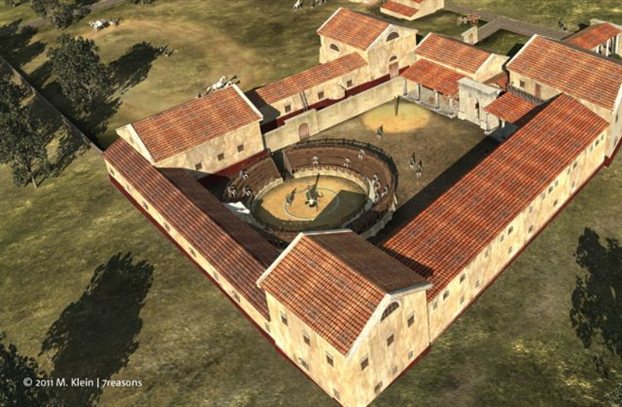
– Digital reconstruction of the "Gladiator Gymnasium" found in the ancient Roman city of Carnundum in Austria by an international team of researchers from the Ludwig Boltzmann Institute for Archaeological Research and Virtual Archeology.

In this city, which she once had 50.000 inhabitants and today it is a huge archaeological park, the fourth largest in the world has been discovered, school for gladiators of the 4th c. X. century. It is a closed complex with an inner courtyard, circular training area, living quarters and a cemetery while high-resolution images collected by the GPR survey show underfloor heating, swimming pools and paths.

Additional, with the improved technology developed, visitors can watch the life of the gladiators inside it.

– Uncovering meal remains in Chinese burials in Shaanxi and Xinjiang provinces. The world's oldest soup is 2000 years, the particular one found in pots was dog soup. the second _ 2400 years old _ it was millet noodles.
– War and ethnogenesis through the excavation of pre-Columbian settlements at Taraco, on the edge of Peru's Lake Titicaca. The research showed, that cooperation between different ethnicities can certainly be a path to success, but sometimes an organized conflict can be more effective in obtaining resources!
– Revelation of the whaler "Two Brothers" that sank the 1823 in Hawaii. The ship holds a special place in literary history, for his captain was hard-headedGeorge Pollard Jr.Pollard's first ship, the "Essex" was rammed and sunk by a blow whale, providing inspiration toHerman Melville for the creation of the famous work of "Moby Dick".
– The "Arab Spring" and its effects on the monuments of Egypt as well, of Tunisia, of Syria and Libya. Recording of the disasters and looting in these countries, to the degree, that this is possible due to turbulence and minimal information. As is well known, Egyptian archaeological sites and museums were looted, last September, the Seleucid city of Apamea in Syria was looted, while many monuments in these countries have been damaged by the military operations.
Source : tovima.gr

Maserati chooses Alfa Romeo Giulietta

Maserati and Alfa Romeo, two leading representatives of Italian design in the automotive world, they deify the concepts of sportsmanship, of technology and elegance.

A special edition Alfa Romeo Giulietta created exclusively for the Maserati network will soon hit the roads across Europe. Maserati chose the Alfa Romeo Giulietta as a service car for its customers who appreciate Italian style and want to drive unique cars.

Giulietta's choice, the most captivating and safest compact car in its class, it is further proof of the importance Maserati places on the safety of its customers.

The cars are equipped with the impressive engine 1750 Turbo Petrol of 235 horses (which was created for the Giulietta Quadrifoglio Verde model, historic representative of Alfa Romeo's top performance vehicles), a true epitome of technology that guarantees a perfect combination of sporty characteristics and an ecological approach.

This is achieved with the direct injection system, dual continuously variable valve timing, the turbocharger and degassing system to eliminate time lags in engine response. It is an engine that achieves top performance in its class, both in power and specific torque, but with low fuel consumption in daily use.

The equipment chosen by Maserati for the Giuliettas it will offer to its customers are characterized by attention to detail: heated power adjustable seats upholstered in original, high quality Venere leather in the new shade Maserati Brown, an exclusive 'Alfa Romeo for Maserati' plaque to adorn the dashboard and special aluminum plaque on the door sills engraved with the Giulietta and Maserati names to seal the partnership.

These hundred cars carry a particularly rich equipment from a technological point of view:bi-xenon headlights with AFS function, navigation system with folding screen, maps of Europe and TMC Pro, Blue hands-free system&Me with steering wheel controls, AUX-IN ports, USB and Bluetooth and dual-zone automatic climate control.

The 'Giulietta for Maserati' also stands out for its exterior details: the aluminum wheels of 18 inches have a diamond finish, the brake discs are larger, the brake calipers are red, the dashboard inserts are of polished, brushed aluminum and sporty suspensions guarantee that the car has the best dynamic behavior in its class without sacrificing passenger comfort which is the Giulietta's forte.

Like all other Giuliettas, this particular version also offers the Alfa Romeo DNA dynamic driving selector as standard equipment, so that the character of the car can be adapted to the needs of the driver and to different driving conditions, interacting with all its systems. In the Dynamic option the behavior of the car is sportier.

The engine reacts faster, torque output is more immediate thanks to the turbocharger function, the Alfa Q2 locking differential works with absolute safety and the brake pre-fill system maximizes braking readiness.

Normal mode guarantees absolute comfort, combined with low fuel consumption and low emissions, it is the ideal choice for "everyday" driving. In All Weather mode, the car's grip improves even in the harshest weather conditions.

In this way, the European Maserati network can offer its customers a unique elegant and sporty car that fits perfectly with the special philosophy and Italian spirit of the company.

Source : auto24.gr

5 stars for the new Kia Rio

The new Kia Rio was rated five stars by the European Road Safety Agency, EuroNCAP, during the recent crash tests it conducted.

Specifically, the new Kia Rio, which is already available in our country with two bodies (3door and 5 door) achieved a high score in the protection of adult passengers (92%), in the protection of minor passengers (84%) and safety assistance equipment (86%). Kia was also singled out by testers for its placement of the electronic stability control system (ESP) standard equipment in all European markets.

From the beginning of Rio's creation, Kia engineers wanted to build a car that would offer driving pleasure and top safety technology in the event of an accident.

All over Europe they are included in the standard equipment of the car 6 airbags (driver, passenger, side and curtain type), ESP (electronic stability control system), HAC (hill start assist system) and three-point seat belts for five passengers.

The distinction of 5 The Kia Rio's star rating adds to the accolades already received by the Venga, Soul, cee’d, Sportage and Sorento in EuroNCAP crash test results. Also all Kia models are covered with 7 years factory warranty.

Source : sport-fm.gr

The ten most important archaeological facts in the world about 2011

One of the world's first buildings was discovered in Jordan. In Scotland came to light boat 1000 years with the burial of a Viking. While scientists reconstituteddigitally a school of Roman gladiators. The "Top 10" of the archaeological discoveries of the past year, as recorded by the authoritative American magazine "Archaeology" includes investigations, events, even highlighting the effects of the war in Libya on the monuments, the political and social upheaval in Egypt, Tunisia and Syria by 2011.
Absent from this list, however, is Greece, not necessarily due to a lack of archaeological activity but perhaps also due to insufficient information. Moreover, as the magazine itself points out, the reason par excellence why it will go down in history 2011 is the political and economic crisis in the world. Without meaning that, of course, that archaeologists and other scientists stopped working and presenting work. Applications of modern technology, for example, in archeology new possibilities open up both in field research and in the study of findings to draw more accurate conclusions.

So in the "Top 10" of "Archaeology"., are included, in no particular order anyway, the following events:

– Viking burial on a ship, which came to light in exceptionally good condition in Ardamurchan, Scotland (the first on British soil). The dead man was a high-ranking warrior who had been buried with his weapons, a sword with a silver hilt, shield, spear, ax but also a drinking horn.
– Neolithic building uncovered in Wadi Fainan, Jordan. It is dated 11.700 years before today, it is oval in shape and was made of mud. An interesting fact is that it is surrounded by two terraces reminiscent of the construction of an amphitheater, while according to the evidence it had a roof, which covered a part of it. The building may have been used periodically by small groups of people to process products such as barley and peanuts or for gatherings.
– Research developments on the search for skin remains in fossil remains of Australopithecus sediba discovered in Malapa, South Africa. The remains are 2,2 million years old and a thin layer of minerals found on them, it is thought that it could be the remains of skin. However, the investigation has not yet reached definitive conclusions.
– Discovery of the earliest domesticated dogs in Predmosti, Czech Republic. This is about publishing a study, which refers to three dog skulls, dating from ca 31.500 years ago and present characteristics, which separate them from their ancestor the wolf. This is a smaller and wider muzzle and a wider space for the brain. Researchers as recently, they considered that the domestication of the dog took place before 14.000 years.
– Unveiling of a rare burial of a woman, who was a Mayan ruler in Nakum, Guatemala. The burial chamber was found under another and was _surprisingly_ untouched by antiquarians. The woman carried two vases on top of her head and was buried with valuables. Both the quality of the grave and the position in which it was found, show that it was used for people of royal descent for half a millennium.
– Digital reconstruction of the "Gladiator Gymnasium" found in the ancient Roman city of Carnundum in Austria by an international team of researchers from the Ludwig Boltzmann Institute for Archaeological Research and Virtual Archeology.

In this city, which she once had 50.000 inhabitants and today it is a huge archaeological park, the fourth largest in the world has been discovered, school for gladiators of the 4th c. X. century. It is a closed complex with an inner courtyard, circular training area, living quarters and a cemetery while high-resolution images collected by the GPR survey show underfloor heating, swimming pools and paths.

Additional, with the improved technology developed, visitors can watch the life of the gladiators inside it.

– Uncovering meal remains in Chinese burials in Shaanxi and Xinjiang provinces. The world's oldest soup is 2000 years, the particular one found in pots was dog soup. the second _ 2400 years old _ it was millet noodles.
– War and ethnogenesis through the excavation of pre-Columbian settlements at Taraco, on the edge of Peru's Lake Titicaca. The research showed, that cooperation between different ethnicities can certainly be a path to success, but sometimes an organized conflict can be more effective in obtaining resources!
– Revelation of the whaler "Two Brothers" that sank the 1823 in Hawaii. The ship holds a special place in literary history, for his captain was hard-headedGeorge Pollard Jr.Pollard's first ship, the "Essex" was rammed and sunk by a blow whale, providing inspiration toHerman Melville for the creation of the famous work of "Moby Dick".
– The "Arab Spring" and its effects on the monuments of Egypt as well, of Tunisia, of Syria and Libya. Recording of the disasters and looting in these countries, to the degree, that this is possible due to turbulence and minimal information. As is well known, Egyptian archaeological sites and museums were looted, last September, the Seleucid city of Apamea in Syria was looted, while many monuments in these countries have been damaged by the military operations.
Source : tovima.gr