Tag Archives: tovima.gr

Greek cinema and its "horsemen".

Two-day event aimed at the need for extroversion of Greek cinema

The complete program of the two-day meeting of representatives of the cinema that will take place on 29 and 30 September at the House of Letters and Arts.

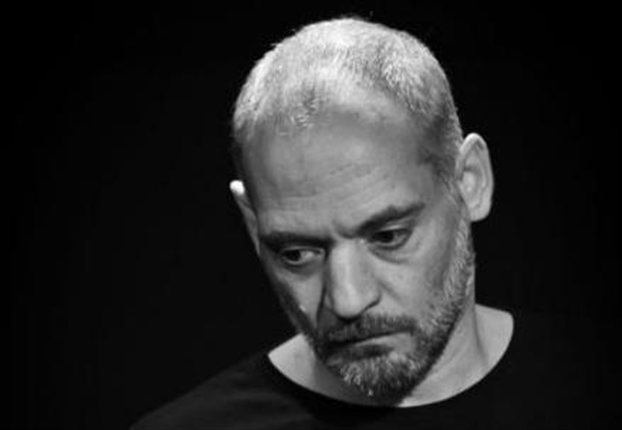
The effort is supported by the Hellenic Film Academy and aims at the extroversion of Greek cinema, which for years has been doing well at festivals abroad where it has distinguished itself. A more recent example is the case of Giorgos Zois' short film "Ending Titles" which was awarded at the Venice festival. Zois and his producer Maria Drandaki are among the presenters of the event and will present the development process of the first feature film of the former, «Stage Fright».

The philosophy of the two-day conference with the general title "Riding the Greek wave" ("Riding the Greek Wave") are the meetings and exchanges of ideas and experiences between Greek and foreign representatives of the cinema.

For more details visit ittovima.gr

Pemy Zouni at Badminton with tango and zeibekiko

On Saturday, he presents the show "17. 37΄Πειραιάς – The Mouth»

Greece and Argentina meet in a port. On a journey through time. Six faces, each with their own history and memories, with his partings and dreams. Dominant theme, the waiting. Their weapons, the song and the dance. Tango and zeibeki, ball and tzakarera. Carnival and demonstration. Pictures of him 30, of 70 and his 2012. Everything sweetly tangles and unites them.

This is how the theatrical production that culminates the actions of the Tango Acropolis Festival unfolds on Saturday 8 September entitled "17. 37"Piraeus - La Boca" at the Badminton Theatre.

"It is a theatrical performance with a lot of dancing where Greeks and Argentinians participate", says Pemy Zouni who directs and stars in the production. "I would essentially say that it is a meeting of the cultures of two countries that may be far away, but they have, many common elements. The course of Greece and Argentina in the 20th century shows many similarities. Comprehensive regimes, forbidden songs ( zeibekiko and tango), tendency to flee and cities full of immigrants. They are two countries with big hearts and unruly minds..."

The "soul" of the show are the tangeros, the community of Greeks and Argentinians who live in our country and love tango and Argentinian culture. From the end of April, the small group of core performers of the show prepares the play. A woman in a harbor waits for her lover who is a sailor to return. Based on a story of waiting, many different separation stories, of love, of dreams and hope unfold in parallel.

The direction is by Pemis Zounis and the texts are by Stelios Hatziadamidis. Assistant director is Pella Makrodimitri. They are playing: Pemy Zounis, Elena and Luis Mestre, Panis Kalofolias, Dimitris Nikolaidis, Marianna Cutulas. Marios Strofalis participates (accordion), Costas Vlachopoulos (harmonica) and the Quilombo percussion group.

What will the viewer take away from the show?; "A sweetness of things he knows and loves, and from stories he may have recognized. Memories "touch". And seeing the harbor can, for example, may come to your mind "The minor of the dawn" with the voice of Sotiria Bellou..."

There is a case for repeating the performance; "We are in discussions with Buenos Aires", Pemy Zouni answers. "I would also like the show to be staged in Thessaloniki. All possibilities are open…”

Saturday 8 September
Badminton Theatre
«17. 37΄Πειραιάς – The Mouth»

Source : tovima.gr

69the Venice Festival: Live or die; Here's the question

Not many years have passed since the death of 17 years in a coma Elwana Englaro had shocked Italian public opinion. In February 2009, Englaro who had been in a coma since the 1992, after a car accident, died while the Italian Senate was debating in an emergency session the passage of Silvio Berlusconi's bill on compulsory feeding of patients in hospitals.

The request by Englaro's parents, who had repeatedly expressed their wish that she not live should she fall into a coma, amounted to euthanasia, which is illegal in Italy. With the support of the Vatican, Berlusconi drafted the law on compulsory feeding.

One of the people who were shocked by the Englaro case was the teenager – then –  daughter of Marco Bellocchio. Talking to her, the Italian director came up with the idea of ​​a film that would raise hot issues and dilemmas such as, in this case, euthanasia. The film called "Unseen Beauty" (Sleeping Beauty) and starring Tony Servillo and Isabelle Hyper, it was screened on Wednesday in competition in Mostra and received warm applause

Having the Elwana Englaro case constantly in the background, Bellocchio sets up short stories of death that take place in Rome. The most interesting of all is that of a senator (Tony Servillo) who is living the exact same drama as his wife who is dying of cancer and is determined to vote against the bill.

"There is no neutrality in Art, but the film is not a manifesto either," said the leftist Marco Bellocchio who had admired the lonely attitude of Englaro's father and was shocked by the way the media handled the event and also by the political dimension the issue had taken. "I want to believe that my film is serious and non-ideological and above all open to different points of view" he added.

Voyeuristic wandering

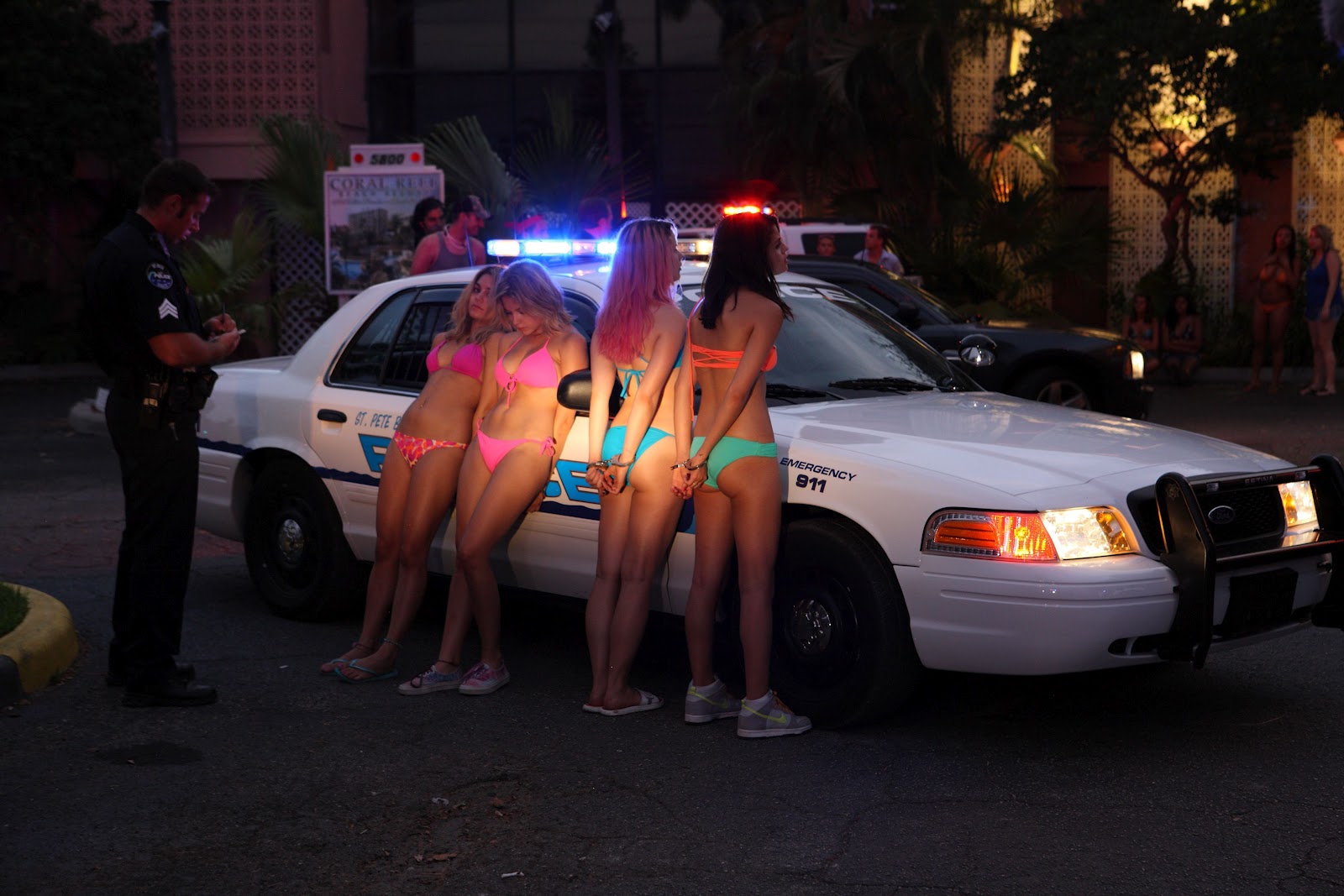
The sex, drugs and crime, permanent reflections of the "provocative" American director Harmony Korine, student of the equally challenging (but a better director) Larry Clark, dominate his latest creation as well, "Spring breakers" which is shown today Wednesday in a competition in Mostra.

We follow the adventures of four girls in Miami during Spring break, an American custom, according to which, shortly before the end of the academic term, students go on a two-week break.

Relaxation, sure, we mean nothing stands still. The girls go prepared for everything and Korain's lens with a voyeuristic mood captures every graphic detail emphasizing young girls' backsides and breasts. Such rabid cinematography of bare flesh can only be expected from the deeply deprived.

The interest in the film is its cast. Corinne cast actors closely associated with teen movies such as singer Selena Gomez and Ashley Benson as well as James Franco as a Miami criminal rapper who takes the four girls under his wing.

Source : tovima.gr

Jean Genet is still looking for "some paradise"

Vana Pefani attempts to immerse herself in the universe of the provocative creator

Having chosen, and very reasonable, the prison as the main theatrical space, the show "Somebody's Paradise 2" introduces us and takes us on a tour of the life and work of Jean Genet, wanting to bring us face to face with both the harsh world of the French writer and our wild world.

With questions about justice, punishment and reward, and mainly with the subject of good and evil, Vana Pefani attempts to immerse herself in the universe of this misunderstood and provocative creator who managed to "find beauty in evil", as Baudelaire would say, and make it a theater, novel, poem.

In the theatrical version that we will see from 10 September at the Michalis Kakogiannis Foundation, Vana Pefani brings Genet himself into focus, where imprisoned again, he is trying to finish another book of his. And there, between reality and fantasy, all his heroes spring up, they either love or hate their creator, creating a new universe, ours.

Marginalized, imprisoned, murderers, whores, slaves and masters make the puzzle of searching for a paradise _elusive perhaps, but absolutely necessary.

Unknown father, inmate of reformatories and prisons, petty thief and petty swindler, deserter and homosexual, Jean Genet found an outlet in writing and managed to turn the violence and ugliness of life into words, verses, pictures.

Born in 1910 (died in Paris on 1986) it did not take long to find an outlet in writing. He became famous through novels ("The Name of the Rose", "Our Lady of Flowers", "Diary of a Thief", "Death processions" etc.) as well as from his plays ("High Surveillance", "The Slaves", "The Balcony", "The Negroes", "The Screens"), while in the monumental work dedicated to him by Jean-Paul Sartre "Saint Genet: Commodus and Martyr" owes part of their recognition from the international philological community.

The project "A certain paradise 2" was first staged in Patras in March 2012 with the same title, but without the number 2, which signals the fact that the extension has been reworked and is returning….

WHEN & WHERE
"Some Heaven" – an ongoing performance based on the life and work of Jean Genet
Michalis Kakogiannis Foundation – Piraeus 206, Taurus
Premiere 10 September on 21.30 _performances as 23/9
Room: Specially Designed Underground Space
Unsuitable under 18 years
Tickets 12 – 9 euro

PERFORMANCE IDENTITY
Text-directed by Vana Pefani, scenery Giorgos Lyntzeris, costumes by Ioanna Zafeiropoulou, lighting design Katerina Maragoudaki, video Nikos Giavropoulos, music by Panagiotis Kalatzopoulos, lyrics by Aris Davarakis , edited by Sofia Michael. They play: Panagiotis Petrakis, Kyriakos Kosmidis, Hieronymos Kaletsanos, Kostas Falelakis, George Striftaris, Vassilis Afentoulis, Vana Pefani, Nikolina Mouaimi, Dimitris Katsis, Stavroula Oikonomou, Margarita Papantoni

Source : tovima.gr

“Who Killed the Dog at Midnight;» at the Concert Hall

Mark Haddon's novel live from the England National

A 15-year-old autistic boy, mathematical genius, decides to discover the killer of his neighbor's dog and in the course of his investigation unravels the disorders of "normal" people while at the same time confronting his own demons through his personal view of reality.
All this in "Who Killed the Dog at Midnight;» by Mark Haddon. A touching one, tender and humorous portrait book of young Christopher's life, which has sold more than two million copies worldwide and is a reference text for anyone trying to understand the conditions and manifestations of autism. Award-winning author Simon Stephens brings the novel to the stage of England's National Theater in a performance that can be watched live by Athenians on 6 September (at 21.00) on the screen of the Athens Concert Hall (Alexandra Trianti Hall).

The play "Who Killed the Dog at Midnight;" is the first of the broadcasts of this year's series from the National Theater of England, which the Concert Hall offers for the third year in a row to the Athenian audience in collaboration with the British Embassy and the British Council. The show is directed by Marianne Elliott and stars Luke Trendaway.

Source : tovima.gr

The way to return fragments of the Parthenon opens

Discussion begins between the Acropolis Museum and the British Museum

"Stray" fragments of the Parthenon, from its sculptural decoration mainly, which are in the British Museum may return to Greece _if not in their entirety, but at least some of them _ as long as cooperation is achieved, which he proposed at the last UNESCO session last June, the Acropolis Museum.

The issue was raised for the first time and is of course independent of Greece's constant and ongoing request for the reunification of the Parthenon Sculptures. In this particular case, the president of the Acropolis Museum, professor Mr. Dimitris Pandermalis proposed the special request for a first reunification of "stray" fragments, which are in the British Museum with the sculptures exhibited in Athens.

In the intentions of the Acropolis Museum like this, is the invitation in the autumn of representatives of the British Museum, in order to see the exhibition of the Parthenon Sculptures together in order to form their own opinion about the possibility of re-positioning fragments found in the British Museum in the places from which they are missing. The main argument of the Greek side is, that the recovery of the overall image of a sculpture, even with the addition of a small broken marble is a matter, first of all, scientific ethics.

But what kind of fragments are these?; For example the back part of the upper torso of Poseidon from the west pediment of the Parthenon (the front part is exhibited in the Acropolis Museum).

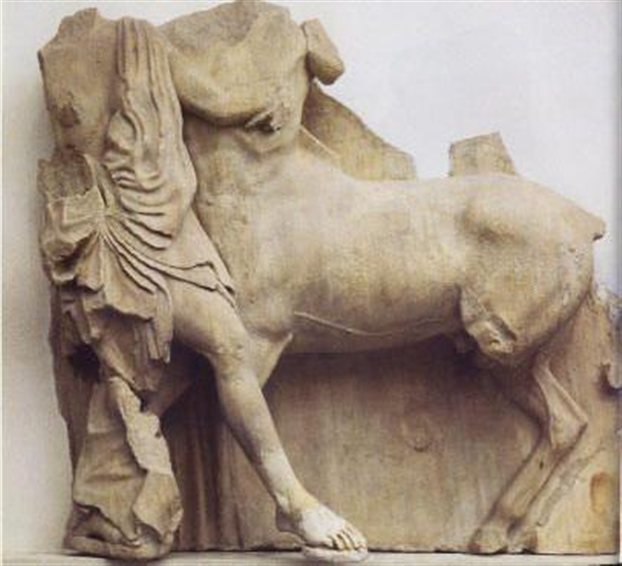
 Part of the leg of a Lapithidos being seized by a Centaur from the 12th south pediment of the temple (the composition is preserved almost entirely in the Acropolis Museum).

Part of the chest of a warrior depicted on the frieze, as well as other stray fragments of sculptured heads, hands or feet. Of course, there are also some very small fragments.
Of course, many discussions will need to be held in order to have a positive outcome, but the beginning was made and indeed with a positive sign.

In any case, the willingness of the British side to cooperate on such a delicate issue is highly welcomed. It is also noted that according to the standard practice applicable to the Intergovernmental Commission of UNESCO, the two sides negotiated on the sidelines of the Meeting a relevant "Recommendation" draft (Recommendation), which was unanimously adopted by the Commission.

In addition to this, the representative of the British Ministry of Culture Mrs. Bower positively assessed the Greek proposal for a 3D digital scan of the Parthenon frieze in terms of its parts that are in the British Museum. The digital scanning of the stones found in the Acropolis Museum is already being completed in the autumn - it started about a year ago - and at the end the digital composition of the entire frieze will be done in order to obtain "more accurate scientific knowledge", as Mrs. Bauer mentioned.

The same, however, in Greece's constant request for the return of the Sculptors, which was presented at the meeting by the general director of Antiquities and Cultural Heritage of the Ministry of Education and Culture Mrs. Maria Andreadaki – Vlazakis and professor Mr. Pandermali repeated the familiar arguments of the British side, that this matter falls under the exclusive supervision and management of the Board of Governors of the British Museum.

As for the fragments of the Acropolis, however, it should be noted that they have already started to be returned to Greece. We recall the marble part of the corner capital, which was in the possession of a Dutch privateer, who had taken it as a souvenir on a visit in his decade’ 50. Another large fragment from the north frieze of the Parthenon depicting a man's head and part of a boat supported by him, which was returned by the Vatican (it was in the Etruscan Museum of the Vatican).

One foot man, fragment of the north frieze returned by the University of Heidelberg. And even on loan from the Salina Museum of Palermo, Italy, found for a few months in the Acropolis Museum a fragment of the relief decoration of the Parthenon in which the extreme right leg and the fringes of the garment of the goddess Artemis are depicted. Fragments of the Parthenon frieze can be found in many European cities: Paris, Vienna, Copenhagen, Munich and Würzburg.

Very often, however, the political leadership of the Ministry of Culture had expressed the country's willingness to provide "in return" in the event of a donation or long-term loan, even of fragments of the Parthenon sculptures, and to cooperate in the organization of exhibitions in foreign museums by lending antiquities..

A problem that has not been solved yet is the embargo of the Greek Ministry of Culture (current Secretariat) to the British Museum. A tactic, which was adopted in the 80s by Melina Merkouri, perfectly understandable and useful for that time, when the request for the return of the Sculptures was first raised, but not necessarily today.

Times have changed, people too, even the means of claim, so that now the embargo creates problems instead of acting as a bargaining chip. The impossibility of official cooperation with the British Museum "forbids" even direct discussion between the two parties, makes communication difficult, exchange of views and communication, let alone the organization of joint exhibitions or other cultural activities. Something that does not apply to private Greek museums, which do not follow this line.

However, the development of relations is now imperative and this is of course not related to the request for the return of the Sculptors, which will always remain in the forefront until satisfied.

Source : tovima.gr

A Minoan mansion was discovered in Ierapetra

At altitude 900 meters – Dated from 1.600 up to 1.400 B.C.

Minoan building, dating from 1.600 up to 1.400 B.C. brought to light by the archaeological hoe at the site of Gaidourofas, in East Ierapetra, in altitude 900 meters.

The first indications, according to archaeologists, they speak of an important building, which with the so far features resulting from the excavation, it could be classified as a mansion.

And the British archaeologist Arthur Evans when he passed by the point 1898, he noted in his diary that he found that in the area - and despite the embankments- there were architectural elements that testified to the presence of a Minoan building.

During this year's first two-week excavation period, archaeologists managed to excavate, down to the floor, the interior of two rooms.

The building – according to archaeologists- he saves all his embankments, it has not been subjected to subsequent circulation and the main thing, the occupants left it after its destruction without taking with them the objects that were inside it.

The causes of destruction and the reasons for the building's abandonment have not yet been clarified and further evidence is expected to emerge as the excavation progresses., according to them.

Yet, as they emphasize, archaeologists such mansions exist in other parts of Crete but so far they have only been recorded and excavated in lowland areas, at an altitude of up to 400 meters, where they are traditionally associated with agricultural cultivation.

On the contrary, the building in the East is much higher, and is the second building to be excavated at such a high altitude after the one in Zominthos by Yiannis and Efi Sakelarakis.
The excavation is carried out as part of a five-year research program implemented and financed by the University of Athens, with the financial support of institutions from Greece and abroad, led by the Prehistoric Archeology lecturer at the Department of History and Archeology Yiannis Papadatos, and Gerapetri archaeologist Kostis Halikias as deputy director, PhD from the University of Heidelberg.

"With this excavation we are trying to understand the importance of the mountains for the Minoan economy, i.e. the natural resources and wealth-producing sources that the Minoans exploited at these altitudes, emphasizes the head of the excavation, Yiannis Papadatos.

Mr. Papadatos emphasized that "the second goal is to begin to understand what was happening in Minoan Ierapetra where the evidence is minimal. Despite the timeless importance of the Ierapetra plain, we have not the slightest idea about the location of the Minoan settlement, and we do not know whether there was any kind of administrative or even palatial center, such as those excavated at neighboring sites, in Gournia, in Makri Gialos and Myrtos.

» Yi’ this and we are looking for indirect evidence in the mountains hoping that the excavation in the East will provide us with it".

Source : tovima.gr