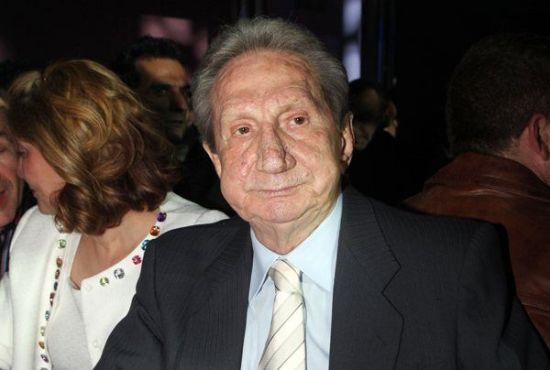
Emilios Liatsos: General Director of News and Information of ERT;

After a period of television abstinence, Emilios Liatsos, accepted the proposal to take over the duties of Director General of News and Information of the state television.

According to enikos.gr, the well-known journalist, who met today with government spokesman Simos Kedikoglou at the offices of the General Secretariat of the Press and discussed with him the proposal and the plan for the return of NET to the competition,  not only does he consider with interest the proposal made to him, but has already responded positively to it. However, official announcements are expected in the coming days.

It is worth noting that Emilios Liatsos has been in a similar position in the past., since he has been the news director of Mega.

Source : yupiii.gr

The way to return fragments of the Parthenon opens

Discussion begins between the Acropolis Museum and the British Museum

"Stray" fragments of the Parthenon, from its sculptural decoration mainly, which are in the British Museum may return to Greece _if not in their entirety, but at least some of them _ as long as cooperation is achieved, which he proposed at the last UNESCO session last June, the Acropolis Museum.

The issue was raised for the first time and is of course independent of Greece's constant and ongoing request for the reunification of the Parthenon Sculptures. In this particular case, the president of the Acropolis Museum, professor Mr. Dimitris Pandermalis proposed the special request for a first reunification of "stray" fragments, which are in the British Museum with the sculptures exhibited in Athens.

In the intentions of the Acropolis Museum like this, is the invitation in the autumn of representatives of the British Museum, in order to see the exhibition of the Parthenon Sculptures together in order to form their own opinion about the possibility of re-positioning fragments found in the British Museum in the places from which they are missing. The main argument of the Greek side is, that the recovery of the overall image of a sculpture, even with the addition of a small broken marble is a matter, first of all, scientific ethics.

But what kind of fragments are these?; For example the back part of the upper torso of Poseidon from the west pediment of the Parthenon (the front part is exhibited in the Acropolis Museum).

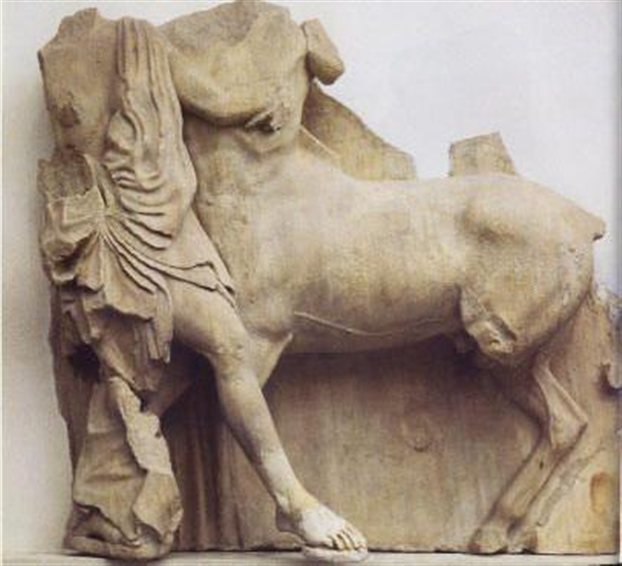
 Part of the leg of a Lapithidos being seized by a Centaur from the 12th south pediment of the temple (the composition is preserved almost entirely in the Acropolis Museum).

Part of the chest of a warrior depicted on the frieze, as well as other stray fragments of sculptured heads, hands or feet. Of course, there are also some very small fragments.
Of course, many discussions will need to be held in order to have a positive outcome, but the beginning was made and indeed with a positive sign.

In any case, the willingness of the British side to cooperate on such a delicate issue is highly welcomed. It is also noted that according to the standard practice applicable to the Intergovernmental Commission of UNESCO, the two sides negotiated on the sidelines of the Meeting a relevant "Recommendation" draft (Recommendation), which was unanimously adopted by the Commission.

In addition to this, the representative of the British Ministry of Culture Mrs. Bower positively assessed the Greek proposal for a 3D digital scan of the Parthenon frieze in terms of its parts that are in the British Museum. The digital scanning of the stones found in the Acropolis Museum is already being completed in the autumn - it started about a year ago - and at the end the digital composition of the entire frieze will be done in order to obtain "more accurate scientific knowledge", as Mrs. Bauer mentioned.

The same, however, in Greece's constant request for the return of the Sculptors, which was presented at the meeting by the general director of Antiquities and Cultural Heritage of the Ministry of Education and Culture Mrs. Maria Andreadaki – Vlazakis and professor Mr. Pandermali repeated the familiar arguments of the British side, that this matter falls under the exclusive supervision and management of the Board of Governors of the British Museum.

As for the fragments of the Acropolis, however, it should be noted that they have already started to be returned to Greece. We recall the marble part of the corner capital, which was in the possession of a Dutch privateer, who had taken it as a souvenir on a visit in his decade’ 50. Another large fragment from the north frieze of the Parthenon depicting a man's head and part of a boat supported by him, which was returned by the Vatican (it was in the Etruscan Museum of the Vatican).

One foot man, fragment of the north frieze returned by the University of Heidelberg. And even on loan from the Salina Museum of Palermo, Italy, found for a few months in the Acropolis Museum a fragment of the relief decoration of the Parthenon in which the extreme right leg and the fringes of the garment of the goddess Artemis are depicted. Fragments of the Parthenon frieze can be found in many European cities: Paris, Vienna, Copenhagen, Munich and Würzburg.

Very often, however, the political leadership of the Ministry of Culture had expressed the country's willingness to provide "in return" in the event of a donation or long-term loan, even of fragments of the Parthenon sculptures, and to cooperate in the organization of exhibitions in foreign museums by lending antiquities..

A problem that has not been solved yet is the embargo of the Greek Ministry of Culture (current Secretariat) to the British Museum. A tactic, which was adopted in the 80s by Melina Merkouri, perfectly understandable and useful for that time, when the request for the return of the Sculptures was first raised, όχι όμως απαραίτητα και σήμερα.

Οι καιροί έχουν αλλάξει, οι άνθρωποι επίσης, ακόμη και τα μέσα διεκδίκησης, so that now the embargo creates problems instead of acting as a bargaining chip. Η αδυναμία επίσημης συνεργασίας με το Βρετανικό Μουσείο «απαγορεύει» ακόμη και την απ΄ ευθείας συζήτηση ανάμεσα στα δύο μέρη, δυσκολεύει την συνεννόηση, exchange of views and communication, let alone the organization of joint exhibitions or other cultural activities. Something that does not apply to private Greek museums, which do not follow this line.

However, the development of relations is now imperative and this is of course not related to the request for the return of the Sculptors, που θα παραμένει πάντα στην πρώτη γραμμή ώσπου να ικανοποιηθεί.

Source : tovima.gr

Toll stickers are being removed

New system through TAXISNET is launched

The new way of paying traffic fees has been "locked"..

The financial staff puts an end to the sticker mark by enlisting TAXISNET.

Taxpayers will print the notification form from the system and with it they will go to the bank to pay the amount corresponding to the type and category of vehicle.

Those who do not pay will have the amount charged to their income tax 2013, as an overdue debt, together with the corresponding increments.

Taxpayers will be informed of the dates for the payment of the fees either by written notice (probably for those who submitted a handwritten tax return), or through TAXISNET.

Source : newsbeast.gr

The way to return fragments of the Parthenon opens

Discussion begins between the Acropolis Museum and the British Museum

"Stray" fragments of the Parthenon, from its sculptural decoration mainly, which are in the British Museum may return to Greece _if not in their entirety, but at least some of them _ as long as cooperation is achieved, which he proposed at the last UNESCO session last June, the Acropolis Museum.

The issue was raised for the first time and is of course independent of Greece's constant and ongoing request for the reunification of the Parthenon Sculptures. In this particular case, the president of the Acropolis Museum, professor Mr. Dimitris Pandermalis proposed the special request for a first reunification of "stray" fragments, which are in the British Museum with the sculptures exhibited in Athens.

In the intentions of the Acropolis Museum like this, is the invitation in the autumn of representatives of the British Museum, in order to see the exhibition of the Parthenon Sculptures together in order to form their own opinion about the possibility of re-positioning fragments found in the British Museum in the places from which they are missing. The main argument of the Greek side is, that the recovery of the overall image of a sculpture, even with the addition of a small broken marble is a matter, first of all, scientific ethics.

But what kind of fragments are these?; For example the back part of the upper torso of Poseidon from the west pediment of the Parthenon (the front part is exhibited in the Acropolis Museum).

 Part of the leg of a Lapithidos being seized by a Centaur from the 12th south pediment of the temple (the composition is preserved almost entirely in the Acropolis Museum).

Part of the chest of a warrior depicted on the frieze, as well as other stray fragments of sculptured heads, hands or feet. Of course, there are also some very small fragments.
Of course, many discussions will need to be held in order to have a positive outcome, but the beginning was made and indeed with a positive sign.

In any case, the willingness of the British side to cooperate on such a delicate issue is highly welcomed. It is also noted that according to the standard practice applicable to the Intergovernmental Commission of UNESCO, the two sides negotiated on the sidelines of the Meeting a relevant "Recommendation" draft (Recommendation), which was unanimously adopted by the Commission.

In addition to this, the representative of the British Ministry of Culture Mrs. Bower positively assessed the Greek proposal for a 3D digital scan of the Parthenon frieze in terms of its parts that are in the British Museum. The digital scanning of the stones found in the Acropolis Museum is already being completed in the autumn - it started about a year ago - and at the end the digital composition of the entire frieze will be done in order to obtain "more accurate scientific knowledge", as Mrs. Bauer mentioned.

The same, however, in Greece's constant request for the return of the Sculptors, which was presented at the meeting by the general director of Antiquities and Cultural Heritage of the Ministry of Education and Culture Mrs. Maria Andreadaki – Vlazakis and professor Mr. Pandermali repeated the familiar arguments of the British side, that this matter falls under the exclusive supervision and management of the Board of Governors of the British Museum.

As for the fragments of the Acropolis, however, it should be noted that they have already started to be returned to Greece. We recall the marble part of the corner capital, which was in the possession of a Dutch privateer, who had taken it as a souvenir on a visit in his decade’ 50. Another large fragment from the north frieze of the Parthenon depicting a man's head and part of a boat supported by him, which was returned by the Vatican (it was in the Etruscan Museum of the Vatican).

One foot man, fragment of the north frieze returned by the University of Heidelberg. And even on loan from the Salina Museum of Palermo, Italy, found for a few months in the Acropolis Museum a fragment of the relief decoration of the Parthenon in which the extreme right leg and the fringes of the garment of the goddess Artemis are depicted. Fragments of the Parthenon frieze can be found in many European cities: Paris, Vienna, Copenhagen, Munich and Würzburg.

Very often, however, the political leadership of the Ministry of Culture had expressed the country's willingness to provide "in return" in the event of a donation or long-term loan, even of fragments of the Parthenon sculptures, and to cooperate in the organization of exhibitions in foreign museums by lending antiquities..

A problem that has not been solved yet is the embargo of the Greek Ministry of Culture (current Secretariat) to the British Museum. A tactic, which was adopted in the 80s by Melina Merkouri, perfectly understandable and useful for that time, when the request for the return of the Sculptures was first raised, όχι όμως απαραίτητα και σήμερα.

Οι καιροί έχουν αλλάξει, οι άνθρωποι επίσης, ακόμη και τα μέσα διεκδίκησης, so that now the embargo creates problems instead of acting as a bargaining chip. Η αδυναμία επίσημης συνεργασίας με το Βρετανικό Μουσείο «απαγορεύει» ακόμη και την απ΄ ευθείας συζήτηση ανάμεσα στα δύο μέρη, δυσκολεύει την συνεννόηση, exchange of views and communication, let alone the organization of joint exhibitions or other cultural activities. Something that does not apply to private Greek museums, which do not follow this line.

However, the development of relations is now imperative and this is of course not related to the request for the return of the Sculptors, που θα παραμένει πάντα στην πρώτη γραμμή ώσπου να ικανοποιηθεί.

Source : tovima.gr

Shelby GT500 Cobra 862 horses

Η αμερικανική αυτοκινητοβιομηχανία της Shelby παρουσίασε σε ιστορικό event τη μοναδική Mustang GT500 Cobra 862 ίππων που κατασκευάστηκε για να τιμήσει τη μνήμη του Carroll H. Shelby.
Η Shelby παρουσίασε την μοναδική Mustang GT500 Cobra στο ετήσιο event ιστορικών αυτοκινήτων Role Monterey Motorsports Reunion στην Καλιφόρνια, τιμώντας τον «πατέρα» της αμερικάνικης φίρμας Carroll Hall Shelby, ο οποίος έφυγε από τη ζωή στις 10 Μαίου 2012 in age 89 years.

Το εκρηκτικό μοντέλο είναι βαμμένο σε εντυπωσιακό μπλε χρώμα, ενώ κατά μήκος του αμαξώματος έχουν τοποθετηθεί δύο λευκές γραμμές τονίζοντας τον δυναμικό του χαρακτήρα. also, διαθέτει ένα αρκετά φαρδύ body kit, νέο –σχεδιαστικά- καπό, καθώς και τροχούς 20 inches.

Η «καρδιά» του θηρίου χτυπάει με τον ήχο ενός V8 κινητήρα 5,8 liter, ο οποίος έχει δανειστεί τον κομπρέσσορα του υπερτροφοδοτούμενου 4λιτρου κινητήρα της Ford Racing, αγγίζοντας τους 862 horsepower, that is 200 ίππους παραπάνω από το «απλό» μοντέλο. Το αυτοκίνητο θα κάνει τη… βόλτα του σε αρκετά event της Αμερικής και δεν αποκλείεται να πουληθεί με τα χρήματα να καταλήξουν σε κάποιο φιλανθρωπικό ίδρυμα, κάτι που ο Carroll Shelby συνήθιζε να πράττει.

Source : autotriti.gr

A Minoan mansion was discovered in Ierapetra

At altitude 900 meters – Dated from 1.600 up to 1.400 B.C.

Minoan building, dating from 1.600 up to 1.400 B.C. brought to light by the archaeological hoe at the site of Gaidourofas, in East Ierapetra, in altitude 900 meters.

The first indications, according to archaeologists, they speak of an important building, which with the so far features resulting from the excavation, it could be classified as a mansion.

And the British archaeologist Arthur Evans when he passed by the point 1898, he noted in his diary that he found that in the area - and despite the embankments- there were architectural elements that testified to the presence of a Minoan building.

During this year's first two-week excavation period, archaeologists managed to excavate, down to the floor, the interior of two rooms.

The building – according to archaeologists- he saves all his embankments, it has not been subjected to subsequent circulation and the main thing, the occupants left it after its destruction without taking with them the objects that were inside it.

The causes of destruction and the reasons for the building's abandonment have not yet been clarified and further evidence is expected to emerge as the excavation progresses., according to them.

Yet, as they emphasize, archaeologists such mansions exist in other parts of Crete but so far they have only been recorded and excavated in lowland areas, at an altitude of up to 400 meters, where they are traditionally associated with agricultural cultivation.

On the contrary, the building in the East is much higher, and is the second building to be excavated at such a high altitude after the one in Zominthos by Yiannis and Efi Sakelarakis.
The excavation is carried out as part of a five-year research program implemented and financed by the University of Athens, with the financial support of institutions from Greece and abroad, led by the Prehistoric Archeology lecturer at the Department of History and Archeology Yiannis Papadatos, and Gerapetri archaeologist Kostis Halikias as deputy director, PhD from the University of Heidelberg.

"With this excavation we are trying to understand the importance of the mountains for the Minoan economy, i.e. the natural resources and wealth-producing sources that the Minoans exploited at these altitudes, emphasizes the head of the excavation, Yiannis Papadatos.

Mr. Papadatos emphasized that "the second goal is to begin to understand what was happening in Minoan Ierapetra where the evidence is minimal. Despite the timeless importance of the Ierapetra plain, we have not the slightest idea about the location of the Minoan settlement, and we do not know whether there was any kind of administrative or even palatial center, such as those excavated at neighboring sites, in Gournia, in Makri Gialos and Myrtos.

» Yi’ this and we are looking for indirect evidence in the mountains hoping that the excavation in the East will provide us with it".

Source : tovima.gr

The great singer Michalis Menidiatis has passed away

The great folk singer Michalis Menidiatis has passed away after suffering from a terminal illness.

The singer, due to the deterioration of his health, was hospitalized recently and finally lost the battle for his life.

His young son wrote on twitter “Have a good trip Father”!

The young Kalogranis as his real name was, was born and raised in Menidi.

His father worked as a security guard in the Vegetable Market.

From a small child he was moved by the sound of the bouzouki and, after Liberation he started to “carves” the coveted but then maligned instrument.

He went on stage for the first time- despite his father's strong objections- the 1953, in “Cool” of Dimitris Gikas in Menidi , where Michalis Daskalakis appeared, Takis Binis, George Lavkas and Gerasimos Klouvatos.

It entered the discography on 1957 with the “I will build a hut” of Ger. Kuvatou.

It was established and recognized by the compositions of Ap. Caldera, “do not wait any more”, “Contempt with, sweetheart”, “Little by little you will get used to me”, “Little by little” etc.

His collaboration with Akis Panos bore brilliant fruit.

“I saw your eyes crying, my dear”, “Illegal love” etc.

In the early 1960s, together with his brothers, he opened his own shop in Treis Gefyres.

Then they launch the “Tamba-Tumba” in Tzitzifies, from the eponymous sux of Karabessini.

The 1965 they take it “Global” on the beach and rename it to “Imagination”

Source : radar.gr