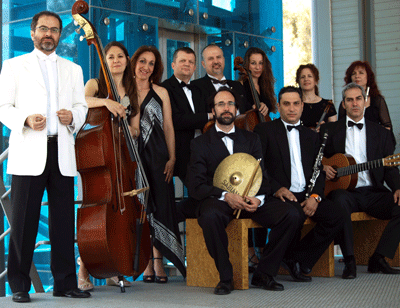
The "global" Kiki Dimoula was applauded in the Concert Hall

The anthology of 79 of her poems in English

As soon as she appeared and the presence of Kiki Dimoula was noticed in the packed "Alexandra Trianti" hall of the Athens Concert Hall on Tuesday afternoon (29/1) the first scattered applause also fell. When the spotlights lit up her white hair, not a few stood to applaud the 81-year-old poet as she slowly climbed the steps leading to the stage. "It would be the first time he stayed in one place for that long without smoking" and he finally succeeded.
Not in her case, it is probably needless to mention that a significant part of the youth who read it fanatically was also waiting for it in the audience. After all, "you don't need an occasion to honor Kiki Dimoulas" as the writer Yiannis Efstathiadis said at the beginning of the event (which was made in honor of this "unique literary artist" as her translator Cecile Inglesi Margellou called her, on the occasion of the publication of an anthology of her poems in the English language.
The evening indeed, beyond the expected good reasons, she also had an air of extroversion without necessarily referring to the ambassadors who attended her. Recently - after the poet's recent interview that was featured on the front page of the "International Herald Tribune" and republished by the "New York Times" - a lot has been said, even the magic word "Nobel" was heard.
One had the impression, however, that he was attending an event that had a specific goal and was part of a strategy, even if in some places it was unnecessarily pompous. Declared purpose of the bilingual edition with the 79 poems by Kiki Dimoulas under the title "The Brazen Plagiarist" (The brazen plagiarist) by Margellos World Republic of Letters (MWRL) of Yale University Press, is the worldwide recognition and award of her work.
"I bow to the incomparable national poetess of Greece who is now also a world poetess," said the director of Yale University Press, John Donatich, in a taped message, calling it a "shame" that only "the 3% of titles circulating in the US correspond to translated literature'.
The translator Cecile Inglesi Margellou highlighted the importance of translation - a "deep political act" - in the evolution of culture and the approach to otherness "because give and take is a relationship of two-way and constantly renegotiated parity". In addition, MWRL's special publishing series under the imprint of Yale University Press was created at the end of it 2007 precisely to alleviate "the appalling absence of great world literature in the English language". It is characteristic that in Greece the percentage of translated literature corresponds to 40% of the titles.
To them 50 so far titles in this series, the 10% it concerns books by Greek writers, a percentage that becomes particularly important if one considers that they are somehow co-located in it 19 different languages. "The Greeks have things to offer to the world beyond our ancient heritage," she said, referring to the wish of her husband Dori - who celebrated his sixtieth birthday on Tuesday - "that we publish Kiki in English, one of the largest modern intellectual capitals of the place". She also said that The New Yorker and Vanity Fair magazines want to interview the poet.. Finally, he mentioned the long-distance "difficult but exciting" translation adventure he had with the American poet Rika Lesser, who surprisingly does not speak any Greek.
At the event, a video excerpt from the "Monogram" of Giorgos and Iros Sgourakis was shown, with the poet talking about her childhood and youth in Kypseli, holding a fan in her hand (whole, shortly, on the NET), while the actresses Katerina Didaskalou and Marina Psalti read her poems in English and Greek respectively.
The attendees, including, they heard the poem "Melancholia" by Kiki Dimoulas set to music by Nikos Xydakis (from the "Erebos" collection with which she herself appeared in the letters 1956), the first part of "Two short poems about a riddle and a road" from the collection "On the Tracks" (1963) composed by Tassos Rossopoulos and Christos Papageorgiou (with the cinematographic instructions of Argyris Papadimitropoulos) to improvise on his piano "commenting" on the poet's verses.
Yiannis Efstathiadis, who moderated the evening said, referring to whether and to what extent Dimoula's poetry can be set to music, that "in musical terms her poetry is a contradiction" as she "removes the music so that the sounds of the words can be heard so as to remind us that there is not only the time of music but also the music of time".
Kiki Dimoula took the floor after about two hours during which she watched the various artistic transformations where "everyone translated my poetry with their own inspiration and their own notes". "The translator is a co-creator" he emphasized, among other things, and "must mend the cracks in the writing" where the other language is more generous. "Cécile Inglesi Margellou's flexible translation brought together the two-faced essence of the words giving a certificate of translation legitimacy". It is "a translation so transparent that the reflection of the native language breathes from underneath," he said.
She quietly wondered if "there was poetry before the creation of the world and fear" in yet another personal testimony to the essence of her art. He wished "to save the poverty of our lives from shocking events". He thanked God "for hiding himself from us" and concluded that poetry is probably "a kind of ark to save us from the deluge of so many truths".
Read her poems, he especially thanked the many academics who attended the event and was delighted by the audience's long standing ovation at the end. He's still enjoying it, with a restrained and melancholic character.
Source : tovima.gr

The "global" Kiki Dimoula was applauded in the Concert Hall

The anthology of 79 of her poems in English

As soon as she appeared and the presence of Kiki Dimoula was noticed in the packed "Alexandra Trianti" hall of the Athens Concert Hall on Tuesday afternoon (29/1) the first scattered applause also fell. When the spotlights lit up her white hair, not a few stood to applaud the 81-year-old poet as she slowly climbed the steps leading to the stage. "It would be the first time he stayed in one place for that long without smoking" and he finally succeeded.
Not in her case, it is probably needless to mention that a significant part of the youth who read it fanatically was also waiting for it in the audience. After all, "you don't need an occasion to honor Kiki Dimoulas" as the writer Yiannis Efstathiadis said at the beginning of the event (which was made in honor of this "unique literary artist" as her translator Cecile Inglesi Margellou called her, on the occasion of the publication of an anthology of her poems in the English language.
The evening indeed, beyond the expected good reasons, she also had an air of extroversion without necessarily referring to the ambassadors who attended her. Recently - after the poet's recent interview that was featured on the front page of the "International Herald Tribune" and republished by the "New York Times" - a lot has been said, even the magic word "Nobel" was heard.
One had the impression, however, that he was attending an event that had a specific goal and was part of a strategy, even if in some places it was unnecessarily pompous. Declared purpose of the bilingual edition with the 79 poems by Kiki Dimoulas under the title "The Brazen Plagiarist" (The brazen plagiarist) by Margellos World Republic of Letters (MWRL) of Yale University Press, is the worldwide recognition and award of her work.
"I bow to the incomparable national poetess of Greece who is now also a world poetess," said the director of Yale University Press, John Donatich, in a taped message, calling it a "shame" that only "the 3% of titles circulating in the US correspond to translated literature'.
The translator Cecile Inglesi Margellou highlighted the importance of translation - a "deep political act" - in the evolution of culture and the approach to otherness "because give and take is a relationship of two-way and constantly renegotiated parity". In addition, MWRL's special publishing series under the imprint of Yale University Press was created at the end of it 2007 precisely to alleviate "the appalling absence of great world literature in the English language". It is characteristic that in Greece the percentage of translated literature corresponds to 40% of the titles.
To them 50 so far titles in this series, the 10% it concerns books by Greek writers, a percentage that becomes particularly important if one considers that they are somehow co-located in it 19 different languages. "The Greeks have things to offer to the world beyond our ancient heritage," she said, referring to the wish of her husband Dori - who celebrated his sixtieth birthday on Tuesday - "that we publish Kiki in English, one of the largest modern intellectual capitals of the place". She also said that The New Yorker and Vanity Fair magazines want to interview the poet.. Finally, he mentioned the long-distance "difficult but exciting" translation adventure he had with the American poet Rika Lesser, who surprisingly does not speak any Greek.
At the event, a video excerpt from the "Monogram" of Giorgos and Iros Sgourakis was shown, with the poet talking about her childhood and youth in Kypseli, holding a fan in her hand (whole, shortly, on the NET), while the actresses Katerina Didaskalou and Marina Psalti read her poems in English and Greek respectively.
The attendees, including, they heard the poem "Melancholia" by Kiki Dimoulas set to music by Nikos Xydakis (from the "Erebos" collection with which she herself appeared in the letters 1956), the first part of "Two short poems about a riddle and a road" from the collection "On the Tracks" (1963) composed by Tassos Rossopoulos and Christos Papageorgiou (with the cinematographic instructions of Argyris Papadimitropoulos) to improvise on his piano "commenting" on the poet's verses.
Yiannis Efstathiadis, who moderated the evening said, referring to whether and to what extent Dimoula's poetry can be set to music, that "in musical terms her poetry is a contradiction" as she "removes the music so that the sounds of the words can be heard so as to remind us that there is not only the time of music but also the music of time".
Kiki Dimoula took the floor after about two hours during which she watched the various artistic transformations where "everyone translated my poetry with their own inspiration and their own notes". "The translator is a co-creator" he emphasized, among other things, and "must mend the cracks in the writing" where the other language is more generous. "Cécile Inglesi Margellou's flexible translation brought together the two-faced essence of the words giving a certificate of translation legitimacy". It is "a translation so transparent that the reflection of the native language breathes from underneath," he said.
She quietly wondered if "there was poetry before the creation of the world and fear" in yet another personal testimony to the essence of her art. He wished "to save the poverty of our lives from shocking events". He thanked God "for hiding himself from us" and concluded that poetry is probably "a kind of ark to save us from the deluge of so many truths".
Read her poems, he especially thanked the many academics who attended the event and was delighted by the audience's long standing ovation at the end. He's still enjoying it, with a restrained and melancholic character.
Source : tovima.gr

Tango Greco: The most beautiful Greek tangos from ancient Athens to our days at Badminton

 The Badminton Theater presents an evening entitled "Tango Greco", in which the most beautiful Greek tangos will be presented, on Monday 18 January 2013.

When the 1930 the "king of tango" Eduardo Bianco arrives in Athens for the first time, Athens is "tango occupied". The arrival of a leading foreign representative of Argentine tango was a great worldly event. Bianco will include Michalis Souyoul in his orchestra and they will play together in different parts of Greece…

The concert series "The Themes of Greek Music and Greek Song", conducted by the composer Michalis Koubios, presents us with the most beautiful Greek tangos. From ancient Athens to the present day. Because many old songs will always coexist with new ones, as the,what finally comes close to Art, it moves outside of time.

The tangos of composers such as: Attic, Kostas Giannidis, Michalis Suyul, Christos Hairopoulos, Manos Hadjidakis, Dionysis Savvopoulos, Eleni Karaindrou, Stamatis Kraunakis et al. they will perform four exquisite and special voices. Glyceria, Christos Thebeos, the mezzo-soprano Eleni Voudouraki and the tenor Yiannis Christopoulos, while a group of prize-winning dancers from the Academia del tango will dance them.

 Tango is a world rhythm that since its birth, loves to travel.

Tango is believed to have its roots in African rhythms. They are rhythms that traveled long distances and thus evolved, they changed. They arrived in Spain with the Arab conquerors to later migrate to the American continent. This is how the danzon and habanera were created in Cuba and the Tango in Uruguay and Argentina.

Around the 1870 tango is spreading both in and around Uruguay and Argentina 1890 settles permanently in Buenos Aires, starting with the infamous bars, mainly from those of slaughterhouses, where the gauchos (the South American cowboys) they give it their own temperament and personal nostalgia.

Initially he is banned, illegal and danced by men, but not in amorous moods, but aggressive, as they are men girded with knives dancing in a warlike atmosphere. However, tango will escape from the popular neighborhoods of Buenos Aires and will reach cosmopolitan Paris where it will be Europeanized and develop into an erotic, classy dance.

The tango from Paris is spreading quickly throughout the old Epirus and of course its waves are not long in "hitting" all of Greece. Even at the festivals of the Greek countryside, accordion viols, clarinet and lute as well as the Cretan lyre convey the melancholic thought that is being danced. Sure, what the Greek traditional orchestras played, it was but the echo of the great fashion of the Athenian salons. There, where tangos were a key ingredient in secular teas (tea) and the dance parties. Over the years, tango entered modern Greek song as well…

At Tango Greco you will hear the greatest Greek tangos, from the 1930s to the present day.

The musical performance Tango Greco is held with the support of the urban non-profit company AKOS "Cancer: Treatment of Body and Soul" in the framework of its Hellenic campaign entitled "Study in the human body - Prevention projects" for the information, the prevention and treatment of cancer. AKOS sends the message: "I love and take care of my body".

Series of concerts
"Themes of Greek Music and Greek Song"
Artistic Direction: Michalis Koubios
They sing: 
CANDY, CHRISTOS THEBIOS,
ELENI VOUDOURAKI, YIANNIS CHRISTOPOULOS
Την ATHENS CHAMBER ORCHESTRA
directed by Apollon Kouskoumvekakis
They participate:
Zoe Teganouria (accordion)
Dimitris Margiolas (bouzouki, mandolin, lute)
Award-winning dancers from the Academia del Tango group dance

Source : culturenow.gr

Ζέτα Μακρυπούλια : Τα παιδικά της χρόνια και ο άνθρωπος που την πρόδωσε

Η Ζέτα Μακρυπούλια μίλησε στο Κυπριακό περιοδικό «Όμικρον» και τον δημοσιογράφο Γιάννη Χατζηγεωργίου, for the theater, love, τις ψυχολογικές μεταπτώσεις που βιώνει από παιδί, το ενδεχόμενο ενός παιδιού χωρίς να έχει παντρευτεί και κατά πόσο την ενοχλούν οι σκληρές κριτικές που της ασκούνται.

Η παρουσιάστρια και ηθοποιός μίλησε για τις ψυχολογικές μεταπτώσεις που βιώνει κατά περιόδους: «Έχω πολλέςμαύρεςπεριόδους, είμαι ιδιαίτερα κυκλοθυμική και εκεί που είμαι πολύ χαρούμενη μπορεί ναπέσωκαι ξαφνικά να με δεις ξανά πολύ χαρούμενη μετά από λίγο. However, συμβαίνει και το αντίστροφο. Generally, Nevertheless, στο τέλος όλων των σκέψεών μου, μου αρέσει να έχω μία θετική οπτική των πραγμάτων. Και στην τελική, πιστεύω ότι είμαι ένας αισιόδοξος άνθρωπος», εξήγησε και συμπλήρωσε: «Αν και τότε δεν ήξερα τι ακριβώς μου συνέβαινε -γενικά, ήμουν πολύ κλειστό παιδί και νομίζω ότι οφείλεται σε αυτό-  ήμουν πάρα πολύ χαμηλών τόνων από μικρή, ενώ πάντα θυμάμαι ότι περνούσα και φάσεις στις οποίες ήμουν πιοσκεπτικήκαι μελαγχολική. Αυτό το βλέπω και τώρα από τη ζωή μου. Ακόμη και όταν είμαι πολύ χαρούμενη και θεωρώ πως δεν έχω κανένα πρόβλημα, η μουσική που βάζω για παράδειγμα για να ακούσω στο σπίτι μου είναι πολύ μελαγχολική -πιο slow, πιο lounge, δεν θα βάλω ποτέ να ακούσω, for example, κάτι πιο bit».

Still, η Ζέτα Μακρυπούλια αναφέρθηκε και στα παιδικά της χρόνια και τις αναμνήσεις που έχει από αυτά: «Τώρα που τα σκέφτομαι, θα σου έλεγα επίσης πως δεν ήμουν από τα παιδιά που έκαναν πάρα πολλές ατασθαλίες ή από τα παιδιά εκείνα που έφευγαν απ το σπίτι τους και γύριζαν την επόμενη μέρα -δεν έκανα τέτοια πράγματα. Ήμουν πάρα πολύ τυπική σε οτιδήποτε αφορούσε στην οικογένειά μου για να μην τους στεναχωρέσω, δεν έβγαινα πάρα πολύ -προτιμούσα να μένω στο σπίτι. Θυμάμαι ότι οι φίλες μου πήγαιναν σε café, σε σινεμά, αλλά εγώ δεν ήμουν τέτοιο παιδί, δεν πήγαινα ποτέ σε αυτά. Ίσως να ήμουν παραπάνω απ΄όσο πρέπει κλεισμένη στον εαυτό μου, αλλά δεν μπορώ να πω ότι έχω κάποιο παράπονο ή ότι μου έλειψε κάτι πολύ. Πιθανότατα να μην είχα κι εγώ την ανάγκη του να βγαίνω ή να κάνω κάτι άλλο -δεν ένιωθα πάντως ότι καταπιεζόμουν από κάτι».

Κατά πόσο τη βοήθησε η επαφή της με τον ψυχολόγο, να ανακαλύψει περισσότερο τον εαυτό της; «Πολύ! Ανακάλυψα για ποιο λόγο είμαι κλειστός σαν άνθρωπος, τις άμυνες μου, όλους τους μηχανισμούς μου, για ποιο λόγο αντιδρώ με συγκεκριμένο τρόπο σε δύσκολες καταστάσεις της ζωής μου ή ακόμη και γιατί δεν αντιδρώ όταν κάποιος μπορεί να με προσβάλει ή να μου μιλήσει άσχημα». And that, άραγε τη βοηθά να αντιμετωπίζει και τις σκληρές κριτικές που της γίνονται; «Η δουλειά αυτή είναι μία άλλη ψυχολογία, είναι σαν να κάνεις ψυχανάλυση από μία άλλη πλευρά. Is, Nevertheless, έτσι αυτή η δουλειά και αυτό είναι κάτι που μαθαίνεις μέσα στα χρόνια: Το γιατί γράφονται κάποια πράγματα, γιατί λέγονται. Και επίσης, η αλήθεια έχεις χάσει πια τόσο πολύ το νόημά της -αφού βγαίνει ο καθένας και λέει ό,what does he want- while, many times, πίσω από όλα αυτά κρύβονται πάρα πολλά, πολλοί λόγοι, πολλά συμφέροντα. Δεν μπαίνω πια στη διαδικασία να ασχοληθώ με όλα αυτά. Ούτε και να στεναχωρεθώ. Σε αυτά τα θέματα είμαι της άποψης ότι ο καιρός δείχνει πάντα την αλήθεια, ενώ όσοι λένε βλακείες θα τη βρουν μπροστά τους αυτή την αλήθεια. Παλαιότερα στενοχωριόμουνα. But, ξέρεις, όταν ζεις σε μία κλειστή κοινωνία όπως είναι η οικογένεια, το σχολείο και οι φίλοι, μαθαίνεις με αυτούς, συνεννοείσαι, είσαι καλά με αυτούς τους ανθρώπους, όταν υπάρξει κάποιο πρόβλημα το λες και το λύνεις, ενώ όταν ξαφνικά βγαίνουν κάποιοι άλλοι που δεν σε ξέρουν καν και λένε για σένα περίεργα πράγματα, τρομάζεις στην αρχή και λυπάσαι γιατί μέχρι τότε πίστευες πως όλα λειτουργούν όπως στην κλειστή κοινωνία στην οποία μεγάλωσες. Ε, δεν είναι έτσι. Άργησα να το μάθω αυτό, αλλά τώρα πια το έμαθα».

Στο τρέιλερ της «Ακτής Πειραιώς» όπου ο Ζουγανέλης ρωτάει τον Μιχάλη «Κύριε Χατζηγιάννη, πότε θα παντρευτείτε;», το κοινό γελάει. Πώς αντέδρασε, όμως όταν το είδε και η Ζέτα; «Γέλασα, γιατί είναι ωραίο να σατιρίζεται πια αυτό το πράγμα -όπως και στα «Βαφτίσια» υπάρχει κάτι αντίστοιχο. Και μου αρέσει που κι εμείς οι ίδιοι έχουμε την άνεση να το σατιρίσουμε όλο αυτό. Νομίζω ότι αυτό δείχνει προς τα έξω ότι το έχουμε χειριστεί με όλους τους τρόπους, e, ας το διασκεδάσουμε κιόλας».

Still, η Ζέτα Μακρυπούλια αποκάλυψε ότι θα έκανε ένα παιδί, ακόμη και εκτός γάμου. «Θα το έκανα. It can, Nevertheless, μετά να έκανα και το γάμο. Θέλω να πω, ότι ο γάμος δεν είναι προϋπόθεση για να κάνω παιδί. Και δεν έχω στο μυαλό μου αυτή την ιεραρχία που λέει πως το να θέλει κάποιος να κάνει παιδί θα πρέπει προηγουμένως να έχει παντρευτεί, όπως συνέβαινε παλιά».

Alongside,  δεν δίστασε να μιλήσει και για την προδοσία στο ερωτικό κομμάτι της ζωής της: «Ερωτικά δεν νομίζω να έχω προδοθεί ποτέ. Ή τουλάχιστον δεν θυμάμαι αυτή τη στιγμή που μιλάμε. Σε φιλικό, Nevertheless, επίπεδο θυμάμαι, γιατί δίνω μεγάλη βάση στη φιλία και, when something like this happens, εμένα με πονάει πάρα πολύ», ενώ αποκάλυψε αν μετάνιωσε για κάποιες σχέσεις που έκανε στο παρελθόν: «Είναι πολύ βαριά κουβέντα αυτή. Οι επιλογές που κάνουμε δεν γίνονται ερήμην μας. Τις κάνουμε και πρέπει να γνωρίζουμε κάποια στιγμή γιατί κάνουμε κάποιες σχέσεις -πάσης φύσεως σχέσεις».

End, τι γνώμη έχει η ίδια για τον εαυτό της όταν κοιτάζεται στον καθρέφτη; «Υπάρχουν μέρες που ξυπνάω και δεν νιώθω και πολύ όμορφη. Emotions are the language that the body uses to communicate its needs, Nevertheless, μία γυναίκα φτιαχτεί, περιποιηθεί τον εαυτό της, θα νιώσει όμορφα. Έτσι κι εγώ, in the same way, νιώθω όμορφα».

Source : yupiii.gr

Antonia Kallimoukou: She remembers the first time she had sex

THE Antonia Kallimoukou θυμήθηκε την πρώτη φορά που έκανε έρωτα και πώς αντέδρασε η μητέρα της όταν επέστρεψε στο σπίτι της, καλεσμένη στο “All” με τον Θέμο Αναστασιάδη, on Monday night.

Η νεαρή συνεργάτιδα της εκπομπής “Helen” αποκάλυψε πως είχε ολοκληρωμένη σεξουαλική επαφή για πρώτη φορά στην ηλικία των 18 ετών περίπου και μάλιστα μετά τοσυμβάνήταν πάρα πολύ αγχωμένη, επειδή πίστευε πως θα φαινόταν για κάποιο λόγο και θα το καταλάβαινε η μητέρα της.

Σε άλλο σημείο της συζήτησης, in fact, η Αντωνία Καλλιμούκου παραδέχτηκε πως η αγαπημένη της ώρα για να κάνει σεξ είναι το μεσημέρι και όχι το βράδυ!

Source : yupiii.gr

Toyota Avensis 1,6

After four years of presence in the Greek market, the Toyota Avensis returns fiercer, improved in points and ready to face with claims the most modern competition in the market.

It's been four years since Toyota took the next step into the midsize segment, introducing the new generation Avensis. From then until today, a lot has changed in the Greek car market, including buyers' priorities, who put over’ all the consumption and place the value for money very high.

Avensis has always performed very strongly in these areas, while now, renewed and in appearance, is gaining even more interest as a mid-range option.

Appearance: More beautiful and impressive

Toyota is famous for its conservative aesthetics that characterizes the original models, but also their facelifts. However, for quite some time now, that has changed. The GT86 seems to have swept the entire range, giving it an air of design freshness and dynamism. The Avensis benefits from this.

The updated model may not have great changes with the old one, but these are capable of making it stand out. At the front, the new lighting bodies can be seen, which are elegant with the daytime LEDs giving them a distinctive "eyebrow". The grille of the mask has also been changed, while the new bumper respects what Toyota calls "under priority".

That is, it has a large air intake that emphasizes the lower part of the car. The more aerodynamic mirrors can be seen from the side, while at the back, the lights and bumper have a fresh design.

Interior: Even more upgraded quality

Inside the Avensis, the changes are more imperceptible. Toyota announces that it has put more insulating materials in the cabin floor, but also behind the dashboard, further enhancing the feeling of quality you get inside.

inside, single dashboard stands out, which is made of soft touch plastic with an excellent finish, but also the flawless assembly of all individual plastic surfaces.

Overall, it is a dark but very comfortable interior, with ample spaces, careful ergonomics and great usability. The driving position is comfortable, with moderate lateral support, while peripheral visibility is uninterrupted.

Another new item of equipment that responds to the Elegant version, is the infotainment system, Toyota Touch, which includes a large touch screen and connection to all external audio and communication sources. It is worth noting that, the system is easy to use and works fast.

Motor: Slightly cheaper

From the beginning of his career, the Avensis had… ecological concerns. Besides, was the one that launched the implementation of the package of ecological measures to limit consumption under the title Optimal Drive.

At its heart is the 1,600 rpm Valvematic technology motor, according to which, in addition to the well-known technology of double variable timing of the intake and exhaust valves, a system has also been added that continuously changes the dip of the intake valves, for better control of air flow and speed. The result is more efficient operation with lower consumption.

In his case 1,6 emissions have been reduced by 2 gr / km. (compared to the pre-renewal model), with consumption limited by 0,1 l./100 km.

The motor works civilized and economical, while giving a good 0-100 in the car, but moderate prices for the replays, due to the sparsely scaled 6-speed gearbox.

Road behavior: Basically comfortable

The Avensis, with the upgrades in soundproofing and (according to Toyota) to the robustness of the frame, has tried to put the issue of comfort on new bases, which has always been his strong point.

Actually even after the update, the medium Toyota is the ideal ally for long comfortable journeys, while, despite its large dimensions, it turns out (proportional) flexible and comfortable even in the city.

Its steering wheel has been reconfigured to provide more direct information to the driver, something you collect, while its brakes have a mediocre feel, but very good performance.

From now on, the Avensis unfolds a mature character, whenever the driver wants to move nimbly. Bends in turns are present, but not annoying, while the car in fast driving proves to be safe, but not compatible with any sporty moods of the driver. Besides, each in its own way.

Conclusion

Toyota is loved by the general public because it remains true to certain values. Buying an Avensis, currently the renewed, you know what you're getting (and you really get) a reliable car (according to the findings of TÜV Germany), which is also "shielded" by Toyota's 6-year "super warranty". (as the company typically mentions it).

With something less than 20.000, you're also buying build quality, ultimate comfort, careful safety, since the 7 airbags belong to the standard equipment of the model, and very good value for money, since the fixed costs of the model are "reserved".

You will redeem the upgrade bonus at the show, which is more special, but also in the option of choosing up to date comfort equipment. So the Avensis re-enters the claim game.

Source : autotriti.gr

Tango Greco: The most beautiful Greek tangos from ancient Athens to our days at Badminton

 The Badminton Theater presents an evening entitled "Tango Greco", in which the most beautiful Greek tangos will be presented, on Monday 18 January 2013.

When the 1930 the "king of tango" Eduardo Bianco arrives in Athens for the first time, Athens is "tango occupied". The arrival of a leading foreign representative of Argentine tango was a great worldly event. Bianco will include Michalis Souyoul in his orchestra and they will play together in different parts of Greece…

The concert series "The Themes of Greek Music and Greek Song", conducted by the composer Michalis Koubios, presents us with the most beautiful Greek tangos. From ancient Athens to the present day. Because many old songs will always coexist with new ones, as the,what finally comes close to Art, it moves outside of time.

The tangos of composers such as: Attic, Kostas Giannidis, Michalis Suyul, Christos Hairopoulos, Manos Hadjidakis, Dionysis Savvopoulos, Eleni Karaindrou, Stamatis Kraunakis et al. they will perform four exquisite and special voices. Glyceria, Christos Thebeos, the mezzo-soprano Eleni Voudouraki and the tenor Yiannis Christopoulos, while a group of prize-winning dancers from the Academia del tango will dance them.

 Tango is a world rhythm that since its birth, loves to travel.

Tango is believed to have its roots in African rhythms. They are rhythms that traveled long distances and thus evolved, they changed. They arrived in Spain with the Arab conquerors to later migrate to the American continent. This is how the danzon and habanera were created in Cuba and the Tango in Uruguay and Argentina.

Around the 1870 tango is spreading both in and around Uruguay and Argentina 1890 settles permanently in Buenos Aires, starting with the infamous bars, mainly from those of slaughterhouses, where the gauchos (the South American cowboys) they give it their own temperament and personal nostalgia.

Initially he is banned, illegal and danced by men, but not in amorous moods, but aggressive, as they are men girded with knives dancing in a warlike atmosphere. However, tango will escape from the popular neighborhoods of Buenos Aires and will reach cosmopolitan Paris where it will be Europeanized and develop into an erotic, classy dance.

The tango from Paris is spreading quickly throughout the old Epirus and of course its waves are not long in "hitting" all of Greece. Even at the festivals of the Greek countryside, accordion viols, clarinet and lute as well as the Cretan lyre convey the melancholic thought that is being danced. Sure, what the Greek traditional orchestras played, it was but the echo of the great fashion of the Athenian salons. There, where tangos were a key ingredient in secular teas (tea) and the dance parties. Over the years, tango entered modern Greek song as well…

At Tango Greco you will hear the greatest Greek tangos, from the 1930s to the present day.

The musical performance Tango Greco is held with the support of the urban non-profit company AKOS "Cancer: Treatment of Body and Soul" in the framework of its Hellenic campaign entitled "Study in the human body - Prevention projects" for the information, the prevention and treatment of cancer. AKOS sends the message: "I love and take care of my body".

Series of concerts
"Themes of Greek Music and Greek Song"
Artistic Direction: Michalis Koubios
They sing: 
CANDY, CHRISTOS THEBIOS,
ELENI VOUDOURAKI, YIANNIS CHRISTOPOULOS
Την ATHENS CHAMBER ORCHESTRA
directed by Apollon Kouskoumvekakis
They participate:
Zoe Teganouria (accordion)
Dimitris Margiolas (bouzouki, mandolin, lute)
Award-winning dancers from the Academia del Tango group dance

Source : culturenow.gr

our breath, Your review