Harlem Swing – Aint’ Misbehavin: Musical at the Badminton Theatre

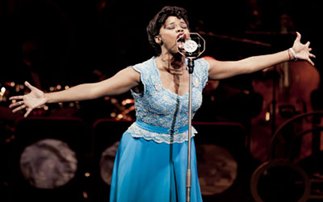
TheBadminton Theatretransforms intoCotton Club and everyone swing dances to his heartHarlem! TheAin’t Misbehavin’is aMusical in a scriptMurray Horwitzand Richard Maltby Jr. andmusic by Thomas Wright "Fats" Waller. From the famous song he wrote himself 1929, after all, got the work and its name. It is a tribute to the African-American musicians of the 20s and 30s who were part of the so-called Harlem Renaissance (Harlem Renaissance), a time of growing creativity, cultural awareness and national pride.
It was a time when Manhattan's legendary nightclubs, such as the Cotton Club and Savoy Ballroom,  and Lenox Avenue set the tone for high society entertainment, filled with pianists who were rocking the town with a 'new' beat, she was teaching the city her first steps in swing. Five performers present a noisy, "lewd" night, with humorous songs, a night that makes the audience feel like they've booked a table at the Cotton Club and just handed the wardrobe their hat and gloves.
TheAin’t Misbehavin’ premiered on February 1st 1978 in a small New York cabaret and until 5 June of the same year had won several awards in the musical category (Tony, New York Drama Critics, Outer Critics Circle, Drama Desk Award, Obie), while Richard Maltby Jr. (Is, Song and Dance, Baby, Miss Saigon) wins a Tony Award for Best Director and Nell Carter a Tony Award for her performance and the show's original music album received a Grammy Award. A year later, five troupes were already formed that toured the United States, while London and Paris soon surrendered to his magic. So did the rest of the world on all six world tours that have taken place to date, while now it seems completely normal that there isn't a day that Ain't Misbehavin' isn't being played somewhere in the world.
When it was first presented at the Manhattan Theater Club cabaret, one could discover the young singer Irene Cara in its cast (years later he would "shine" through the soundtrack of the hit Fame. Soon the Broadway production under the direction of Maltby, directed and choreographed by Arthur Faria, uploaded on 9 of May 1978 at the Longacre Theatre, while later he was in Plymouth and Belasco filling in at 21 of February 1982 1604 representations. The original cast included Nell Carter, Andre DeShields, Armelia McQueen, Ken Page to Charlayne Woodard.
Luther Henderson adapted Waller's score and was also the pianist for the production. Some of the replacements in the later shows were Debbie Allen, Yvette Freeman, Adriane Lenox and Alan Weeks. The West End production of the play in London premiered on 22 March of 1979 at Her Majesty's Theatre, while his revival the 1995. A Broadway revival with the same director, the same choreographer and the same cast as the first production ten years ago, premiered on 15 August 1988, at the Ambassador Theater in New York where it remained for 176 representations. The 2009 Aint Misbehavin turned thirty (30) years and the anniversary performance featured American Idol winner Ruben Studdard and contestants Frenchie Davis and Trenyce Cobbins.
In this particular performance that will be hosted at the Badminton Theater, American stars star, like Yvette Monique Clark who had excelled in Hairspray, Crowns, Chicago et al., Grammy Award nominee Patricia Covington, o Milton Nealy (Dreamgirls, The Full Monty, Jesus Christ Superstar, The Cage Aux Folles), η Rebecca Covington (Oh mama, Thoroughly Modern Millie) and TV star Wayne Pretlow (The Good Wife, Law & Order),  flanked by a talented cast of singers and dancers.
The musical direction is signed byWilliam Foster McDaniel, while the direction of Richard E. Maltby, Jr. and the choreography oArthur Faria.
• The first Broadway musical about the work and life of a songwriter/artist, by Thomas Wright "Fats" Waller.
• The first musical of its kind to win a Tony Award.
• The first musical of its kind to become a worldwide success.
• The first musical of its kind to win any kind of New York theater award.
• The first "biography" musical to which all others are compared.
 Source: culturenow.gr

Nikos Psarras : "I have been the third person"

On the occasion of his new performance, Nikos Psarras talks to Down Town about the role that love has played in his life.
The wedding, when it exists, it does not fatally delimit the relationship with a third person;
There should be no limits to love. Equally equal, I think that when there are such obstacles, love is greater. Only in the idea that you cannot have the other completely, you fill with assertiveness. You want to beat the other guy 100% and, when this happens, you are bored!
Have you ever been in a similar situation?;
I have never been the third person in a marriage. I have existed, Nevertheless,  the third person in a relationship. I was the wildcard and I left precisely because I didn't like that at all. Now that I'm older I weigh things a lot before letting go, because I know what I want and it's very specific. In my life, Nevertheless, I've done a lot of crazy things and I've let myself fall in love many times. Until recently, love defined my life in everything. Of jobs I would choose, until the trips I would take.
But these crazies are not what fill life;
Certainly. Think about love, when I was an infantryman, I had gone abroad illegally three times with the risk of being caught and going to prison. I was then 25. Now I don't know if I would - or rather very difficult. Maybe it's time for others to do it for me.
It would scare you more to live a life of loneliness and at some point find a person or a life of many people and in the end be alone;
Just like you said it, the first one (laughs). If you have met many people, how lonely you live; But being on your own to find the ONE person is incredibly nightmarish.
More on Down Town coming out.

Source : yupi.gr

David Beckham launches clothing line

He seems to be following in his wife's footsteps
The talent of his wife Victoria in designing clothes was revealed by David Beckham. The footballer made a dynamic entry into the world of fashion by designing a clothing line in collaboration with a large chain of stores.

In fact, the 36-year-old football star was not satisfied with the design but also proceeded to advertise the clothing line that includes T-shirts, pajamas and boxers showing off his fit body.

“I wanted to make sure it was clothes that not only I would wear but anyone else would be proud to put my signature on. I always want to challenge myself and this experience rewarded me even more", said David Beckham.

Source : newsbeast.gr

New Dodge Dart: The American Giulietta!

Just 24 hours before its official premiere in Detroit, we reveal to you the new Dodge Dart, a "small" by the standards of the American sedan market based on the floor of the Alfa Romeo Giulietta.
To the point, this is the first product of the American Dodge to make its way to the production line and use as a basis a model of the "mother" Fiat, which, as known, now controls Chrysler's fortunes, which also includes Dodge. The new Dodge Dart is a small, for the lowlands of the opposite shore of the Atlantic, four-door family model, by the standards of the forgotten Chrysler Neon, with which the now-merged Chrysler/Fiat group hopes to increase its influence in the domestic market, where proven the… races are still on - along with the big SUVs of course- to fascinate the Americans by having a special commercial appeal. By design, simple lines are adopted, without exaggeration, extremes or sophisticated forms, just as was the case with Caliber, which effectively now hands over the baton to Dart. Beneath the metal surfaces of the car lies the familiar, but except, especially for the occasion, enlarged in its dimensions, Alfa Romeo Giulietta floor, from which it also borrows the architecture of its posts.
 For now, the official technical details of the car have not been announced, as all that has been leaked are the photos we are listing for you. Sure, given our information so far, it is a given that the new Dart will be available with three petrol engine sets, two naturally aspirated and one turbocharged. Regarding the first, these are two engines of Chrysler's Tigershark generation, with capacity 2,0 and 2,4. The latter will integrate, according to all indications, the well-known Fiat MultiAir system, while its returns are rumored to be similar 160 and 184 horses. As for the supercharged one, it's about the familiar 1,4 MultiAir by Fiat, the performance of which will probably fluctuate around them 160 horsepower. It is worth adding that the Dart will initially be equipped with two gearbox options, a 6-speed manual and also a 6-speed dual-clutch, while later it will be available with a new automatic transmission 9 relations.
 Closing, to recall that with the new Dodge Dart the Fiat group managed to acquire an additional one 5% of Chrysler's stock, as with its presentation the condition set between the Italians and the American Environmental Protection Agency was reached and it concerned the construction of a car with an average fuel consumption of around 5,9 lit./100 km.

Source : 4troxoi.gr

An excellent year 2011 for Rolls Royce

The demand for luxury cars is on the rise
The British car manufacturer Rolls-Royce, which belongs to the German BMW, sold more than ever before 2011, as the demand for luxury cars reached record highs last year, according to data released today.

Based on the data released by the company itself, the 2011 were sold 3.538 cars, increase by 31% compared to last year.

Most sales are for the luxury Ghost and Phantom models, the company emphasizes in its announcement, which characterizes last year as "excellent".

Sales of Rolls-Royce's luxury models increased particularly in Germany and Russia, where they were double and now the 2011.

Sales in the Asia-Pacific region increased by 47%, in Britain v 30% and in Middle Eastern countries vs 23%.

However, the US and Chinese markets remain the most important, underlines the British car industry in its announcement.

Source : newsbeast.gr

Charles Gounod – Faust from the Lyric Stage at the Athens Concert Hall

One of the most popularFrench operas, which is based on the first part of his well-known tragedyGoethite, presents the NationalLyric Stageat20 January 2012and foronly eight performances, in theAthens Concert Hall– HallAlexandra Trianti. The masterpiece of French romanticism with the famous arias, the great choral and ballet performances of Walpurgis Night, is presented under the musical direction of Myron Michaelidis and directed by Renato Tzanella.
It is one of the world's favorite grands opéras, which has been presented in Greece since the 90s. It is based on Goethe's famous tragedy, where the aged scientist Faust sells his soul to Mephistopheles, in exchange for youth and love. At the heart of the opera is not so much Faust himself as Margarita, who is transformed by love and ultimately pays dearly for her choices.
He conducts the orchestra of the National Opera for the first time after assuming his duties as the artistic director of the Greek National Opera, the chief musician Myron Michaelidis, who has conducted some of the most important symphony orchestras, as among others, the Berlin Symphony Orchestras, of Rome, of Jerusalem and Mexico, the Philharmonic of Bucharest and Bratislava, the Prague Radio Orchestra, as well as all Greek orchestras.
The director and director of the ELS Ballet, Renato Zanellawith many years of service in the direction of the ballet of the Vienna State Opera, sets the case in an old empty classroom. There, in front of blackboards full of knowledge, Faust alone, tormented by the fundamental questions of life, of death, love, of happiness. Inside his clouded mind he meets Mephistopheles, who enticed Margarita, convinces him to sign the deal with the devil.
Zanella notes: "My approach moves away from both the supernatural and the religious element and places man and his weaknesses at the heart of the matter. Faust really becomes young again, or simply Mephistopheles shows him what he wants to see; They really leave the room to travel to other places and have the most amazing adventures, or maybe they never leave the classroom; Is this hall Faust's head?, filled with so much information that it cannot tell the real from the imaginary; My work moved in this direction thanks to the help and amazing, unique capture of Alessandro Camera (scenery), Carla Ricotti(suits) and Vinicio Kelly(illuminations)».
A multitude of leading Greek and foreign performers participate in the production. The role of Faust will be performed by American tenor Eric Cutler, who has appeared in the last years in the biggest Lyric Theaters of the world, such as New York's Metropolitan Opera, the Royal Opera of London and the Paris Opera, while his appearance with Anna Netrebko the MET, in Bellini's Puritans is considered one of the high lights of his career.
Margarita is performed by Alexia Voulgaridou, the leading Greek soprano who carries out an extremely important career abroad, with appearances at leading theaters such as the Royal Opera, the Scala of Milan, and the Berlin State Opera, while he has collaborated with Riccardo Muti, among others, Ronaldo Villazon, Sir Colin Davies, Andrea Bocelli, but also Isabelle Hyper in the film "Deux" by Werner Schroeter. Voulgaridou has sung with great success the role of Margarita in Rome, Basel as well as the Ravenna festival.
Mephistopheles is performed by Paata Boursoulatze, the famous Georgian bass, extremely popular with opera audiences in Greece as well. Boursoulage has performed leading roles at the Metropolitan in New York, in Milan's Scala, in the Vienna Opera and in many other theaters around the world. Last summer the Athenian audience applauded him in Verdi's Nabucco, in the Conservatory of Herod Atticus.
The distribution is completed by leading Greek soloists such as Dimitris Platanias, who was warmly applauded at Verdi's Masquerade Dance presented at the ELLS, in December, Dimitris Kasioumis, Irini Karayanni and Ines Zikou. In the second distribution we find among others, the recently awarded with the Grand Prize of the Greek music critics Tselia Kostea, Askar Abdrajakov and many other famous singers.
Nikos Vassiliou conducts the ELLS choir. The ELS Ballet participates, choreographed by Renato Zanella.
Faust at a Glance
The composer / Charles Gounod was born in Paris in 1818 and took his first piano lessons from his mother. He studied at the Paris Conservatory and the 1839 won the famous Prize of Rome for the cantata of Ferdinand. In Italy he studied the works of Palestrina and other compositions of church music. Later, thanks to Fanny and Felix Mendelssohn he came into contact with the music of JS Bach. The 1851 composed his first opera, Sappho. The 1859 Faust made the composer known throughout the world. They were followed by the French themed Mireille (1864), which has recently come to the fore again, and the opera Romeo and Juliet (1867), based on Shakespeare. In addition to lyrical works, Gounod also composed symphonies, while during the last years of his life he was particularly involved in works of religious music, oratorios, functions, motet. He died of cerebral congestion on 1893.
The project / Opera in five acts, Faust is based on a poetic text by Jules Barbier and Michel Carré, who drew their material from Carré's play Faust and Margarita (1850), as also from Part I of Faust, by Johann Wolfgang von Goethe (1808) in its French translation by Gerard de Nerval (1828). A typical sample of French grand opera - grand opéra- and the first of its kind to be so successful worldwide, Faust remained the most popular lyric work until about World War II. It began as an opéra comique with nonsensical dialogues and was gradually transformed, during a decade, to suit the tastes of the global audience. The term opéra comique - comic opera- does not hint at comic elements, but it concerns structural and aesthetic features, one of which is prose dialogues. From Goethe Faust keeps only the narrative and skips the philosophical background: the aged scientist Faust sells his soul to Mephistopheles, in exchange for youth and love. At the heart of the opera is not so much Faust himself as Margarita, who is transformed by love and ultimately pays dearly for her choices.
Premieres / As a comic opera, with prose dialogues, Faust premiered at the Paris Lyric Theater on 19 Of March 1859. In its majestic version, with dialogues set to music and ballet, given by the Paris Opera on 3 Of March 1869. The play opened at the New York Metropolitan Opera on 22 October 1883.
From the National Opera, which started operating the 1939/40 as part of the National – then Royal- Theater, Faust first appeared on 12 November 1959 starring Nikos Hatzinikolaou (Faust), Zoe Vlachopoulos (Daisy) and Nikos Moschonas (Mephistopheles). The orchestra and choir were conducted by Antiochos Evangeliatos, while the direction was by Leo Nedomanski.
Summary
Act I / Germany, 16the century. In his workshop, Faust, an elderly scientist, he reasons that his investigations have yielded nothing, while on the contrary, they made him bypass life and love. He tries to kill himself, he curses science and faith and asks for help from dark forces. Mephistopheles appears, who tempts him with an image of the innocent Margarita and proposes the following agreement: he will serve Faust on earth in return for Faust serving him in Hell. The poison in Faust's cup turns into an elixir of youth, the old scientist transforms into a charming young man and together with Mephistopheles sets out to conquer the world.
Act II / At the gates of the city students, soldiers and villagers rejoice. Valentine leaves for the war with his friend Wagner and entrusts his sister Margarita to his young friend Zibel. Mephistopheles treats the crowd to wine and sings a hymn to the "golden calf". He speaks badly of Margarita and when Valentine defends her honor, his sword breaks in the air. Valentine and company recognize dark supernatural forces and resist the sign of the cross. Mephistopheles, Faust and the villagers dance a waltz. Margarita appears to whom Faust expresses his admiration.
Act III / Zibel, in love, leaves a bouquet in Margarita's garden. Faust asks Mephistopheles to find him a gift as well, and he leaves a jewelry box and a mirror on the girl's doorstep. Margaret reflecting on her encounter with Faust, he sees the gifts: in a few minutes the demure girl has transformed into a flirtatious young woman, who together with Martha's neighbor welcome Faust and Mephistopheles in the garden. She leaves Faust alone to kiss her, but after he leaves, alone, at her window, wishes to return. This is indeed what happens, and with the help of Mephistopheles it is certain that the young Faust will dissuade her.
Act D / Faust abandoned Margaret pregnant. She gave birth to the child and lives as an outcast from society. He prays in the church, but she is stopped by Mephistopheles and a chorus of demons. She finishes her prayer, όμως τρομοκρατείται όταν ο Μεφιστοφελής την καταριέται. As Valentine returns from the war, Zibel asks him to forgive his sister. As Valentine enters her residence, Faust and Mephistopheles arrive, who carelessly sings an ironic serenade to Margarita. Valentine comes out, he sees the two of them, he understands what has happened and attacks Faust. Mephistopheles intervenes in the sword fight, resulting in Faust killing Valentine, who before he cools off manages to curse his sister.
Act V / Witches have surrounded Faust and Mephistopheles. In a cave Faust meets queens and courtesans of other times. Mephistopheles promises him the love of the most important and beautiful women in history. The orgy night lasts until it blows. At dawn Faust sees Margaret as a vision and calls her. Mephistopheles helps him enter the prison where the girl is being held after killing her child. Only a mortal hand can save Margaret from her fate, and Faust intends to give her his, but she has put her faith in God. In his delirium he sees Faust's hands stained with blood, she pushes him away and passes out. Mephistopheles shouts that Margarita has been judged: She is protected because of her faith and penance. It is enough for him to drag Faust with him to Hell. Margaret ascends into the heavens as angels sing that she is saved.
In the context of its social pricing policy, ELLS has reduced ticket prices for the Faust production, which are now configured as follows: €22, €40, €60, €80 / childish, student €13.
Music directionMyron Michaelidis
Direction – Choreography – KinesiologyRenato Zanella
SceneryAlessandro Camera
SuitsCarla Ricotti
LightingVinicio Kelly
Choir DirectionNikos Vassiliou
Distribution
Faust Eric Cutler (20,22,24,27,29/1)
WILL. (21,25,28/1)
Margarita Alexia Voulgaridou (20,22,24,27,29/1)
Tselia Costea (21,25,28/1)
Mephistopheles Paata Bourjulatze (20,22,29/1) Tasos Apostolou (21,25,28/1)
Askar Abdrajakov (24, 27/1)
Valentine Dimitris Platanias (20,22,24,27/1)
Dionysis Sourbis (21,25,28,29/1)
Wagner Dimitris Kasioumis (20,22,24,27,29/1)
Dionysis Tsantinis (21,25,28/1)
Zibel Irini Karayanni (20,24,27/1)
 Georgia Iliopoulou (21,22,25,28,29/1)
Martha Ines Zikou (20,22,24,27/1)
Angeliki Kathariou (21,25,28,29/1)
The Orchestra participates, the Choir and Ballet of the National Opera
Info
Location
Athens Concert Hall, Vasilissis Sofias and Kokkalis 1, Athena
Date
Premiere Friday 20 January 2011. Performance dates: 20, 21, 22, 24, 25, 27, 28, 29 January 2012. Start time 20.00
Ticket prices
€22, €40, €60, €80. Children's, student €13
Ticket sales
From the coffers of the Athens Concert Hall, Bas. Sophia & Boney
Monday-Friday 10 am-6 pm. and Saturday 10 a.m.-2 p.m
during the days of the performances: Monday-Friday 10 a.m.- 8.30 p.m. /
Saturday 10 a.m.-2 p.m. & 6 Creation "regarding the modern administration and the European ones- 8.30 p.m. Sunday 6 p.m.-8.30 p.m
Homer 8 operating hours: Monday-Friday 10 a.m.- 4 p.m.
Telephone Purchase of Tickets – 210 7282333
& from the Funds of the OLYMPIA THEATER, Academy 59-61, Athena
Daily 9.00–21.00. Tel. sales 210 3662 100, 210 3612 461, 210 3643 725, Electronic pre-sale: www.megaron.gr – GROUP TICKETS Tel. 210 3711 342, SUBSCRIBER SERVICE Tel. 210 3711 381
 Source : culturenow.gr

Charles Gounod – Faust from the Lyric Stage at the Athens Concert Hall

One of the most popularFrench operas, which is based on the first part of his well-known tragedyGoethite, presents the NationalLyric Stageat20 January 2012and foronly eight performances, in theAthens Concert Hall– HallAlexandra Trianti. The masterpiece of French romanticism with the famous arias, the great choral and ballet performances of Walpurgis Night, is presented under the musical direction of Myron Michaelidis and directed by Renato Tzanella.
It is one of the world's favorite grands opéras, which has been presented in Greece since the 90s. It is based on Goethe's famous tragedy, where the aged scientist Faust sells his soul to Mephistopheles, in exchange for youth and love. At the heart of the opera is not so much Faust himself as Margarita, who is transformed by love and ultimately pays dearly for her choices.
He conducts the orchestra of the National Opera for the first time after assuming his duties as the artistic director of the Greek National Opera, the chief musician Myron Michaelidis, who has conducted some of the most important symphony orchestras, as among others, the Berlin Symphony Orchestras, of Rome, of Jerusalem and Mexico, the Philharmonic of Bucharest and Bratislava, the Prague Radio Orchestra, as well as all Greek orchestras.
The director and director of the ELS Ballet, Renato Zanellawith many years of service in the direction of the ballet of the Vienna State Opera, sets the case in an old empty classroom. There, in front of blackboards full of knowledge, Faust alone, tormented by the fundamental questions of life, of death, love, of happiness. Inside his clouded mind he meets Mephistopheles, who enticed Margarita, convinces him to sign the deal with the devil.
Zanella notes: "My approach moves away from both the supernatural and the religious element and places man and his weaknesses at the heart of the matter. Faust really becomes young again, or simply Mephistopheles shows him what he wants to see; They really leave the room to travel to other places and have the most amazing adventures, or maybe they never leave the classroom; Is this hall Faust's head?, filled with so much information that it cannot tell the real from the imaginary; My work moved in this direction thanks to the help and amazing, unique capture of Alessandro Camera (scenery), Carla Ricotti(suits) and Vinicio Kelly(illuminations)».
A multitude of leading Greek and foreign performers participate in the production. The role of Faust will be performed by American tenor Eric Cutler, who has appeared in the last years in the biggest Lyric Theaters of the world, such as New York's Metropolitan Opera, the Royal Opera of London and the Paris Opera, while his appearance with Anna Netrebko the MET, in Bellini's Puritans is considered one of the high lights of his career.
Margarita is performed by Alexia Voulgaridou, the leading Greek soprano who carries out an extremely important career abroad, with appearances at leading theaters such as the Royal Opera, the Scala of Milan, and the Berlin State Opera, while he has collaborated with Riccardo Muti, among others, Ronaldo Villazon, Sir Colin Davies, Andrea Bocelli, but also Isabelle Hyper in the film "Deux" by Werner Schroeter. Voulgaridou has sung with great success the role of Margarita in Rome, Basel as well as the Ravenna festival.
Mephistopheles is performed by Paata Boursoulatze, the famous Georgian bass, extremely popular with opera audiences in Greece as well. Boursoulage has performed leading roles at the Metropolitan in New York, in Milan's Scala, in the Vienna Opera and in many other theaters around the world. Last summer the Athenian audience applauded him in Verdi's Nabucco, in the Conservatory of Herod Atticus.
The distribution is completed by leading Greek soloists such as Dimitris Platanias, who was warmly applauded at Verdi's Masquerade Dance presented at the ELLS, in December, Dimitris Kasioumis, Irini Karayanni and Ines Zikou. In the second distribution we find among others, the recently awarded with the Grand Prize of the Greek music critics Tselia Kostea, Askar Abdrajakov and many other famous singers.
Nikos Vassiliou conducts the ELLS choir. The ELS Ballet participates, choreographed by Renato Zanella.
Faust at a Glance
The composer / Charles Gounod was born in Paris in 1818 and took his first piano lessons from his mother. He studied at the Paris Conservatory and the 1839 won the famous Prize of Rome for the cantata of Ferdinand. In Italy he studied the works of Palestrina and other compositions of church music. Later, thanks to Fanny and Felix Mendelssohn he came into contact with the music of JS Bach. The 1851 composed his first opera, Sappho. The 1859 Faust made the composer known throughout the world. They were followed by the French themed Mireille (1864), which has recently come to the fore again, and the opera Romeo and Juliet (1867), based on Shakespeare. In addition to lyrical works, Gounod also composed symphonies, while during the last years of his life he was particularly involved in works of religious music, oratorios, functions, motet. He died of cerebral congestion on 1893.
The project / Opera in five acts, Faust is based on a poetic text by Jules Barbier and Michel Carré, who drew their material from Carré's play Faust and Margarita (1850), as also from Part I of Faust, by Johann Wolfgang von Goethe (1808) in its French translation by Gerard de Nerval (1828). A typical sample of French grand opera - grand opéra- and the first of its kind to be so successful worldwide, Faust remained the most popular lyric work until about World War II. It began as an opéra comique with nonsensical dialogues and was gradually transformed, during a decade, to suit the tastes of the global audience. The term opéra comique - comic opera- does not hint at comic elements, but it concerns structural and aesthetic features, one of which is prose dialogues. From Goethe Faust keeps only the narrative and skips the philosophical background: the aged scientist Faust sells his soul to Mephistopheles, in exchange for youth and love. At the heart of the opera is not so much Faust himself as Margarita, who is transformed by love and ultimately pays dearly for her choices.
Premieres / As a comic opera, with prose dialogues, Faust premiered at the Paris Lyric Theater on 19 Of March 1859. In its majestic version, with dialogues set to music and ballet, given by the Paris Opera on 3 Of March 1869. The play opened at the New York Metropolitan Opera on 22 October 1883.
From the National Opera, which started operating the 1939/40 as part of the National – then Royal- Theater, Faust first appeared on 12 November 1959 starring Nikos Hatzinikolaou (Faust), Zoe Vlachopoulos (Daisy) and Nikos Moschonas (Mephistopheles). The orchestra and choir were conducted by Antiochos Evangeliatos, while the direction was by Leo Nedomanski.
Summary
Act I / Germany, 16the century. In his workshop, Faust, an elderly scientist, he reasons that his investigations have yielded nothing, while on the contrary, they made him bypass life and love. He tries to kill himself, he curses science and faith and asks for help from dark forces. Mephistopheles appears, who tempts him with an image of the innocent Margarita and proposes the following agreement: he will serve Faust on earth in return for Faust serving him in Hell. The poison in Faust's cup turns into an elixir of youth, the old scientist transforms into a charming young man and together with Mephistopheles sets out to conquer the world.
Act II / At the gates of the city students, soldiers and villagers rejoice. Valentine leaves for the war with his friend Wagner and entrusts his sister Margarita to his young friend Zibel. Mephistopheles treats the crowd to wine and sings a hymn to the "golden calf". He speaks badly of Margarita and when Valentine defends her honor, his sword breaks in the air. Valentine and company recognize dark supernatural forces and resist the sign of the cross. Mephistopheles, Faust and the villagers dance a waltz. Margarita appears to whom Faust expresses his admiration.
Act III / Zibel, in love, leaves a bouquet in Margarita's garden. Faust asks Mephistopheles to find him a gift as well, and he leaves a jewelry box and a mirror on the girl's doorstep. Margaret reflecting on her encounter with Faust, he sees the gifts: in a few minutes the demure girl has transformed into a flirtatious young woman, who together with Martha's neighbor welcome Faust and Mephistopheles in the garden. She leaves Faust alone to kiss her, but after he leaves, alone, at her window, wishes to return. This is indeed what happens, and with the help of Mephistopheles it is certain that the young Faust will dissuade her.
Act D / Faust abandoned Margaret pregnant. She gave birth to the child and lives as an outcast from society. He prays in the church, but she is stopped by Mephistopheles and a chorus of demons. She finishes her prayer, όμως τρομοκρατείται όταν ο Μεφιστοφελής την καταριέται. As Valentine returns from the war, Zibel asks him to forgive his sister. As Valentine enters her residence, Faust and Mephistopheles arrive, who carelessly sings an ironic serenade to Margarita. Valentine comes out, he sees the two of them, he understands what has happened and attacks Faust. Mephistopheles intervenes in the sword fight, resulting in Faust killing Valentine, who before he cools off manages to curse his sister.
Act V / Witches have surrounded Faust and Mephistopheles. In a cave Faust meets queens and courtesans of other times. Mephistopheles promises him the love of the most important and beautiful women in history. The orgy night lasts until it blows. At dawn Faust sees Margaret as a vision and calls her. Mephistopheles helps him enter the prison where the girl is being held after killing her child. Only a mortal hand can save Margaret from her fate, and Faust intends to give her his, but she has put her faith in God. In his delirium he sees Faust's hands stained with blood, she pushes him away and passes out. Mephistopheles shouts that Margarita has been judged: She is protected because of her faith and penance. It is enough for him to drag Faust with him to Hell. Margaret ascends into the heavens as angels sing that she is saved.
In the context of its social pricing policy, ELLS has reduced ticket prices for the Faust production, which are now configured as follows: €22, €40, €60, €80 / childish, student €13.
Music directionMyron Michaelidis
Direction – Choreography – KinesiologyRenato Zanella
SceneryAlessandro Camera
SuitsCarla Ricotti
LightingVinicio Kelly
Choir DirectionNikos Vassiliou
Distribution
Faust Eric Cutler (20,22,24,27,29/1)
WILL. (21,25,28/1)
Margarita Alexia Voulgaridou (20,22,24,27,29/1)
Tselia Costea (21,25,28/1)
Mephistopheles Paata Bourjulatze (20,22,29/1) Tasos Apostolou (21,25,28/1)
Askar Abdrajakov (24, 27/1)
Valentine Dimitris Platanias (20,22,24,27/1)
Dionysis Sourbis (21,25,28,29/1)
Wagner Dimitris Kasioumis (20,22,24,27,29/1)
Dionysis Tsantinis (21,25,28/1)
Zibel Irini Karayanni (20,24,27/1)
 Georgia Iliopoulou (21,22,25,28,29/1)
Martha Ines Zikou (20,22,24,27/1)
Angeliki Kathariou (21,25,28,29/1)
The Orchestra participates, the Choir and Ballet of the National Opera
Info
Location
Athens Concert Hall, Vasilissis Sofias and Kokkalis 1, Athena
Date
Premiere Friday 20 January 2011. Performance dates: 20, 21, 22, 24, 25, 27, 28, 29 January 2012. Start time 20.00
Ticket prices
€22, €40, €60, €80. Children's, student €13
Ticket sales
From the coffers of the Athens Concert Hall, Bas. Sophia & Boney
Monday-Friday 10 am-6 pm. and Saturday 10 a.m.-2 p.m
during the days of the performances: Monday-Friday 10 a.m.- 8.30 p.m. /
Saturday 10 a.m.-2 p.m. & 6 Creation "regarding the modern administration and the European ones- 8.30 p.m. Sunday 6 p.m.-8.30 p.m
Homer 8 operating hours: Monday-Friday 10 a.m.- 4 p.m.
Telephone Purchase of Tickets – 210 7282333
& from the Funds of the OLYMPIA THEATER, Academy 59-61, Athena
Daily 9.00–21.00. Tel. sales 210 3662 100, 210 3612 461, 210 3643 725, Electronic pre-sale: www.megaron.gr – GROUP TICKETS Tel. 210 3711 342, SUBSCRIBER SERVICE Tel. 210 3711 381
 Source : culturenow.gr