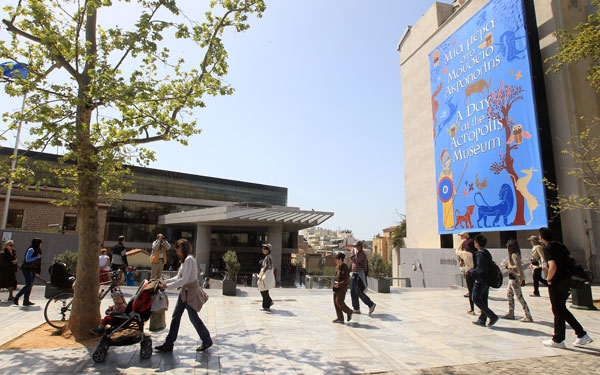
Summer opening hours for archaeological sites and museums is proposed by the Ministry of Culture

Instructions to the general secretary of Culture of the Ministry of Culture and Tourism, regarding the issue of the summer schedule of the country's archaeological sites and museums, sent yesterday by the Deputy Minister of Culture and Tourism Petros Alivizatos.

The undersecretary, recognizing the delay in the recruitment procedures of seasonal staff through ASEP due to elections, which does not allow the issuance of a relevant administrative act for summer hours, as well as the intense protests of the tourist world, requested the immediate implementation of temporary operating hours from 9.30 a.m. until 5.30 pm.

The temporary operation during the specified period negates the need for staffing in two shifts, in order for the spaces to function even after 3 pm.

The public will be able to visit the areas of responsibility of the Ministry of Health and Welfare from 10 a.m. until 5 pm, thus overcoming the staffing difficulty faced by the regional services in correctional staff.

This schedule does not apply to archaeological sites that already operate with two shifts and beyond 3 pm, such as the Acropolis of Athens, which continue with their existing schedule.

Alongside, the deputy minister sent instructions for better utilization of the existing prison staff, requesting his immediate disengagement from any tasks and facilities that are not his competence and requested that the services performed be readjusted, in order to achieve better field guarding.

Source : kathimerini.gr

Vasilopoulos – Tsouri : They got married!

About two months before their first child was born, Panagiotis Vassilopoulos and Maria Tsouri got married at the town hall of Glyfada.

 The couple also plans to get married in a religious wedding after the birth of the baby. "She chose the ring with one of my best friends and with Olympia Hopsonidou and her husband (Vassilis Spanoulis). When he saw me and gave me the ring it was a very special moment. It was a day I had not seen him at all and I just saw him- equal for five minutes, and those five minutes were probably the most beautiful of my life! I was very moved. "I did not expect it," the 26-year-old polytheist had recently stated about the marriage proposal.

Source : yupi.gr

Elli Kokkinou: "Alexander is the man of my life"

In an interview with the "Glam" insert of the Free Press, Elli Kokkinou talked about her personal life, explaining how he has accepted the media's involvement with her, for her son Alexander, but also for her attitude towards men. Here are some of the most telling excerpts from her statements:

 For her son Alexander:
"I'm a capsule with him! His touch, his breath, his "good morning"., the way he comes and slides into my bed… (…) My son is the only man in my life. The best "I love you" are all my son's "I love you". A, and the "my girl I will marry you" he tells me. Of course, from what I remember, I also told my dad that I would marry him".

For the fact that she no longer lives with the father of the little one:
"I am not raising Alexander alone. I have my mother's help. However, there are difficulties. There is that loneliness and some moments you wish you could share with his dad or your partner, like a family. But what to do?; Everything is in life".

For making her personal life public:
"I have nothing to hide about my life, I'm not doing anything wrong, I'm not illegal, I don't bother anyone. Why should I hide?; It is not pleasant to see my life hanging on the stands. On the other, Nevertheless, if I didn't want this to happen, let me sit at home and stop doing the work I'm doing".

About her love affairs:
"I don't like castrating men. I find that I weaken them and that they lose their masculinity. I want there to be a balance in a relationship. I don't care who has the upper hand. This leaves me coldly indifferent".

Source : yupi.gr

Premiere for the VW E-Bugster Speedster Concept

The Beijing Motor Show was chosen by VW to present the open version of the electric E-Bugster Concept, which essentially photographs the open version of the modern Scarab.

Last January, at the Detroit International Auto Show, VW presented the E-Bugster concept for the first time, an electric version of the new Beetle with even more... advanced design features. Today, the Germans go one step further by choosing the Beijing Expo to "unveil" the open version of the prototype. With the letter 'E' representing the word 'Electric' and the type of powertrain and the 'Bugster' being a contraction of the words 'Bug', which on the other side of the Atlantic is the Beetle's nickname and "ster", behind which the word "speedster" is hidden, this open concept is based on the latest generation Beetle, with a more... sporty and aggressive outer appearance, with wheels 20 inches, lower ground clearance and differently designed front and rear bumpers. also, characteristic is the panel that covers the batteries, directly behind the backs of the two passengers, as is the lowest by 90 mm.  windshield. Regarding its dimensions, VW announces length 4.278 μ. and width 1,838 m., value greater by 30 mm. compared to that of the "regular" Beetle.

As regards the vehicle's power unit, VW executives have chosen to install a sophisticated electric motor (zero emissions for sure), which yields 115 horsepower and is combined with lithium-ion batteries which in turn ensure a minimum driving range of the order of 180 km. According to the official announcements of the German company, the open electric prototype is able to accelerate from standstill to first 100 km/h in 10,9 δλ. Regarding charging the accumulators with energy, the German company announces that they are needed – as in the case of the corresponding closed one- just 35 minutes for a full charge, while, of course, their supply is also carried out through the braking of the vehicle

Source : 4troxoi.gr

At a height of a thousand meters in Messinia : An unknown ancient temple opposite Epicureus was discovered

The tops of the mountains,  the sky and two ancient temples!  Across from each other,  up there on the mountains of Ilia and Messinia,  the well-known Epicurean Apollo on one side and a "new" temple,  which is only now being revealed,  on the other hand. At an altitude of 1000 meters and after traveling at least 7 kilometers of impassable, rural dirt road above the village of Ano Melpeia until you reach the hill with the chapel of the Prophet Ilias, the remains of this temple were discovered by the archaeologist Dr. Xeni Arapogianni, previously head of the Greek Antiquities Ephorate.

Dated late 6th – early 5th BC. century this unknown temple is preserved unfortunately only in terms of its foundation,  however, the space was scattered around it with architectural members, which had been used to build a small church.  As Mrs. Arapogianni says, when the small church was demolished to build a new one - eventually this was done on a neighboring hill -, the place was filled with letters,  triglyphs and other members of the ancient temple.

This is what happened 1995 but as soon as 2010   the excavation began,  which revealed not only the existence of the building but also extraordinary findings: Ceramics,  copper objects and the most interesting, a large number of iron weapons and mainly spearheads that were tributes to the temple. But also a bronze statuette of a naked man came to light,  probably a warrior since he is holding a spear in one hand.

"This fact allows us to conclude that the temple was dedicated to a war deity",  says Mrs. Arapogianni. Adding: "The direct visual contact with the temple of Epicurean Apollo but also the similarity of the vows, mainly of iron spears, they could attribute the temple of Ano Melpeia to Apollo, but without excluding the worship of Artemis or Athena".

The temple was found in "Petroula" which is located on the outskirts of Mount Tetrazi. The top of the hill where it was built had been leveled by the ancients just to accommodate the building. The temple was long,  according to calculations,  about the 23  meters,  although its maximum surviving dimensions are 20.65×10.75 meters while the thickness of the walls ranges from 0,80 to 0,90 μ. A part of it though,  the east,  it is completely destroyed, because it had served as the foundation of the Christian temple.

But the interesting thing is,  that inside it Mrs. Arapogiannis revealed a smaller building with surviving dimensions of 15.60x2.18 meters made of clay stones, without binding material, the eastern side of which was also damaged. The floor of the temple and the inner building was covered with small ones, almost slab-like stones connected with mortar.

“In my opinion this was the first temple, the archaic,  which dates back to the end of the 6th BC.  century. It was probably built by the Spartans who were the conquerors of Messinia and when later the Messinians were freed they built a bigger temple in the same place",  says the archaeologist.

Copper bracelets ending in a snake's head, copper small vessel a copper plate with a relief of a woman holding a branch, iron hilts and iron fittings of utensils and among them in excellent preservation a bronze cylindrical stem terminating in a lion's head. And of course the iron weapons and at least 20 spearheads. These are findings from the sanctuary ,  which the faithful dedicated to the worshiped deity. Also, one of the most important finds was a votive inscription, engraved on the rim of a portion of a clay vessel, where the word stands out: TOLERANCE.

But there is a problem:  No columns or capitals have been identified anywhere. Only epistles and triglyphs with metopes and cornices,  all stone. “I think it might have had wooden columns, but this was not usual at all. Therefore, further research is needed, are there somewhere...",  as Mrs. Arapogianni says. Except that she herself can no longer come back, after the "reserve" caught up.

Source : tovima.gr

At a height of a thousand meters in Messinia : An unknown ancient temple opposite Epicureus was discovered

The tops of the mountains,  the sky and two ancient temples!  Across from each other,  up there on the mountains of Ilia and Messinia,  the well-known Epicurean Apollo on one side and a "new" temple,  which is only now being revealed,  on the other hand. At an altitude of 1000 meters and after traveling at least 7 kilometers of impassable, rural dirt road above the village of Ano Melpeia until you reach the hill with the chapel of the Prophet Ilias, the remains of this temple were discovered by the archaeologist Dr. Xeni Arapogianni, previously head of the Greek Antiquities Ephorate.

Dated late 6th – early 5th BC. century this unknown temple is preserved unfortunately only in terms of its foundation,  however, the space was scattered around it with architectural members, which had been used to build a small church.  As Mrs. Arapogianni says, when the small church was demolished to build a new one - eventually this was done on a neighboring hill -, the place was filled with letters,  triglyphs and other members of the ancient temple.

This is what happened 1995 but as soon as 2010   the excavation began,  which revealed not only the existence of the building but also extraordinary findings: Ceramics,  copper objects and the most interesting, a large number of iron weapons and mainly spearheads that were tributes to the temple. But also a bronze statuette of a naked man came to light,  probably a warrior since he is holding a spear in one hand.

"This fact allows us to conclude that the temple was dedicated to a war deity",  says Mrs. Arapogianni. Adding: "The direct visual contact with the temple of Epicurean Apollo but also the similarity of the vows, mainly of iron spears, they could attribute the temple of Ano Melpeia to Apollo, but without excluding the worship of Artemis or Athena".

The temple was found in "Petroula" which is located on the outskirts of Mount Tetrazi. The top of the hill where it was built had been leveled by the ancients just to accommodate the building. The temple was long,  according to calculations,  about the 23  meters,  although its maximum surviving dimensions are 20.65×10.75 meters while the thickness of the walls ranges from 0,80 to 0,90 μ. A part of it though,  the east,  it is completely destroyed, because it had served as the foundation of the Christian temple.

But the interesting thing is,  that inside it Mrs. Arapogiannis revealed a smaller building with surviving dimensions of 15.60x2.18 meters made of clay stones, without binding material, the eastern side of which was also damaged. The floor of the temple and the inner building was covered with small ones, almost slab-like stones connected with mortar.

“In my opinion this was the first temple, the archaic,  which dates back to the end of the 6th BC.  century. It was probably built by the Spartans who were the conquerors of Messinia and when later the Messinians were freed they built a bigger temple in the same place",  says the archaeologist.

Copper bracelets ending in a snake's head, copper small vessel a copper plate with a relief of a woman holding a branch, iron hilts and iron fittings of utensils and among them in excellent preservation a bronze cylindrical stem terminating in a lion's head. And of course the iron weapons and at least 20 spearheads. These are findings from the sanctuary ,  which the faithful dedicated to the worshiped deity. Also, one of the most important finds was a votive inscription, engraved on the rim of a portion of a clay vessel, where the word stands out: TOLERANCE.

But there is a problem:  No columns or capitals have been identified anywhere. Only epistles and triglyphs with metopes and cornices,  all stone. “I think it might have had wooden columns, but this was not usual at all. Therefore, further research is needed, are there somewhere...",  as Mrs. Arapogianni says. Except that she herself can no longer come back, after the "reserve" caught up.

Source : tovima.gr