The temptation of freedom

Exhibition in Berlin shows the post-war adventures of the highest social good

She is blind, but not spiritually unscented, or asleep. Justice never sleeps. At least not in the minds of the artists, where he works constant overtime. A permanent court-martial, which turns against everything – sometimes of himself.
That is why in the imaginary "Court of Right Reason", as the first part of the exhibition "Temptation of Freedom" at the Deutsches Historisches Museum in Berlin is called, the roles are not clear. Not only the opponents of freedom are sitting in the accused's dock, but also many of its supporters. Judges are not professionals, but amateurs. And their verdict is not recorded in documents, but in pictures – tables, sculptures, facilities, photos, video.
Upside down world: Artists judge not only the crimes committed in the name of Enlightenment, but in necessity also the Right Word itself, as a potential source of atrocities. Not only the sleep of Logic, they say, but her wake can also give birth to monsters – more frightening, from everything else.
Accused Robespierre and Marat: Guilty! says judge Yiannis Kounelis. His work, a metal plate, on which the names of the two heroes of the French revolution are written in chalk, as well as the phrase: «Free Death» (freedom or death), reminds, that anyone who did not then agree with the Jacobin regime, he was in danger of ending up in the guillotine. Jacobin freedom, based on "terreur", the terror, it produced unfreedom and death. A lighted white candle in front of the plaque gives a religious overtone to the verdict.
The judge's judgment is also speculatively extreme – whether it is a "sweet" greeting, as in the sculpture "Je vous salue Marat" (Greetings Mara) by Ian Hamilton Finley – where the phrase is the work itself, formed from neon tubes. Either a "sharp" sentence like a guillotine stroke, such as "The Age of Enlightenment" by Ginka Shonibare, which shows the Orthologus as beheaded, i.e. mindless body.
The exhibition presents projects 113 artists from total 28 Countries, which were created after the 1945. From the Greek side, except for the installation of Kounellis, a surrealist painting by Nikos Eggonopoulos is also on display.
 Two prostitutes, surrounded by fascists, Stalinist and democratic symbols, they escape from a mess only to end up in a much worse one – as always happens in a "Civil War", as the work is called.
The starting point of works is freedom, as she secured the 1949 in the United Nations Charter of Human Rights.
The exhibition follows the aesthetic adventures of freedom against the background of the two blocs of the cold war, the east, under the guidance of the Soviet Union, and the west, under US hegemony.
A century and a half full of dizzying successes, but also tragic mistakes, captured in classical works, such as René Magritte's "Memory" from 1948, or in completely modern ones, such as "Untitled" by Maria Bartusova from 2012: a set of small amorphous sacks tied together with thin strings, which shows how fragile the balance between the components of the social fabric is today.
The newest of all projects: "Capital-ism" by Dan Perjovsky, the highest stage of social chaos, which was created just on the eve of the inauguration – at 17 October.
One of the good things about the exhibition is its systematic division into 12 thematic sections with more or less poetic titles: "Journey to the Garden of Wonders", "Fear and Darkness", "The other place" so to speak. The visitor can thus more easily understand the problematic and the affinity of the works per each section.
Of course, the most interesting ones are those that throw it into the "fine" with the established political and aesthetic perceptions.
Example, the "Portable engraving for three persons" by Tamas Oby, a 90x155x53 cm parallelepiped made of cardboard with three open surfaces, which was created 1969 in response to the Warsaw Pact tank raid the 1968 in Prague. A completely inappropriate one, if not a ridiculous means of self-protection, which, precisely for this reason, makes a mockery of any concept of war.
The 10x10 are also enjoyable, namely 100 unwound alarm clocks with the inscription "Minutes of the Hour", which Armand has lined up on a tableau (Fernandez). For the French artist there is only subjective time: political, personal, erotic, coke. Objective time, on the contrary, it doesn't exist, the metronomes, says, they record only the destruction of human life. That is why he tries to destroy destroyers himself – winding the clocks.
Question from the undersigned: Space, there is;
But even Damien Hirst's painting "Professions without a future" does not go back to ingenuity. Only here, instead of alarm clocks, extinguished cigarette butts are exposed. "They express insecurity in the labor market," says the artist. "This is the price of the so-called free market in the age of globalization".
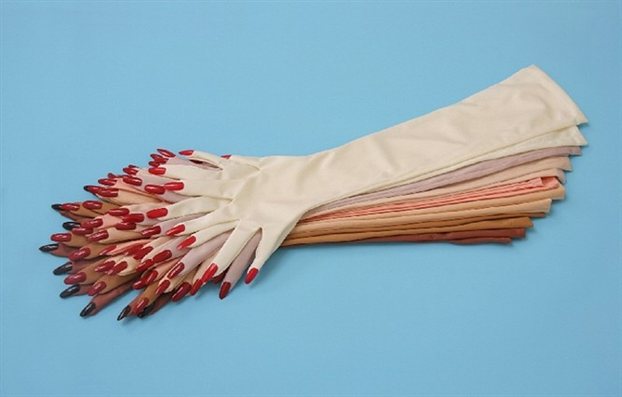
The project, in front of which one remains dazzled, is "Flowers" by Aurora Reinhardt: A bouquet of gloves, on the edge of which they grow, like flowers, "living" polished nails. "It's the projection of men's fantasies in our accessories" says their producer. Feminists never sleep either: The latest here, the visitor realizes that the feminist "Court of Right Reason" does not behave with a glove. And that the fingers he will order to be cut off, it will not be feminine.
The exhibition "Temptation Freedom" at the Historisches Museum Berlin, which takes place under the auspices of the Council of Europe, lasts until 26 January 2013.
Source : tovima.gr

Giannis Zouganelis – Michalis Hatzigiannis – Sakis Boulas: Photographed together and confessed!

When the older generation collaborates creatively with the younger, then yes, there is interest. The modest Yiannis Zouganelis, the stormy Sakis Boulas and the discreet Michalis Hatzigiannis stole some of their limited time and agreed to be photographed as heroes in a spy adventure film.
If the good, the bad and the ugly was a fairy tale, it would be with fairies, princes and dragons or westerns;
YIANNIS ZOUGANELIS: I lean towards mythology, if you allow me. I imagine three poses in each personality, if we are the good, the bad and the ugly. Like three Lernaean Hydras that constantly cut us off, the bad and the ugly and they come out again. My relationship with the title is the same as other people's. We are all good, and bad ones, and ugly. Good is what we project, that which is most easily perceived, we hide the bad, it is in our truth and no one believes the ugly about himself. We all think we have no ugliness. But we have many which some politely do not tell us. But we hide them.
SAKIS BOULAS: For me it would only be with dragons. I have always loved fairy tales with dragons.
MICHALIS HATZIGIANNIS: As a boy and a fighter for life my mind would go straight to a western, in a war project, in an action scenario. Although all this is not very different from the real side of life, from what we live today. These roles exist in our lives, but also to each of us. The good one, and the bad guy, and ugly are roles we all play in our daily lives. I have to admit, however, that I don't do very well with fairy tales. I am not naturally so romantic and so ethereal, but if I were to choose something, I would choose the western.
This year your scheme has special ingredients. This collaboration was not a risk; 
C. G.: We are reproducing something that we have worked on for several years. Michalis Hatzigiannis is from another generation, of another perception, another sound. And it is useful because it makes a difference. I do not believe that harmony arises from identical perceptions, but by different personalities.
This collaboration was a challenge. And we accepted it.
S. M.: For us, that is, John and me, it was a risk, a change. Because we have formed a specific style over the years. Michalis, an artist with an important career and notable collaborations with artists such as Alexiou, Dalaras, Arvanitaki, it has its own distinct style, and that creates interest. Because we are two people with open horizons, which we like to try, without thinking we responded to the proposal for cooperation.
M. X.: For all three of us it is quite different. But all subversives have their risks. It's not something we didn't measure or think about, but I believe that in an age that flirts with risk and with the sense of challenge, it is good to take risks and measure our strength. We dared it. Once again it is proven that through contrasts there is harmony. The law that opposites attract applies, as many times it seems that they can offer creative and beautiful things. In our case this worked and we feel very good.
How would you like the first day of the year to find you?;
C. G.: However, not as I am now. I want to be cleaner, free of remorse for emotional harm to others. To be more restrained and balanced. I don't have all that. I'm tired of being the person who constantly backs down on partnerships.
S. M.: With less stress. With more optimism. With lots of smiles.
M. X.: Even more aware, more clarified, more mature, stronger and less insecure.
Mr. Hatzigiannis, there is a particularly beautiful Christmas memory that is etched in your mind;
M. X.: Two years ago Zeta and I took a trip to London. It was nice. For me, London is a big city completely intertwined with Christmas. It was a special trip and that's why I remember it vividly.

Source : yupiii.gr

Fiat: confirmed 500X & new jeep

Fiat has announced that it plans to build two new crossover up 2014, the Fiat 500X and even a jeep in Italy Facilities, namely in Melfi.
After a generous investment in the amount of 1 billion. euro made in the factory of the Italian automotive in Melfi, will be able to start building a new affordable Jeep and 500X

Both models are based on the same elongated platform and will feature all-wheel drive. Regarding the new entry-level jeeps Italian brand will be the first in production and will be available in the global market, and will later follow the Fiat 500X. also, They hinted that the plant is able to accommodate both models still on the production line.

Bear in mind that Fiat 500X will have a length of about 4,2 measures and mobility up 5 passengers. The total trunk capacity is slightly above the 400 l, probably a little less for the four-wheel drive versions.

End, as soon as the latest factory upgrades, accordance with Fiat, we can produce 1.600 units daily.

Source : autotriti.gr

New Special Edition for Lotus Evora

THE Lotus presented a new version of the Evora, called Sports Racer, which has several stylistic differences in external appearance, that make it stand out.
Lotus has announced a more expensive version of the well-known Evora, Sports Racer, which will be available in the simple and turbocharged S with its price starting from 71.719 euro. The external differences compared to the regular versions are the gloss black paint applied to the front bumper, on the side sills and the diffuser. also, the new Evora Sports Racer wheels have the same glossy color, while the brake calipers can be ordered by the prospective buyer in black or red. Still, the color palette for the new expensive version is limited to 3 shades: the red one, the blue and the white.

Inside it we have no significant changes. The interior is upholstered in black leather with red stitching or can be ordered in reverse color. But what makes the expensive version different is that there is a sportier mapping, which allows to raise the electronic top speed limit of the sports car, while at the same time it can improve the response of the right pedal (throttle). Its price starts from 71.719 euro, while the turbocharged Evora Sports Racer will reach the 81.086 euro.

Source : autotriti.gr

The temptation of freedom

Exhibition in Berlin shows the post-war adventures of the highest social good

She is blind, but not spiritually unscented, or asleep. Justice never sleeps. At least not in the minds of the artists, where he works constant overtime. A permanent court-martial, which turns against everything – sometimes of himself.
That is why in the imaginary "Court of Right Reason", as the first part of the exhibition "Temptation of Freedom" at the Deutsches Historisches Museum in Berlin is called, the roles are not clear. Not only the opponents of freedom are sitting in the accused's dock, but also many of its supporters. Judges are not professionals, but amateurs. And their verdict is not recorded in documents, but in pictures – tables, sculptures, facilities, photos, video.
Upside down world: Artists judge not only the crimes committed in the name of Enlightenment, but in necessity also the Right Word itself, as a potential source of atrocities. Not only the sleep of Logic, they say, but her wake can also give birth to monsters – more frightening, from everything else.
Accused Robespierre and Marat: Guilty! says judge Yiannis Kounelis. His work, a metal plate, on which the names of the two heroes of the French revolution are written in chalk, as well as the phrase: «Free Death» (freedom or death), reminds, that anyone who did not then agree with the Jacobin regime, he was in danger of ending up in the guillotine. Jacobin freedom, based on "terreur", the terror, it produced unfreedom and death. A lighted white candle in front of the plaque gives a religious overtone to the verdict.
The judge's judgment is also speculatively extreme – whether it is a "sweet" greeting, as in the sculpture "Je vous salue Marat" (Greetings Mara) by Ian Hamilton Finley – where the phrase is the work itself, formed from neon tubes. Either a "sharp" sentence like a guillotine stroke, such as "The Age of Enlightenment" by Ginka Shonibare, which shows the Orthologus as beheaded, i.e. mindless body.
The exhibition presents projects 113 artists from total 28 Countries, which were created after the 1945. From the Greek side, except for the installation of Kounellis, a surrealist painting by Nikos Eggonopoulos is also on display.
 Two prostitutes, surrounded by fascists, Stalinist and democratic symbols, they escape from a mess only to end up in a much worse one – as always happens in a "Civil War", as the work is called.
The starting point of works is freedom, as she secured the 1949 in the United Nations Charter of Human Rights.
The exhibition follows the aesthetic adventures of freedom against the background of the two blocs of the cold war, the east, under the guidance of the Soviet Union, and the west, under US hegemony.
A century and a half full of dizzying successes, but also tragic mistakes, captured in classical works, such as René Magritte's "Memory" from 1948, or in completely modern ones, such as "Untitled" by Maria Bartusova from 2012: a set of small amorphous sacks tied together with thin strings, which shows how fragile the balance between the components of the social fabric is today.
The newest of all projects: "Capital-ism" by Dan Perjovsky, the highest stage of social chaos, which was created just on the eve of the inauguration – at 17 October.
One of the good things about the exhibition is its systematic division into 12 thematic sections with more or less poetic titles: "Journey to the Garden of Wonders", "Fear and Darkness", "The other place" so to speak. The visitor can thus more easily understand the problematic and the affinity of the works per each section.
Of course, the most interesting ones are those that throw it into the "fine" with the established political and aesthetic perceptions.
Example, the "Portable engraving for three persons" by Tamas Oby, a 90x155x53 cm parallelepiped made of cardboard with three open surfaces, which was created 1969 in response to the Warsaw Pact tank raid the 1968 in Prague. A completely inappropriate one, if not a ridiculous means of self-protection, which, precisely for this reason, makes a mockery of any concept of war.
The 10x10 are also enjoyable, namely 100 unwound alarm clocks with the inscription "Minutes of the Hour", which Armand has lined up on a tableau (Fernandez). For the French artist there is only subjective time: political, personal, erotic, coke. Objective time, on the contrary, it doesn't exist, the metronomes, says, they record only the destruction of human life. That is why he tries to destroy destroyers himself – winding the clocks.
Question from the undersigned: Space, there is;
But even Damien Hirst's painting "Professions without a future" does not go back to ingenuity. Only here, instead of alarm clocks, extinguished cigarette butts are exposed. "They express insecurity in the labor market," says the artist. "This is the price of the so-called free market in the age of globalization".
The project, in front of which one remains dazzled, is "Flowers" by Aurora Reinhardt: A bouquet of gloves, on the edge of which they grow, like flowers, "living" polished nails. "It's the projection of men's fantasies in our accessories" says their producer. Feminists never sleep either: The latest here, the visitor realizes that the feminist "Court of Right Reason" does not behave with a glove. And that the fingers he will order to be cut off, it will not be feminine.
The exhibition "Temptation Freedom" at the Historisches Museum Berlin, which takes place under the auspices of the Council of Europe, lasts until 26 January 2013.
Source : tovima.gr